



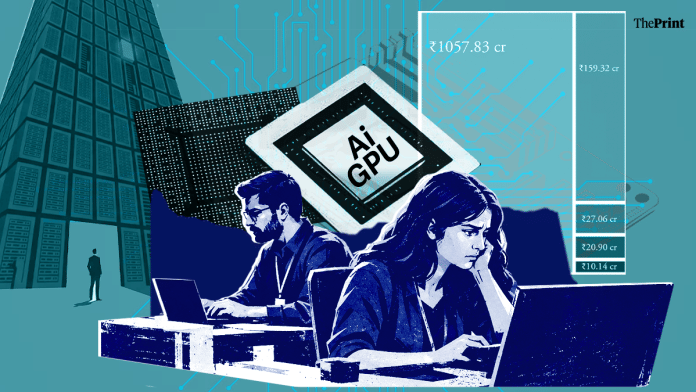
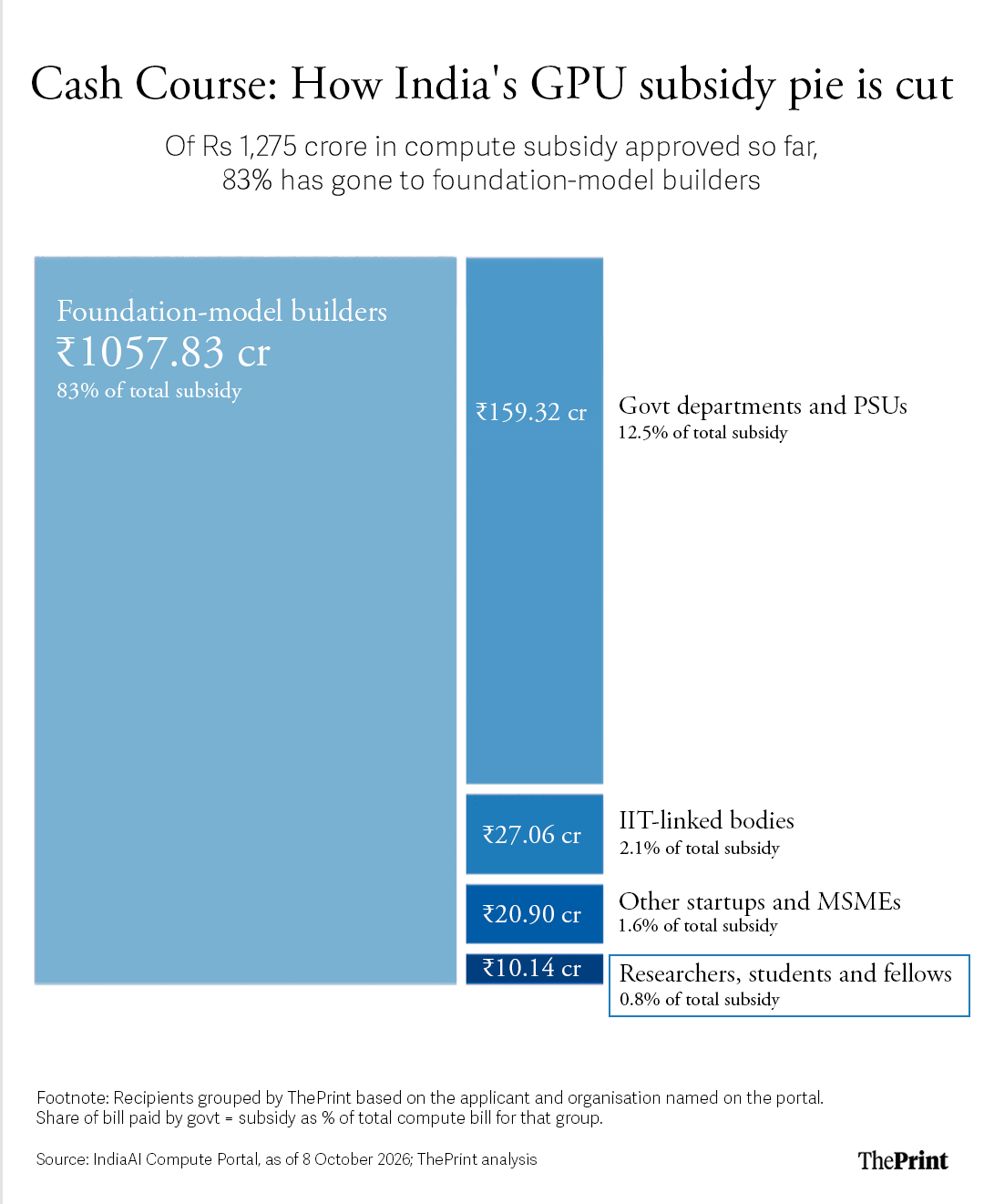
New Delhi: Nine organisations building artificial intelligence foundation models have received Rs 1,058 crore of the Rs 1,275 crore the Centre has committed so far to subsidise computing power under the IndiaAI Mission. Researchers, students and fellows—for whom the scheme was also meant—have received Rs 10.14 crore between them, or 0.8 percent.
AI foundation models are those built on vast datasets to fulfill a broad range of general tasks, for instance ChatGPT or Gemini. A model is the term for a computer program trained on a dataset to recognise patterns, generate content and make predictions.
ThePrint analysed all 304 approvals listed on the IndiaAI Compute Portal, as updated on 8 October.
The analysis shows that a Bengaluru startup founded by an Indian Institute of Science (IISc) professor, filed under ‘Researchers or Academia’, was approved for 2,080 Google TPUs worth Rs 162.86 crore. Five weeks earlier, the government had put the TPU capacity of the entire pool at 1,050. Sarvam AI’s subsidy, listed as Rs 98.68 crore in 2025, now equals its full bill of Rs 246.72 crore.
A Tensor Processing Unit or TPU is an application-specific integrated circuit made by Google exclusively for learning maths, while Graphics Processing Units or GPUs are highly parallel, general-purpose processors. GPUs were first made for processing images but now handle AI, gaming and computing.
Under the IndiaAI Mission that seeks to develop the country’s AI ecosystem, GPUs are the core foundational hardware required to train, run, and scale AI models. The IndiaAI Mission uses a public-private configuration to make GPUs available at subsidised rates and democratise access to high-performance computing.
IndiaAI has also approved Rs 13.24 crore of compute for itself, paid in full from the pool it runs. Then again, government bodies, including the Central Bureau of Investigation (CBI) and Rajya Sabha, have got Rs 38.97 crore of free compute, nearly four times what all individual researchers put together got.
The findings come as the government weighs letting GPU suppliers sell abroad because “there is not enough uptake of GPUs in India right now”, as an official told Business Standard last week.
ThePrint emailed detailed queries to the IndiaAI Mission. It acknowledged receipt, but had not responded at the time of publishing. This report will be updated if it does.
The language problem
The mission’s compute money has gone mostly to one goal: Indian foundation models, most of them large language models. Researchers ThePrint spoke to said this leaves out university labs, which train the engineers these companies hire and do much of the AI work outside language, in areas such as climate, health and materials.
“We need to get rid of language fixation,” said an assistant professor at an IIT, who spoke on condition of anonymity. “Language is not the only frontier.”
India has the people. It had 50,460 AI authors and inventors in 2025, the second-highest number after the US, according to Stanford University’s AI Index 2026, released in April. But it also recorded the largest net outflow of AI talent of any country the report tracked.
“Because of these infrastructure issues, good engineers tend to leave the country,” said Prathosh A.P., associate professor in the Electrical, Electronics, and Computer Sciences division at IISc, Bengaluru. “We are here for a reason. We really want to make some difference and contribute. But some of these things bother us.”
Worldwide, the cost of compute has already moved model-building out of universities. Of the notable AI models released in 2025, no fewer than 93 came from industry and two from academia, the AI Index found, though universities still produce the most top-cited AI papers. A 2024 paper, ‘The Compute Divide in Machine Learning’, found that academic teams are being pushed out of foundation-model work for lack of compute capacity, which leaves fewer independent researchers to test the models that companies release.
Some governments pay for researchers’ compute directly. In September, the US National Science Foundation set up an operations centre to make its National AI Research Resource permanent. The two-year pilot of that resource, launched in January 2024, gave American researchers and educators compute at no charge. Britain’s AI Research Resource awards projects up to 10,000 GPU hours on public supercomputers such as Isambard-AI in Bristol.
Also Read: Infosys chairman Nilekani dismisses idea that AI will displace human workers as ‘hogwash’
Where the money went
The mission, approved in March 2024 with an outlay of Rs 10,372 crore, does not own GPUs. Empanelled private cloud companies bought the hardware, and the mission pays part of the bill when an approved user rents it. Most users get 40 percent paid. Thirty approvals have been paid in full, and they account for Rs 1,089.56 crore, or 85 percent of all subsidy.
The largest is Sarvam AI’s. The next two, worth Rs 177.27 crore and Rs 163.04 crore, leave the organisation blank. They are in the names of Ananth Nagaraj, co-founder of Gnani.ai, and Abhishek Upperwal, founder of Soket AI, both picked in May 2025 to build foundation models.
At least one grant grew after it was first published. In 2025, Sarvam’s entry showed a subsidy of Rs 98.68 crore against a bill of Rs 246.71 crore, reports at the time said. It now shows Rs 246.72 crore.
BharatGen, the IIT-Bombay-led project with the largest foundation-model allocation, Rs 1,058.52 crore, runs through BharatGen Technology Foundation, a Section 8 company incorporated on 7 November 2025. Ten days later, three approvals worth Rs 143.52 crore were recorded in its name, all paid in full.
‘Academia’ on paper
The portal’s ‘Researchers or Academia’ category shows Rs 172.81 crore; of this, Rs 162.86 crore is one approval to a company. Approved on 5 February, it gives Zenteiq Aitech Innovations Pvt Ltd 2,080 Google TPUs through Ishan Infotech till March 2027. The applicant, Sashi Kumaar Ganesan, is an IISc professor and Zenteiq’s founder. Zenteiq is one of 12 foundation-model awardees.
When Zenteiq was selected in September 2025, it was to get Rs 75 crore in its first year to train an 8-billion-parameter model on Nvidia GPUs, reports said then. In the August 2025 tender round, Ishan Infotech had offered 50 Google TPUs. In December 2025, a white paper from the Office of the Principal Scientific Adviser put the TPU capacity of the whole pool at 1,050.
The other 30 approvals add up to Rs 9.95 crore.
Who gets it free
ThePrint grouped the 304 approvals by type of recipient. The 16 approvals to foundation-model builders account for 83 percent of the subsidy, and the government has paid 98.9 percent of their bills. The 123 approvals to government departments and PSUs account for 12.5 percent, with 46.8 percent of their bills paid. The 55 approvals to researchers, students and fellows account for 0.8 percent, with 39.7 percent of their bills paid.
Fifteen approvals to government bodies were paid in full, worth Rs 38.97 crore. They include the National Informatics Centre, the Rajya Sabha, the CBI and Prasar Bharati.
Foundation-model grants also came faster. Going by the project start dates on the portal, they were approved a median four days before work was due to begin. Researchers and students were approved a median 29 days after.
‘For a country of our size’
“We don’t have adequate GPU access for a country of our size,” Prathosh said. “Our resources can’t be compared to what our global peers have.”
On 30 September, he wrote on X of “a peculiar helplessness in watching the world race ahead in AI while being unable to participate at the frontier”. Among those who replied was Manabendra Saharia, associate professor of civil engineering at Indian Institute of Technology-Delhi, whose team had trained a prototype geospatial foundation model on compute given by Nvidia. “We have been twiddling our thumbs for six months now hoping for compute… It sucks to think that we can be at the very frontier of our area, but can’t because we are poor,” he wrote. Academics get by on compute credits from Google, AMD and Nvidia and a few GPUs in their own labs, Prathosh said.
‘Not worth it’
The subsidy covers part of the bill. Researchers pay the rest, usually 60 per cent, to the cloud provider. At the tender rate of about Rs 140 an hour for an H100, a modest workload runs to a few lakh rupees a month.
“The rates are better than the industry but still not affordable for academics,” Prathosh said. “We have conference deadlines to attend to… Say AWS, you pay, and tomorrow you have the access.”
Both his lab and his startup applied on the portal. “We applied, waited for a long time. Not that we don’t get it, some of them we get, but the economy does not work out. The kind of pain that you have to go through to get access is not worth it.”
The IIT assistant professor said the 60 per cent is beyond younger faculty. “At least me as a new assistant professor, I cannot. Maybe a few big professors who have big labs can,” he said. “The kind of GPUs we need, their minimum will run a few lakhs per month. I don’t have that kind of loose money.” Registration itself, he said, “takes more than a month even for the IIT”.
Grants are part of the problem. Government projects are split into heads such as equipment, manpower and consumables. “If I am buying using the IndiaAI portal, it’s cloud computing. It’s not equipment which will come physically to IIT. So then which head will I buy it under? It’s consumable. But consumable amounts are restricted by design,” he said.
The frontier problem
The mission’s current capacity and management are not conducive to frontier model building, Prathosh said. “Existing GPUs are fragmented across multiple providers, which isn’t ideal for large-scale frontier model building.”
The IIT professor did not question the mission itself. “Unless and until government intervenes, Nvidia is not going to sell to us,” he said.
Prathosh, too, backed the mission. “The IndiaAI Mission is definitely the right step towards making our country AI sovereign,” he said.
The start-ups
Dhrumil Barot quit his job in April to build Vynara Technologies, a bootstrapped AI product studio. Its platform Vynaris, an Indian alternative to OpenRouter, crossed $1,000 in monthly revenue within days of launch, he said.
He tried the IndiaAI portal. “It requires me to pay to reserve the compute, and then if I’m accepted, I’ll get 40 per cent back. I can’t afford 100 per cent or even the 60 per cent of that investment upfront.” He later abandoned the project for lack of compute and funds.
Another founder, who asked not to be named, applied in the first week of October for compute worth under Rs 10,000. On 8 October, IndiaAI’s compute team emailed asking for proof, within two days, of annual revenue of Rs 50-200 lakh or funding of at least Rs 100 lakh. ThePrint has reviewed the email.
“Turns out one needs to satisfy all three requirements to get GPU access which is crazy and not at all startup friendly,” the founder said. “Since I got frustrated with the whole process, I moved on to AWS where it was much easier to get a GPU node.”
The portal’s registration form for startups, which ThePrint has seen, has at least 12 mandatory fields. Apart from a name, address and type of organisation, a startup must upload a DPIIT recognition certificate, a certificate of incorporation and resumes of its directors or staff. It must state the funding it has raised and attach a letter from its board or an investor as proof. ‘Awards / recognitions received by the startup’, with supporting documents, are also compulsory. Each upload must be a single merged PDF or JPEG of up to 2 MB. A bootstrapped startup such as Barot’s has no investor letter to attach.
The connections
Some recipients and suppliers have links to the government or to political donors. ThePrint found nothing to suggest these influenced any allocation, and the donations were legal.
Shashi Shekhar Vempati, Prasar Bharati CEO from 2017 to 2022, was appointed an independent director of BharatGen Technology Foundation, ANI reported on 11 November 2025, four days after it was incorporated and six days before its first approvals. He earlier headed Niti Digital, a Rajesh Jain-backed firm that ran political platforms including India272+.
Yotta handled 45.6 percent of the subsidy and E2E Networks 21.4 percent. L&T owns about 21 percent of E2E; an L&T-linked entity gave Rs 500 crore in 2024-25 to the Prudent Electoral Trust, which paid Rs 2,180 crore to the BJP.
The Tata group, whose Tata Communications is a provider, gave Rs 757.6 crore to the Bharatiya Janata Party (BJP) through its electoral trust that year. Qwik Supply Chain, a Reliance-linked firm, bought Rs 410 crore of electoral bonds, Rs 375 crore of them for the BJP; Reliance has said Qwik is not its subsidiary.
(Edited by Nardeep Singh Dahiya)
Also Read: PM to CM, everyone wants Karnataka kids to learn AI. But state’s tech push skips govt schools