


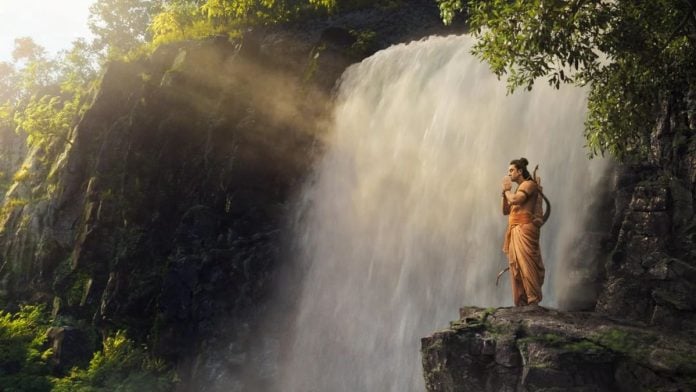
Nitesh Tiwari’s Ramayana: Rise of a Legend, starring Ranbir Kapoor, Yash and Sai Pallavi, has emerged as one of the biggest box-office successes of the year. Released on 5 November, the mythological epic has grossed Rs 1,574.6 crore worldwide in 16 days, according to box-office estimates reported on 21 November.
The film’s success has renewed interest in bringing India’s ancient epics to the big screen. While the Mahabharata offers a vast canvas of complex characters, political intrigue and moral dilemmas, the Ramayana draws on its emotional depth, cultural significance and enduring characters. But which of the two would make for a better cinematic experience?
ThePrint asks: which epic would make a better movie–Ramayana or Mahabharata?
 Ramesh Bala
Film critic and trade analyst
Both Ramayana and Mahabharata are timeless epics deeply rooted in Indian culture, and both have the potential to become extraordinary cinematic experiences. However, if I had to choose one, my personal preference would be Mahabharata.
Ramayana is fundamentally a story of righteousness, sacrifice, devotion and the triumph of good over evil. It has powerful emotions, iconic characters and tremendous visual possibilities. With the right filmmaker, it can become a magnificent spectacle that appeals to audiences across generations.
But what makes Mahabharata particularly fascinating to me is its extraordinary complexity. Unlike a conventional battle between good and evil, Mahabharata explores the grey shades of human nature. Every major character has strengths, weaknesses, ambitions, emotional conflicts and moral dilemmas.
Characters like Karna, Arjuna, Krishna, Bhishma, Draupadi and Duryodhana offer enormous scope for powerful performances. The political strategies, family rivalries, betrayals, friendships and emotional confrontations can create an incredibly engaging cinematic universe.
The Kurukshetra war itself has the potential to become one of the greatest battle sequences ever presented on the Indian screen. But beyond the action, it is the emotional depth and character conflicts that could make Mahabharata truly special.
In terms of casting, I would love to see Prabhas as Karna, Hrithik Roshan as Arjuna, Mahesh Babu as Lord Krishna and Rana Daggubati as Duryodhana. These actors could bring tremendous screen presence to their respective characters.
Another advantage is that Mahabharata can be developed into a multi-part cinematic franchise, allowing sufficient time to explore its numerous characters and interconnected stories.
Ultimately, the quality of execution will determine which film is better. But purely from a storytelling, emotional and cinematic perspective, my vote goes to Mahabharata. With the right vision, casting and technical excellence, it could redefine the scale of Indian cinema.
Also read: Putin-Xi-Trump trilateral meeting: Real progress or just optics?
 Harsh Agarwal
Founder of Uncombed Buddha Films & Music
If I had to choose between the two, I would say Mahabharata, especially now that Ramayana is already being brought to the big screen on such a grand scale. I would love to see Mahabharata mounted with the same ambition, scale and vision, and told in a way that resonates with audiences across the world.
However, what would genuinely excite me even more is seeing stories drawn from the Vedas, Puranas and Upanishads. These ancient texts are an extraordinary treasure trove of philosophy, wisdom, human values and storytelling. While Ramayana and Mahabharata are widely known, there are countless fascinating stories and characters in these texts that have never really found their way into mainstream cinema. They carry profound ideas about life, existence, relationships, morality and the human condition, and I believe they have immense cinematic potential.
As for the cast, I would be far more interested in discovering fresh talent than simply seeing Bollywood superstars in these roles. I would love to see actors from different parts of India, particularly from lesser-known regions and communities, who may not yet have had the opportunity to be seen on a national or international platform. India has an incredible reservoir of untapped acting talent.
For me, the real excitement would lie in discovering these stories and these faces, and bringing them into the spotlight. That, I think, would make for something truly special.
Also read: Quad military exercise: Revival or Trump’s power play?
 Naren Sahay
Assistant professor of Film Studies at the Delhi School of Journalism.
Both the Ramayana and the Mahabharata are great epics in our tradition, and both offer enormous possibilities for cinema. However, if I have to choose which would make a better film, I would lean towards the Ramayana.
The Ramayana has existed in our folklore for centuries, not just as a story but also as faith, an ideal of dignity (maryada) and a way of life. Its presence can be found in Buddhist literature, Jataka tales, tribal and Adivasi cultures, and the Bhakti movement. From Kabir Das to Tulsidas, several poets have explored the character of Ram. There are also hundreds of interpretations of the epic. Father Camille Bulcke, for instance, documented around 300 versions of the Ramayana. This gives filmmakers enormous scope to explore the story from different perspectives.
The Mahabharata, on the other hand, has a wider range of stories and characters. It offers a more practical understanding of life’s complexities, relationships and conflicts. Its philosophical depth, particularly through the Bhagavad Gita, is extraordinary. In many ways, the Mahabharata offers the philosophy of life, while the Ramayana gives us its essence.
I also feel the Ramayana has a deeper connection with people’s everyday lives. Its characters have become ideals that families and society continue to look up to. Ram is not just a mythological figure but a character whose ideas of conduct and dignity have travelled across generations and cultures.
Of course, both epics have been adapted and reinterpreted for centuries, and cinema is another platform for that discourse. A three-hour film cannot explore every character and episode in the way a television series can, but that also makes the filmmaker’s interpretation important.
So, while the Mahabharata might offer a larger canvas in terms of characters, conflicts and philosophical questions, I feel the Ramayana has a stronger emotional and cultural connection with people. That is what could make it a more powerful cinematic experience.
(Edited by Saptak Datta)