


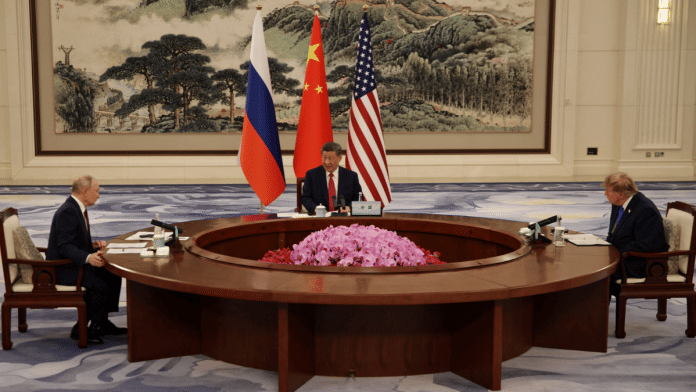
In a historic first, President Donald J Trump of the United States, President Xi Jinping of China, and President Vladimir V Putin of Russia met in a trilateral meeting that several analysts dubbed ‘Yalta 2.0’. The 80-minute meeting between leaders of three countries with the largest nuclear weapons stockpile in the world ended with a four-paragraph joint statement, while nothing on the global order was mentioned. The paragraphs discussed increasing the production and supply of refined petroleum, engaging in further talks on nuclear risk reduction and non-proliferation, and reforming the multilateral system. The joint statement also took aim at international institutions such as the International Criminal Court (ICC).
ThePrint asks: Putin, Xi & Trump signed a peace declaration at the trilateral meet. Is it progress or just optics?
 A summit to stoke Trump’s insatiable vanity
Rajesh Rajagopalan
Professor of International Politics at Jawaharlal Nehru University, New Delhi
Summits between the leaders of global powers are potentially useful, though it takes significant preparation, strategising, and compromise. This wasn’t any of that. The four-paragraph statement that came out of the summit illustrates this—if any illustration was needed at all. The only lasting consequence of this summit will be a photo to decorate Trump’s desk to stoke his insatiable vanity.
What the meeting served was the personal interests of at least two of the leaders who have been facing difficult times. Trump suffered one of the most severe electoral defeats in American politics, hobbling him with a Democratic-led US Congress that will begin investigating him, his cronies, and their families for widespread and blatant corruption. For Trump, this was a nice break to forget his troubles and indulge in his strange infatuation with Putin.
The Russian president, on the other hand, has been watching helplessly as Ukraine systematically takes apart the Russian oil industry and other infrastructure. Trump has so far been a disappointing asset, too incompetent even to spike Western support for Ukraine. But at least Trump can help him strut around as if Russia still matters on the global stage, mere hours after Ukraine blew up Putin’s prized Kerch bridge.
Xi probably also hopes that flattering Trump will help undermine US support for Taiwan as well as American partners in the region.
On the positive side, the summit didn’t cause any serious or irreparable damage to the Indo-Pacific or global order. This will be a worry every single week for the next two years of the Trump presidency but at least we got through this week. Hopefully.
Also read: Quad military exercise: Revival or Trump’s power play?
Three powers, each bargaining from weakness
Vivek Mishra
Deputy Director, Strategic Studies Program at the Observer Research Foundation (ORF)
As China hosted the first-ever trilateral summit with Russia and the US on the sidelines of the APEC Leaders’ Meeting in Shenzhen, comparisons ranged from the Yalta Conference of February 1945 to the dawn of a new moment for whatever order is to follow. Yet the realities facing each of the three powers are very different. They compel each to seek compromise from the others while projecting strength for itself.
For Washington, Trump’s ambitions for his final term have run up against his record as a peacemaker. Despite his repeated promises to end wars, the Russia-Ukraine conflict above all, the vagaries of geopolitics have led him into a strategic cul-de-sac with Iran. That conflict has cost him dearly at home, contributing to a drubbing in the midterm elections. With two years left in office, Trump sees the trilateral summit as an international pitch to offset his domestic setbacks.
For Moscow, sitting at the same table as Washington and Beijing amounts to international accommodation. It reverses, in part, the West’s ostracisation of Russia, which began in earnest when Russia was suspended from the G8 in 2014 after it annexed Crimea. With the war in Ukraine still underway, the summit is a clear gain for Putin, not least because Trump’s evident disdain for Europe has made Washington’s own approach to Ukraine transactional.
China, as host, appears to hold the advantage over both Russia and the US. Unlike the other two members of the trio, it faces no urgency to end a war. If anything, Xi seems to be warming to Trump’s embrace of China as a power second only to the US, a framing Trump captured with his “G2” remark after their meeting in Busan in October 2025.
Detractors of the US-China-Russia trilateral would dismiss it as an oxymoron: an unnatural alignment in which fundamental divergences among the three great powers will override any forced cooperation on global security; strategic stability among them; and the arms-control vacuum left by the expiry of New START, which no trilateral photo opportunity can paper over.

Convergence of the divergent
Dinakar Peri
Fellow, Security Studies at Carnegie India
The trilateral between the Presidents of China, Russia, and the US is unprecedented in many ways and was visibly high on optics. However, the meeting also produced a joint statement titled ‘Declaration Toward Peace’, which makes it a consequential platform to bring real peace to the world riddled with a series of tragedies and conflicts in recent years.
There was much emphasis on preventing the proliferation of nuclear weapons, increasing the production and supply of refined petroleum for stable energy flows, and also a point of common connection for the three leaders—their views and brush with international institutions, with the International Criminal Court specifically referred to in the statement. At the same time, and ironically, the leaders also committed to reform the United Nations so that it can “respond more effectively to global challenges”.
The question now is, is the summit a one-off or the first of the beginning of many? For a world already at the receiving end of unending conflicts, any agreement between the three reached in their own self-interest will have real consequences, with questionable benefits. That is why the countries far and wide will watch any progress on the evolution of ‘G3’.

A policy shift that cannot be ignored
Sidharth Raimedhi
Fellow at the Council for Strategic and Defense Research (CSDR)
At a minimum, such engagement between the three leaders could prove useful during times of crisis. But there is a strong upper limit too, given that structural divergences remain strong. US treaty allies still have ways of influencing outcomes. Moreover, Beijing and Moscow appear to doubt that Trump is capable of long-term policy planning and execution on key issues.
In principle, the three could talk about anything. It is much harder to agree on hard issues, and harder still to work meticulously toward agreed outcomes. What all three leaders could still seek, and achieve, are two interlinked objectives. First, a world that is much less liberal internationalist in nature. On this, Trump agrees with the traditional Chinese and Russian position. Second, more room for themselves to talk and strike bargains outside global and public scrutiny. In other words, more 19th-century realpolitik in practice. Such bargains could be short-term, such as on oil and crisis management, or longer-term and more meaningful, such as the future of Taiwan or a US-Russia rapprochement.
The most immediate and concrete agreement appears to be on disciplining the ICC, with the US and Russia more vocal on the issue than Beijing. There is as much focus on refined petroleum products and higher production. On both, the US and Russia appear more aligned with each other than China is with either. The nuclear question is more mixed. Moscow is closer to Washington in the process of trilateral talks, but closer to Beijing in resisting any real limits.
In the end, the most plausible explanation is that the project mostly carries Trump’s fingerprints, and for reasons of personality. Putin and Xi are cautiously content to humour him and to seize more concrete opportunities through indulgence and engagement. At another level, it has emerged from a decline-accepting US whose top leader wants to make sweeping bargains and deals without being bound by the logic of treating allies and adversaries differently.
(Edited by Prasanna Bachchhav)