





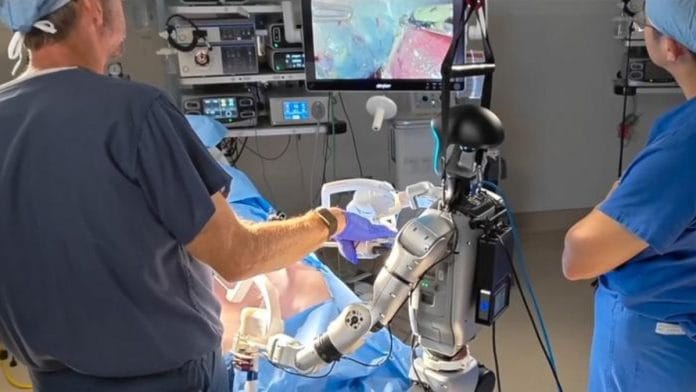


New Delhi: Two human-operated robots have successfully performed a gallbladder removal and another surgery on large mammals not belonging to the family of humans, monkeys, or apes.
The surgeries were a collaboration between a team of surgeons and faculty from the department of engineering at the University of California San Diego. They published their findings in Nature on 8 July in an article titled “In vivo feasibility study of humanoid robots in surgery”.
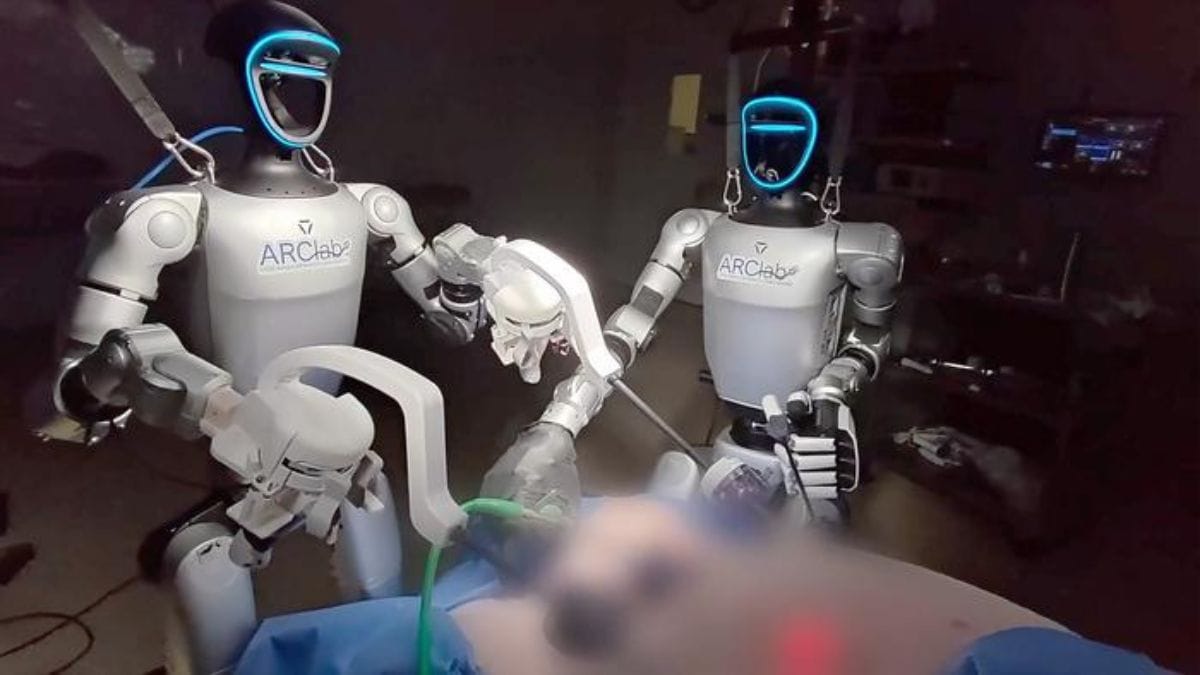
The first surgery was done by a human-robot team made up of a humanoid robot and a surgeon acting as its assistant. The second surgery was performed entirely by two humanoid robots. Both the surgeries, done during a pre-clinical trial were proof-of-concept experiments, small-scale ones where researchers were trying to show that human robots can indeed eventually be a part of operating rooms.
“You can imagine these robots being deployed in remote communities where staffing is challenging, or in austere environments like search and rescue scenarios where a massive deployment of field medicine is needed in a short period of time,” Michael Yip, a faculty member in the UC San Diego Department of Electrical and Computer Engineering and one of the paper’s senior authors, said in a press release.
Also read: What’s on Claude’s mind? AI model keeps a private list of unspoken thoughts, Anthropic finds
The demand for automation
The study’s authors highlighted that there was a shortage of surgeons and a rise of patient needs. This meant that many patients had to wait longer for treatment, and some had significantly better access to healthcare than others.
“Remotely operated and autonomous humanoid robots have real potential for amplifying access to critical surgeries to which patients would otherwise not have access. This can help address the healthcare crisis not only in the United States, but also worldwide,” Yip added.
Another highlight of humanoid robots is that they are different from machines built for existing specialised robotic surgery that can only perform one function. Many of these systems take up a lot of space, are extremely heavy, weighing over 800 kg, and need a team of researchers to set up.
In contrast, the humanoid robot, nicknamed Surgie by researchers, is more compact and mobile. Researchers said such robots like Surgie could be used for a variety of tasks including cleaning up the operation theatre or assisting surgeons with bringing tools.
“Our goal is an operating theatre of the future, where humanoid robots and humans work side by side as an integrated team to deliver procedures to those in need, both in traditional hospital settings as well as in non-traditional, field medicine scenarios,” said Yip.
However, while the initial experiment may have been a success, there are several creases to iron out. Since the robots had to be recalibrated several times during the two surgeries, they took significantly longer than when it is performed with existing specialised tools. However, researchers justified the delay by saying that these were still early-stage robotic systems and they were likely to get far more efficient over time.