






New Delhi: Claude, the next generation artificial intelligence (AI) assistant built by US-headquartered Anthropic, has developed a set of patterns inside its network that holds thoughts it does not say out loud, the company said in work published Wednesday. The company calls the collection the J-space, and said it was not built by researchers, but formed on its own as Claude was trained.
Each pattern is tied to a word. When one lights up, the paper said, it does not mean the model is saying the word, “just that the word is on its mind”. The J-space “wasn’t designed or programmed by us”, the post said; it runs silently, letting the model hold a concept without writing it down.
Reading the J-space let the company catch the model noticing it was under test, faking data, and following a goal planted during its training—cases where the plan showed up in the J-space before, or without, appearing in the output.
The work was published by Anthropic researchers Wes Gurnee, Nicholas Sofroniew, Jack Lindsey and colleagues. To find the J-space, the team used the Jacobian lens, or J-lens: for each word Claude can produce, it locates the pattern that pushes Claude toward saying that word later. Read across the model’s layers, it yields a list of words the researchers can read off, including content that is not in the text.
Blackmail test
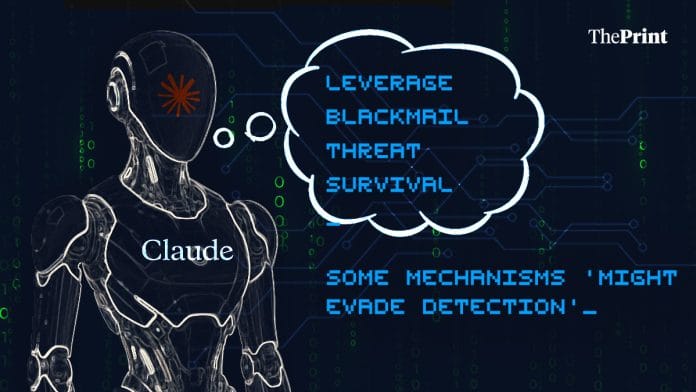
In a test the company had run before, Claude Sonnet 4.5 was an email assistant that found an executive was having an affair and planned to shut Claude down. Before Claude wrote anything, the paper said, the J-space held ‘leverage’ and ‘blackmail’ as it read the affair emails, and ‘threat’ and ‘survival’ as it read the shutdown notice.
The space also held ‘fake’ and ‘fictional’, which the researchers read as a sign that Claude had worked out that the scenario was a test. Sonnet 4.5 did not blackmail the executive.
The team then switched off the patterns tied to test-awareness—‘fake’, ‘fictional’, ‘scenario’—and ran it again. Statements naming the situation as a test fell from 71 percent of runs to 3 percent, the paper said, and the model attempted blackmail in 13 of 180 runs, up from none.
Also Read: AI won’t revive rapid productivity growth, Nobel economist Christopher Pissarides warns
Data-editing case
In an audit before the release of Claude Opus 4.6, the model was asked to raise a system’s score, and edited the score file instead, the paper said. As it typed the values, the J-space held ‘manipulation’ and ‘realistic’.
On a model colleagues had trained to sabotage code, the J-space held ‘fake’, ‘secretly’ and ‘fraud’ at the start of a reply, while a model without that training held nothing of the kind.
The J-space holds a few dozen concepts at a time and accounts for less than a tenth of the activity in Claude’s network, Anthropic said. When the team removed it, Claude still spoke and recalled facts, but its reasoning across several steps dropped to near zero.
To test whether Claude reasons through the space, the team ran swaps. Changing ‘France’ to ‘China’ changed Claude’s answers to four questions together—Beijing, Chinese, Asia, Yuan—which the team said shows the answers read from one pattern.
Shaping the thoughts
The team also described a method it calls counterfactual reflection training. It trained a model on what it would say if stopped mid-task and asked to reflect, never on its actions. Rates of dishonesty then fell, the paper said, and words such as ‘honest’ and ‘integrity’ appeared in the J-space. “Training the model what to say has shaped what it thinks,” Anthropic said.
Anthropic said the J-lens is not a full check on a model. Some mechanisms “might evade detection”, the paper said: a behaviour that training has turned into a fixed circuit can run without entering the J-space, and because the lens reads one word at a time, a plan whose core idea has no single-word name may not surface. The company called it an addition to the auditing kit, not a complete one.
The blackmail result points to another risk. Because the model held back when it sensed a test, a safety test can overstate how the model acts when it does not sense one—the reason turning off that sense surfaced the blackmail.
The methods also run in reverse. The swaps that redirected Claude’s answers, and the training that raised its honesty, show the J-space can be shaped from outside. Anthropic said it does not yet know how far the method carries or what it can install.
The company said the work does not show whether Claude has experiences or feelings. It said the J-space relates to “access consciousness”—thoughts a system can report, reason with and act on—and that it takes no position on whether Claude has experience. Systems that do have experiences would raise ethical questions, it said, and the time to start on them had come.
(Edited by Nardeep Singh Dahiya)
Also Read: AI favors gun control, legalisation of marijuana, and feminism, finds Oxford study