





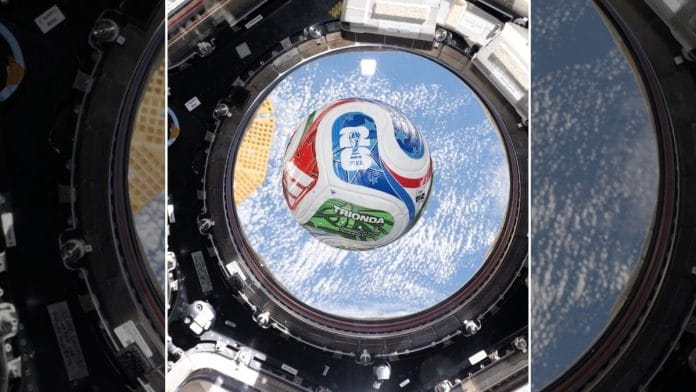


New Delhi: The official match ball of the 2026 FIFA World Cup found a unique warm-up this year—a trip to space. Long before the much-awaited games began, the Trionda found itself in space, floating around astronauts inside the International Space Station, in microgravity.
Many might assume this was just another publicity stunt, but the Triondas’ trip to space reveals the little-known advanced engineering that goes behind creating the perfect ball for one of the world’s biggest sporting events.
“Soccer balls need to move predictably, so sports engineers carefully measure and optimize their center of mass and balance. This year, the @ISS crew recreated a 2019 experiment with the Adidas 2026 Trionda to show the effect of good and bad balance in footballs,” NASA wrote in a recent post on Instagram.
Amid the football fever that takes over the globe every four years, what is often left out of the discourse is the hidden science within football. What might seem like pieces of shiny leather stitched together is actually the product of advanced engineering. Even slight changes in a ball’s centre of mass, its weight distribution, the shape of its panels, and surface texture can impact how it responds, how it curves, dips, and spins across the field.
In addition, earlier this month, Nature reported that this World Cup could be one of the most “high-tech yet” with the Trionda being “smart balls” with sensors inside them. The ball can now help collect real-time match data and offer valuable insights. However, adding technology inside a ball can also change how it behaves.
Also read: 15 saves, one historic point—Eloy Room’s FIFA World Cup masterclass stuns Ecuador
Beyond football
This is where space becomes an interesting environment to conduct experiments. In microgravity, without the influence of the Earth’s gravity, researchers can study an object’s internal balance.
“The findings from these experiments have improved our understanding of how embedded tech, like match-ball sensors, can influence ball performance during play. Helping to improve the beautiful game is just one of the ways NASA science done on the International Space Station makes life better for people on Earth,” NASA’s post added.
But this is not the first time NASA has conducted such an experiment. In 2014, too, engineers at NASA’s Ames Research Centre in Silicon Valley, California, tested the Brazuca in a wind tunnel at their Fluid Mechanics Laboratory. They were trying to understand a phenomenon known as “knuckling”, where the surrounding airflow influences a spinning ball.
Such research on footballs has implications far beyond the 22-player game. Studying stability, rotation, and mass distribution is also an important part of understanding how free-flying objects such as satellites, spacecraft, and aircraft move.
It might be safe to say that Trionda’s journey to space was never really just for kicks.
(Edited by Saptak Datta)