



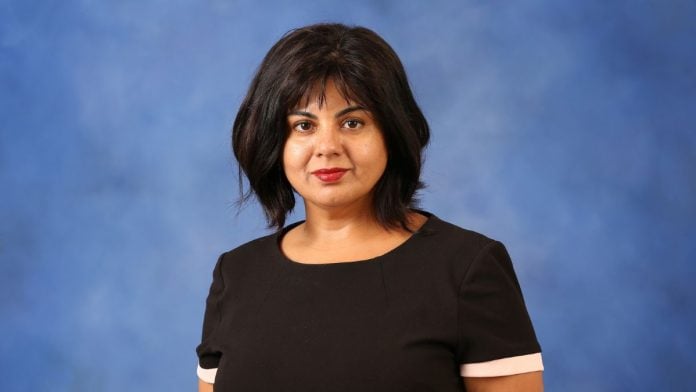
New Delhi: Kolkata-born Indian-American astrophysicist Sukanya Chakrabarti has been elected a Fellow of the American Physical Society, one of the most prestigious honours of the physics community.
Chakrabarti in a statement said she was deeply honoured by the recognition and that she has been developing new ways to map dark matter by measuring the extraordinarily small accelerations it produces in stars throughout our Galaxy.
“By combining extreme-precision measurements of stars, pulsars and eclipsing binaries, we are aiming to detect dark-matter clumps on increasingly small scales. These clumps carry the fingerprints of dark-matter models and could help us answer one of the most fundamental questions in physics: What is dark matter?” Chakrabarti said in a statement.
Chakrabarti is currently the Pei-Ling Chan Endowed Chair at the College of Science at The University of Alabama in Huntsville (UAH). Her work focuses on developing new approaches to measure the distribution and behaviour of dark matter in the Milky Way. Over the past few years she has combined theoretical astrophysics, observational astronomy, and computational methods of precision measurements. In 2022, she led the discovery of the closest known black hole to the earth, Gaia BH1, located 1,560 light-years from our planet, around a Sun-like star.
One of the aims of Chakrabarti’s research is to study how dark matter, the invisible material that makes up much of the universe, affects the motion of stars. Her research tries to detect the subtle gravitational pull of dark matter and to eventually understand how it shapes galaxies.
“I am tremendously grateful for the support I have had at UAH, that lets me continue carrying out these measurements, which bring together time-domain astronomy and precision measurements,” she said in a university statement.
Also read: India-France satellite TRISHNA to take flight by 2027. How it will improve Earth observation
From Kolkata to the US
Chakrabarti moved to the US with her parents when she was 10 years old. She earned her bachelor’s degree from the North Carolina State University in physics and philosophy. She later pursued physics at the Georgia Institute of Technology and eventually completed her PhD from the University of California, Berkeley, specialising in astrophysics.
Following her PhD she has held several prestigious positions including a postdoctoral fellowship at Harvard University and the Pei-Ling Chan Endowed Chair in the University of Alabama in Huntsville.
“When I was a kid, I wanted to be a detective,” Chakrabarti had told The Telegraph in 2011. However, she eventually studied physics and astronomy, inspired by the work of Carl Sagan, the scientist and science communicator.