



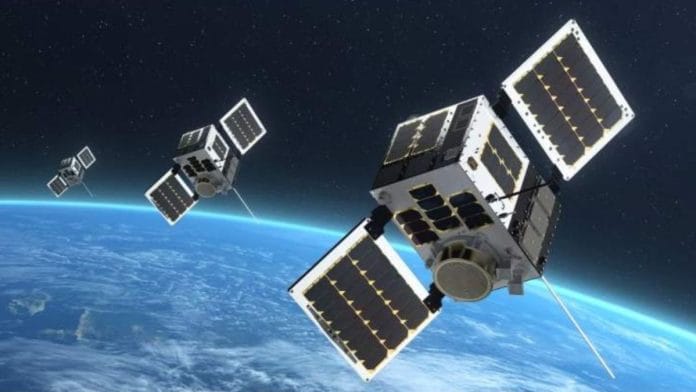
New Delhi: In 2027, the Indian Space Research Organisation, or ISRO, will be ready to launch the India-France satellite TRISHNA. The satellite will advance the capabilities of both countries to map water stress, crop health, and urban heat.
Jasvinder Singh Khoral, Director (projects), UR Rao Satellite Centre, said that the Thermal Infra-Red Imaging Satellite for High-resolution Natural Resource Assessment (TRISHNA) mission is engineered to deliver high spatial and temporal resolution monitoring of Earth’s surface temperature, emissivity, biophysical variables, and radiation variables for surface energy budgeting at regional to global scales.
This mission will also be significant in solving critical water and food security challenges, focusing on the impacts of human-induced climate change and efficient water resource management through evapotranspiration monitoring.
“We will be ready for launch in the next 12 to 16 months. The payloads are divided between us and France. We will be conducting the launch from Sriharikota,” Khoral said at an event in Bengaluru.
The technology
During the course of the mission, TRISHNA will conduct a detailed monitoring of the energy and water budgets of the continental biosphere for quantifying terrestrial water stress and water use, along with high-resolution observation of water quality and dynamics in the coastal and inland waters.
The mission is also designed to conduct a comprehensive assessment of urban heat islands, detection of thermal anomalies linked to volcanic activity and geothermal resources, and precise monitoring of snow melt runoff and glacier dynamics. The satellite will also provide information on aerosol optical depth (AOD), atmospheric water vapour, and cloud cover.
Senior officials from ISRO said that the satellite is in the final stages of development and is likely to take flight by 2027 or early 2028. In September this year, ISRO chairperson V Narayanan reviewed the progress of the mission from the French side.
The mission will provide data at nearly 60-metre resolution, as the satellite revisits the same location every three days near the equator. This will allow scientists to track changes in the land surface temperatures at a level of detail useful for monitoring agricultural fields and local ecosystems.
Also read: Why dementia patients with obesity could live longer
The mission
The TRISHNA mission will carry two instruments that will observe Earth in different parts of the electromagnetic spectrum.
The first is a thermal infrared instrument developed by Airbus Defence and Space, under France’s space agency CNES (Centre national d’études spatiales). It will measure the temperature and emissivity of land surfaces and coastal waters. Emissivity refers to how effectively a surface emits thermal radiation.
The second instrument on board is developed by ISRO. It will observe Earth in visible, near-infrared and shortwave infrared bands. These observations will help scientists identify vegetation characteristics, crop conditions and other properties of the Earth surface.
Both of these combined will allow for the examination of temperature of a surface and the characteristics that influence how it absorbs and releases energy. The satellite will operate in a sun-synchronous orbit, nearly 761 km above Earth, and has a planned mission life of about five years.
(Edited by Aamaan Alam Khan)