





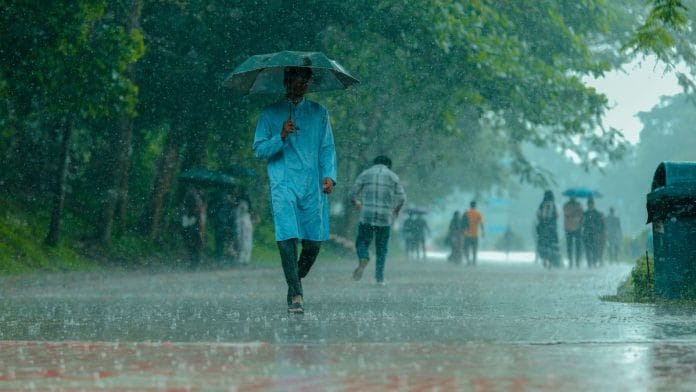


New Delhi: The southwest monsoon officially began in Delhi on Thursday, five days after it was originally expected. However, even as the India Meteorological Department declared the onset of the monsoon, parts of Delhi remained dry and awaiting rainfall, and the country itself saw the fifth lowest rainfall since 1901 in June.
“To declare the onset of monsoon, we look at three things – consecutive rainfall activity, wind speed, and monsoon circulation,” M Mohapatra, director of the IMD told ThePrint.
According to data shared by the IMD, five weather stations in Delhi recorded low rainfall ranging from 2 mm to 5 mm over the last 24 hours. While Ayanagar in West Delhi received 5 mm of rain, Palam recorded only about 1.9 mm, and none of these stations recorded any rainfall the previous day, on 30 June.
For the coming week, the weather forecast indicates cloudy skies and very light to moderate rain across Delhi, with temperatures staying in the range of 22-35 degrees Celsius. The IMD also forecasted thunderstorms and lightning, with wind speeds reaching up to 60 kmph.
Also read: Doubled parking fees, WFH, and drones are a part of Delhi’s new Winter Pollution Master Plan
Erratic rains
The IMD might have declared the beginning of the monsoon, but Delhi’s rainfall has been haphazard and dry. Data from 1 July and 2 July shows that while some stations like Chattarpur recorded 18 mm of rainfall in one day, others like Najafgarh recorded 0 mm. For most stations in the city, though, the last two days brought less than 5 mm of rainfall.
According to the IMD, however, there is no specific rainfall threshold to declare a monsoon expansion, as long as rainfall is observed alongside other parameters.
“We cannot compare this monsoon to last year’s monsoon, because this is a weak monsoon season,” said Mohapatra. “Last year was a strong monsoon, so we saw more showers.”
The last time Delhi experienced a delayed monsoon onset was in 2021, when the rains reached Delhi on 13 July. In 2019, too, monsoon onset occurred on 5 July.
Currently, the IMD’s rainfall map shows that all administrative districts of Delhi are experiencing either a deficit or a large deficit in rainfall. While central, south and north-east Delhi have seen a 95% deficit rainfall, west Delhi has seen a 50% deficit.
Also read: India unveils world’s first nuclear hydrogen production facility. What is this technology?
Weak onset of monsoon
On 30 June, the IMD’s monthly rainfall outlook for the month said that the entire country saw a 42 per cent deficit in rainfall compared to its long-period average for June. Around 65 per cent of the subdivisional areas in the country experienced deficient rainfall, and only 1 per cent saw excess rainfall. In northeast India, this was the lowest rainfall in June since 1901.
While El Niño conditions were broadly mentioned as a reason for overall deficient rainfall this season, the IMD also explained other reasons for low rainfall in June specifically.
One main reason is the unfavourable conditions of the Madden-Julian Oscillation (MJO) which is a “pulse of clouds and rainfall” that moves eastwards and is highly responsible for tropical rain conditions. In the absence of the MJO, India’s overall rainfall in June suffered. Additionally, there were no low-pressure systems observed during June, which are key for bringing rainfall over certain regions. These low-pressure systems form in the atmosphere and pull rain-bearing clouds in.
Usually, the Indian Ocean Dipole, a climate phenomenon unique to the Indian Ocean, pushes warm water towards the western Indian Ocean and results in increased rainfall activity in India even during El Niño conditions. However, in June, the El Niño conditions coincided with a neutral Indian Ocean Dipole, which meant that it could not offset the rainfall deficiency
Moreover, these conditions are likely to continue for the month of July too, with the IMD expecting below-normal rainfall everywhere in the country. The latest forecast says the country will see less than 94 per cent of the long-period average, which is likely to pose challenges for agriculture and water resources, the IMD added.
(Edited by Janaki Pande)