



New Delhi: Last week, India inaugurated the world’s first nuclear hydrogen production facility at the Indira Gandhi Centre for Atomic Research in Kalpakkam, Tamil Nadu. Based on the copper-chlorine thermochemical cycle, the facility is the first of its kind to use heat generated by nuclear energy to produce hydrogen – a process that is both carbon-free and efficient.
“Nuclear power, with its unique ability to provide reliable carbon-free electricity as well as high-temperature process heat, is ideally suited to support large-scale hydrogen production,” said Ajit Kumar Mohanty, Secretary, Department of Atomic Energy (DAE).
Former Atomic Energy Commission chairman and nuclear physicist Anil Kakodkar said hydrogen is becoming one of the world’s most important clean-energy carriers, making cheaper methods of production increasingly important.
“In the new clean energy transition globally, hydrogen constitutes a very important source that can produce heat and energy. It’s an important energy carrier—almost as important as electricity,” Kakodkar said. “Which is why everyone in the world is trying to produce green hydrogen.”
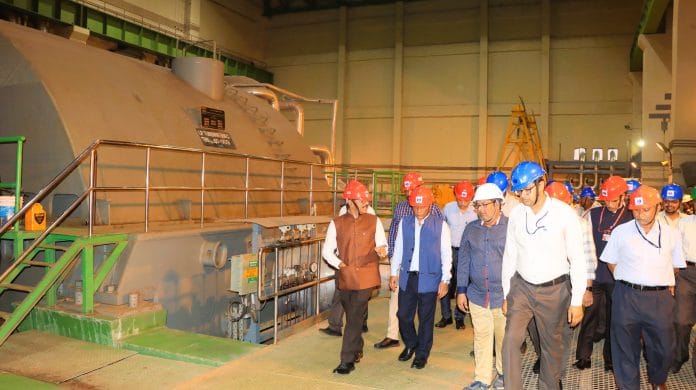
The facility was inaugurated on 26 June at the Fast Breeder Test Reactor (FBTR) in Kalpakkam, India’s first and oldest fast breeder reactor. It has been used for nuclear reactor research since it first achieved criticality in 1985, and is housed in the same complex as the Prototype Fast Breeder Reactor (PFBR), a 500-MW commercial-scale reactor that achieved first criticality in April 2026.
The hydrogen production facility at the FBTR is essentially a technology demonstrator project designed to show the world how hydrogen can be produced using chemical reactions and heat from the nuclear process, rather than electricity. Like green hydrogen plants, this facility also extracts hydrogen (H2) from water (H2O).
However, instead of using electricity, the facility uses excess heat from the fast breeder reactor and a thermochemical chain of reactions involving copper and chlorine.
According to Kakodkar, replacing electricity-intensive electrolysis with heat from the reactor significantly improves the efficiency of hydrogen production.
“The cost of producing hydrogen comes mainly from the energy cost of electrolysis,” he said. “When you replace it with heat from the nuclear process, it’s much more efficient.”
While this process has been studied globally as a viable method of producing clean hydrogen, India is the first country to commission such a facility.
According to a 2025 document released by the Bhabha Atomic Research Centre (BARC)—which developed this technology—the facility has the capacity to produce 150 normal litres of hydrogen per hour (NL/h).
BARC and the DAE plan to expand the technology by setting up a new facility with a capacity of 3,000 normal litres per hour, which they say would be commercially viable. The new facility will likely come up near the PFBR on the same campus.
Also read: PFBR’s criticality milestone at Kalpakkam makes India a firm contender in the global nuclear race
What is this technology?
The DAE said the new hydrogen production facility marks a major milestone in India’s three-stage nuclear programme.
With limited uranium reserves, India’s nuclear programme was conceived in the 1950s by nuclear physicist Homi Jehangir Bhabha to exploit the country’s abundant thorium resources. The first stage involved building pressurised heavy water reactors (PHWRs), such as those at Kudankulam in Tamil Nadu.
The second stage involved fast breeder reactors such as the FBTR and PFBR at Kalpakkam. These reactors are based on the principle that they produce more fuel than they consume. The technology used in fast-breeder reactors differs from that in traditional nuclear reactors — the latter primarily use uranium as fuel, whereas fast breeder reactors utilise plutonium.
India’s fast breeder reactors also currently use plutonium as fuel but have been designed to eventually operate on thorium, a radioactive element that is abundantly available in India.
The fast breeder test reactor, however, is not a commercial nuclear reactor. It has a modest capacity of 40 megawatt thermal (MWt) and serves as a test bed for India’s future fast breeder programme. Different nuclear fuel types, advanced technologies and coolants are first tested here before being deployed in the larger commercial reactors.
The hydrogen production facility is one such technology. The demonstration project marks India’s progress in both the nuclear and hydrogen sectors and is expected to set the stage for commercial-scale nuclear hydrogen production at the Prototype Fast Breeder Reactor.
According to Kakodkar, while hydrogen produced through this process is not classified as green hydrogen, its environmental benefits are comparable.
“This isn’t called green hydrogen, because the production process uses nuclear heat rather than renewable energy,” he said. “But in terms of the carbon footprint, this process is comparable to green hydrogen.” He added that, in the long run, the technology could reduce the overall energy consumed in producing hydrogen.
“This achievement builds upon more than four decades of operational experience and technological excellence gained through the Fast Breeder Test Reactor programme,” said Sreekumar G. Pillai, Director, IGCAR, in a press release.
(Edited by Prashant Dixit)