





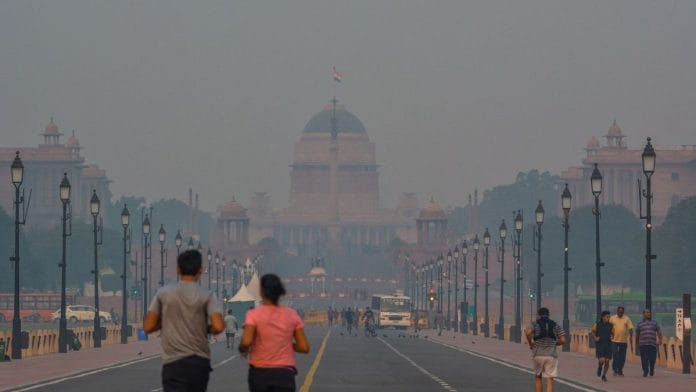


New Delhi: The Delhi government has released a permanent Winter Pollution Master Plan which will be enforced every year from 1 November to 28 February. Along with the usual GRAP recommendations, the government is also set to use drone surveillance to detect open burning, especially at night.
Nearly four months ahead of the winter the city is gearing up for pollution levels to rise again. The notification highlights mandatory staggered timings for employees at the Municipal Corporation of Delhi (MCD) and the capital’s government offices. Private offices have also been told to promote carpooling, ride-sharing, and other forms of public transport to reduce traffic.
The state has also imposed a complete ban on construction and demolition activities from 10 December to 20 January barring any critical government projects. In that same period, trucks carrying construction material such as sand, cement, bricks, or debris, will also be banned from entering the city.
Parking fees at public parking sites are also set to be doubled during the winters to discourage people from using their private vehicles.
To further reduce the pollution, the state has made it mandatory for commercial high rises occupying an area larger than 3000 sq. m to install anti smog guns or mist systems. The state has added that the mist systems are to be operational throughout the year except during the monsoon and peak summer periods from 1 May to 15 September.
Also read: Food over pills—new calcium recommendations flag unnecessary use of supplements
Many of the other measures are not different from the existing Graded Response Action Plan (GRAP), and those mentioned by chief minister Rekha Gupta earlier in June.
These include stricter restrictions on vehicles mandating that petrol, diesel, and CNG pumps dispense fuel only to vehicles with a valid Pollution Under Control (PUC) certificate. In addition, no non-BS-V1 vehicles registered outside Delhi will be allowed into the city from 1 November to 31 January.
The government added that there will be strict penalties which could lead to significant fines, and even prosecution under the Environment (Protection) Act.