







New Delhi: With most Indians consuming far less calcium than recommended, the country’s top endocrinologists have said people should meet their calcium needs primarily through food. Calcium supplements, they said, should be used only when diet alone cannot meet the recommended intake or when the body’s calcium requirements are higher, such as during pregnancy, lactation, after menopause or in certain bone disorders.
The recommendations are part of a new consensus statement by the Endocrine Society of India’s (ESI) Skeletal Health Taskforce, prepared by 22 endocrinologists from across the country and published in the Indian Journal of Endocrinology and Metabolism.
The recommendations come against the backdrop of widespread calcium and vitamin D deficiency in India. Vitamin D helps the body absorb calcium from food, so a deficiency in either can weaken bones and increase the risk of osteoporosis and fractures.
The Indian Council of Medical Research-National Institute of Nutrition’s 2020 guideline has emphasised that Indians typically consume only 300-500 mg of calcium a day, well below the 1,000 mg recommended for most adults.
It is the body’s most abundant mineral and is essential for building and maintaining healthy bones and teeth. It also helps muscles contract, nerves transmit signals, blood clot normally and keeps the heart functioning properly. Over time, inadequate calcium intake can weaken bones, increasing the risk of osteoporosis and fractures.
“Despite so much focus on improving intake, we are still lacking and that is why osteoporosis rates, vitamin D deficiency rates, and overall skeletal health in India are actually worse than what we see in the western population,” said Dr Saptarshi Bhattacharya, consultant endocrinologist at Indraprastha Apollo Hospital in New Delhi.
Why India-specific recommendations
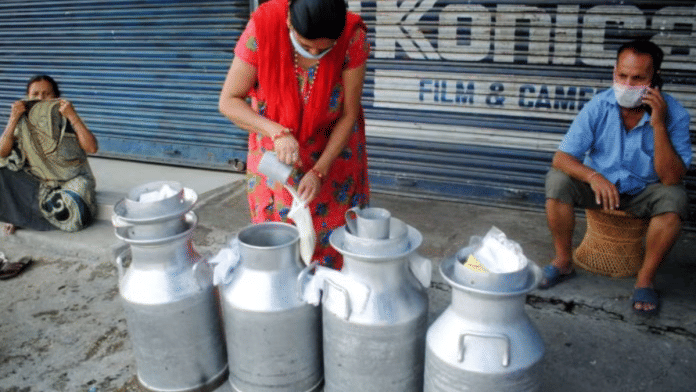
India is the world’s largest milk producer, yet calcium intake remains low because dairy consumption varies widely across regions and income groups. Many Indians, particularly in rural areas, rely on cereal-based diets that provide relatively little calcium. Widespread vitamin D deficiency further reduces the body’s ability to absorb calcium from food.
Experts said most international guidelines are based on Western diets, where dairy products contribute a much larger share of daily calcium intake than they do in India.
“The recommended dietary allowance is close to 1,000 mg, but in India people hardly reach 400 or 500 mg, and sometimes even less,” Bhattacharya told ThePrint.
“National surveys have consistently shown this gap,” he added.
The consensus statement says that calcium becomes particularly important during pregnancy, breastfeeding, after menopause and in people living with osteoporosis and other metabolic bone disorders.
Explaining the need for these recommendations, one of the authors Dr Ambrish Mithal, of the Department of Endocrinology and Diabetes at Max Healthcare in New Delhi, said there was considerable confusion among doctors about when calcium supplements should be prescribed, who actually needs them and which formulation to use.
“While the ICMR recommendations specify how much calcium Indians require, there was no clinical guidance on when supplementation is necessary. This consensus aims to bridge that gap by providing practical recommendations for clinicians,” he told ThePrint.
Food before supplements
A glass of milk provides roughly 250 mg of calcium, meaning most adults would require around three servings of dairy daily to meet the recommended intake through milk alone.
For people who do not consume dairy, the statement recommends calcium-rich alternatives such as ragi, sesame seeds, horse gram, rajma, drumstick leaves and curry leaves. Ragi contains about 344 mg of calcium per 100 grams, although sprouting it improves calcium absorption.
The recommendations broadly align with the Union Health Ministry’s programme under which pregnant women receive calcium and vitamin D supplements from the second trimester until six months after delivery.
However, the new guidance also extends recommendations to men, postmenopausal women and people living with osteoporosis, chronic kidney disease and other metabolic disorders.
‘Routine use of activated vitamin D should stop’
The statement’s strongest recommendation is against routinely prescribing calcium supplements containing active forms of vitamin D, such as calcitriol.
According to the taskforce, 46.5 per cent of calcium supplements available in India contain calcitriol, a special form of vitamin D that helps the body absorb calcium. It is meant only for people whose bodies cannot activate regular vitamin D on their own and should be used only for people with conditions such as chronic kidney disease, hypoparathyroidism and a few rare inherited disorders.
“Routine calcium prescription blindly containing an activated form of vitamin D like calcitriol should be strongly avoided,” Dr Bhattacharya said.
For most people, regular vitamin D3 is enough to help the body absorb calcium. Using calcitriol unnecessarily can increase the risk of high calcium levels and kidney stones, the experts said.
Instead, the statement recommends treating vitamin D deficiency with regular vitamin D3 supplements, rather than activated forms of vitamin D.
“While calcium supplements are not being over-prescribed in India, they are sometimes being prescribed irrationally,” Dr Bhattacharya said.
The statement also addresses concerns that calcium supplements increase the risk of heart disease.
Dr Mithal said that many people avoid calcium supplements because they fear they will harm the heart. “The evidence for that is limited, especially in populations like India where calcium intake is generally low,” he said.
Talking about other misconceptions, he said, “people assume every bone pain or feeling of weakness is due to calcium deficiency. It is often not true.”
“Our aim was to provide balanced, evidence-based guidance so people neither take supplements unnecessarily nor avoid them because of exaggerated fears,” he added.
(Edited by Viny Mishra)
Also read: Govt’s new strategy to tackle anaemia, and its 7x7x7 framework