





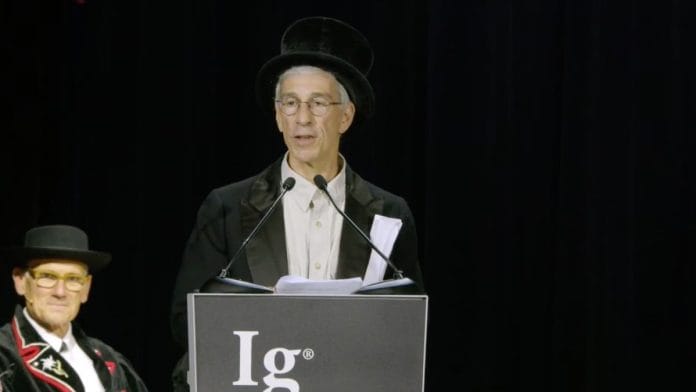

New Delhi: Buried underwear, ancient kissing techniques, splash-free urinals and the aerodynamics of blowing your nose, are just a few of this year’s Ig Nobel prize winners announced on Thursday.
The Ig Nobels, a play on the word “ignoble” and a parody of the prestigious awards, were established in 1991 to honour “achievements that first make people laugh and then make them think”. The theatrical award ceremony, usually held in Boston, features miniature operas and “24/7 lectures” where experts must explain their work first in 24 seconds and then in 7 words.
This year, the ceremony took place in Zurich, Switzerland, with Marc Abrahams, the master of ceremonies telling The Associated Press that it has become “unsafe for guests to visit the country (US). The move also comes after four of last year’s 10 winners chose not to travel to the US due to security concerns.
Here are the winners of the 2026 Ig Nobel prizes.
Biomechanics
The biomechanics Ig Nobel went to Matilda Brindle and her colleagues for a study called “A comparative approach to the evolution of kissing”.
“We use a non-anthropocentric approach to define kissing as a non-agonistic interaction involving directed, intraspecific, oral-oral contact with some movement of the lips/mouthparts and no food transfer,” read the study.
Armed with this definition, the authors of the study concluded that all large apes, except eastern gorillas, engage in some form of kissing. They now plan to take the study further and understand why and how kissing evolved.
Economics
The Ig Nobel in economics went to Paul K Piff, Daniel Stancato, and others who tried to prove that “higher social class predict increased unethical behaviour”.
The team of researchers found a way to link social status with a person’s propensity for unethical behavior such as “stealing cash, receiving bribes, overcharging customers”. One of their field studies checked if upper-class drivers (based on the type of car) were likely to cut off other vehicles.
Although they highlighted that there are several exceptions to their findings, their conclusion was straightforward: “As our findings suggest, the pursuit of self-interest is a more fundamental motive among society’s elite, and the increased want associated with greater wealth and status can promote wrongdoing.”
Chemistry
The Ig Nobel in Chemistry went to a team of researchers that found that cockroach milk is full of energy. The team studied the Pacific beetle cockroach, Diplopter punctata, which nourishes its embryos with a milk-like substance. This substance turns into crystals inside their gut.
When researchers collected these crystals they found that a single one contained over three times the energy compared to the same amount of dairy milk.
Medicine
“How to blow the nose — An aerodynamic study of the nose blowing”, a study by Japanese researchers, won the Ig Nobel in medicine. The lead author, Tokuji Unno, noticed cultural differences in the way people blow their nose and wanted to “give good instructions to those who do not understand how to blow the nose”.
Unno used pneumotachometers, usually used to measure the volume flow of gases, to determine the velocity, volume and the time scale of nose blowing. His recommendation: “A big and long nose blow is therefore recommended to prevent upper and lower respiratory tract diseases.”
Biology
What makes a snake bite a human? That is what João Miguel Alves-Nunes and a team of Brazilian researchers wanted to figure out. In a now retracted article in Nature the team stepped on different parts of a venous snake, at various times of the day, to find out at what point a venomous snake decides to chomp.
The team geared up in safety boots and stomped over the head, mid-body, and tail of 75 venomous pit vipers in their lab. Would the vipers approve of the research? We’ll never know.
Physics
The Ig Nobel in physics went to a Nautilus, pronounced “nauti-loo” a splash free urinal that made quite the “splash” in a fluid dynamics conference in 2022. They finally reported their findings in 2025.
The team began their research because they noticed that urinal designs had remained “stagnant” for over a century, and the unaddressed “splatter” often led to unhygienic environments. The team realised that dogs have already figured out the ideal angle to take a piss — 30 degrees.
Their invention is a nautilus shell shaped urinal. The team’s simulated urine stream tests have shown that not a sign droplet comes splashing back.
Technology
The Ig Nobel for technology went to a team of Chinese scientists that found a way to use the mouth of a mosquito as a high-resolution 3D printing nozzle for “necroprinting”.
Necrobiotics is a field of engineering that builds robots out of synthetic material and animal parts. The team realised that a 3D printer’s nozzle is essentially made to deliver a fluid — so is the stinger of bees, wasps, and scorpions, or the fags of a snake, or even teh claws of centipedes. Among the potential nozzle donors, the mosquito was a winner.
The team created a device called a “3D necroprinter” which can print objects at 18 to 22 micros. For the device, the mosquito nozzle makes for a perfect dispensable tip.
Also read: Dwarka was Delhi’s middle class dream. Now it’s fighting traffic, garbage, water woes daily
Olfaction
Your child might smell wonderful to you as long as they are a baby — but no more once they turn into smelly teens, found a team of German researchers.
There is plenty of research about the odor of newborn babies. It is even known to activate reward centres in the brain and leads to parent-child bonding.
The authors approached 235 parents, 163 mothers and 72 fathers with a questionnaire to rate their child’s odor. They found that as a child grows older a parent stops enjoying their odor.
Peace
The Ig Nobel Peace prize went to a team of researchers that found that people value friends who are vicious to people they dislike.
The study was titled “Sometimes we want vicious friends: People have nuanced preferences for how they want their friends to behave toward them versus others”.
People might think they want friends who are kind and trustworthy but six related studies involving over 1,000 people from the US and India found that people like it when friends are vicious to their enemies.
Soil science
The Ig Nobel for soil science went to a team of researchers that buried 1,000 identical underpants in over 25 countries only to dig them up 2 months later. The best part — it was a citizen science project.
To all the volunteers, the researchers sent detailed instructions along with two pairs of organic cotton men’s underpants, 12 tea bags, and a sampling bag for soil collection. Each volunteer dug a hole, collected a soil sample, then buried the underwear.
Two months later when the underwear were dug out again, their level of delay allowed researchers to analyse the soil in their surroundings, and reveal spots with the highest level of organic matter. The authors of the study said that the “underpant index” gave them meaningful data about soil conditions including chemical and physical properties, elevation and moisture.