





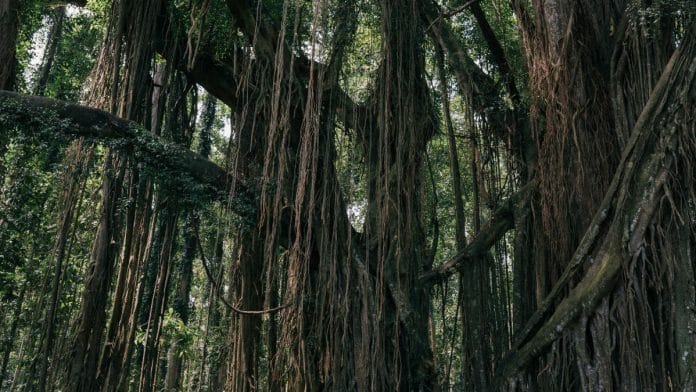


New Delhi: An ancient banyan tree in the Munger district of Bihar has witnessed over 700 years of history — it was alive in the 13th century during Marco Polo’s 24-year journey along the silk route, and it was thriving in the 14th century when Dante Alighieri was penning down the Divine Comedy. Scientists have now deemed it as the world’s oldest accurately dated Ficus benghalensis or Indian banyan.
The findings were published in the journal Quaternary Research in April, by a team of researchers, Mayank Shekhar and Akhilesh K Yadava, led by Trina Bose, a researcher at the Birbal Sahni Institute of Palaeosciences (BSIP), Lucknow, an autonomous institute under the Department of Science and Technology (DST).
The tree is more than just a part of Munger’s ancient landscape. While most are fascinated by the tree’s age, the researchers are more interested in establishing the tree as a silent chronicler of the area’s climate. Bose can’t wait to find out what banyan has to reveal about Munger’s palaeoclimate.
“It can tell us about droughts, heatwaves, floods. A tree doesn’t understand weather, but it understands what is good for it — it knows when it is too hot, too cold, too dry, or too wet,” Bose told ThePrint, adding that by 2027 her team would have gotten a much better understanding for the past 700 years of climate data from analysing the tree.
Also read: Mumbai monsoon has brought a new killer—city’s falling trees
700 years of wisdom
When Bose was invited by the Bihar Forest Department to determine the age of the Munger banyan tree, she realised that conventional dating approaches would not work. Unlike most trees that form annual growth rings on their trunks, large banyan trees are essentially clusters of roots which have over time turned into trunks. To investigate its age, Bose and her team came up with a new method.
Through a process that Bose compared to taking a blood test, the researchers extracted alpha-cellulose, a component of the plant’s cell walls, from wood samples from older parts of the tree.
Through Accelerator Mass Spectrometry (AMS), which can isolate radioisotopes of elements, researchers determined the tree’s age. This process is known as high precision radiocarbon dating. The AMS tool itself can date samples all they way back to a million years, but when Bose’s team was selecting samples from the tree, they couldn’t sample older parts without harming them. Despite the analysed sample being 700 years old, Bose estimates that the tree is likely to be even older.
“This finding refutes earlier assumptions that the Munger Banyan was planted in front of the historic ‘Burra Bunglow’, which, based on architectural style, dates to the late Mughal-Early British period (~300 to 350 years old), as a venue for dialogue between rulers and common citizens, village assemblies, religious ceremonies, and cultural exchanges,” reads a DST press release.
A hidden climate archive
Bose, a history and archeology enthusiast, was first drawn to tree-dating when she realised that it allowed her a window into the past without having to find an abandoned archeological site.
“Palaeoclimate records are often too vague. They deal with a scale spanning centuries. But with trees, that scale is narrowed to years and decades,” she said.
The Munger banyan is one of Bose’s ongoing projects. Her team also travels to various rural parts across the country.
“As we do this more often, I am confident we will find older trees, bigger banyans,” she said, looking forward to the climate archives that await discovery.