



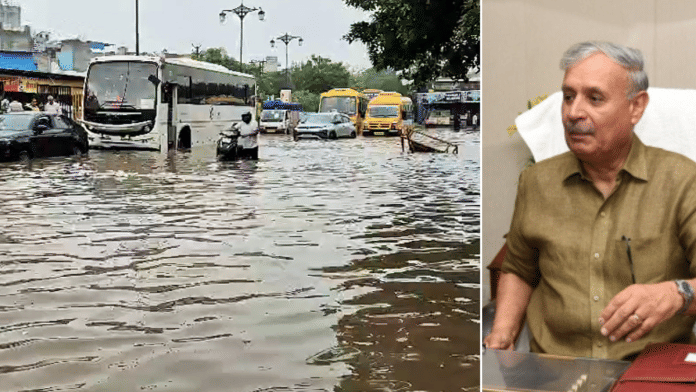
Gurugram: Gurugram MP Rao Inderjit Singh blamed construction during the Congress era for the city’s recurring waterlogging, days after 14 school buses carrying children were stranded on flooded roads for up to six hours and residents suffered a 10-hour traffic jam.
Following a meeting with Haryana Chief Minister Nayab Singh Saini on Wednesday over the city’s waterlogging, Singh told reporters that the solutions being implemented so far were what he called a “Band-Aid solution”.
He added that he was trying to get state government funds to fix the city’s choked drainage network permanently.
Singh called the flooding “a perennial issue for Gurugram” and said explanations would be sought from officials responsible.
“Builders have illegally developed colonies over natural drains. All these illegally developed colonies came up during the past 20 years. We can’t remove these colonies now,” Singh said. “I have suggested the CM provide sufficient funds to make arrangements for the smooth flow of perennial nullahs.”
He also linked the problem to construction during the Congress era, saying it had covered old drainage channels that once carried rainwater from the hills to the Yamuna.
“We are still dealing with the consequences of this development during the Congress era today,” he said.
His proposed fix: underground tunnels, built along the routes of the old drains, on the model of Delhi Metro tunnels.
“What we are doing right now is essentially a Band-Aid solution,” he said. “The government is working on this, and we are arranging the necessary funds.”
Ageing infrastructure
Singh’s own record complicates the charge. He began his political career with the Congress in 1977, held a Haryana ministerial berth, became MP from Mahindragarh in 1998 and 2004, and served as a Union minister in the UPA government before winning the Gurgaon Lok Sabha seat on a Congress ticket in 2009.
He crossed over to the BJP only afterwards, and won the seat in 2014, 2019 and 2024 consecutively and remained a Union minister throughout.
Leader of Opposition Bhupinder Singh Hooda rejected the accusation that unplanned or illegal development took place in Gurugram during his tenure as chief minister from 2005 to 2014.
He told ThePrint that illegal colonies had mushroomed since then because of the “personal interest” of BJP leaders.
Hooda asked whether anyone recalled waterlogging or traffic blockages of this scale during the Congress government’s time. He emphasised that the trouble began only two years into the BJP’s term, with the first major incident in 2016.
Hooda also turned Singh’s own history back on him, saying that the Union minister had been an MP through those very years and a Union minister in the Manmohan Singh government for five years.
Asked for a solution, Hooda said the BJP government does not clean drains and sewer lines through the year, and turned to the Congress era to explain the problem only when residents start to suffer.
“When they have built so many underpasses, they should also make arrangements to pump out water from low-lying areas, besides strengthening the drainage and the sewerage system in the city,” he said.
He added that it was shameful that small children had to sit trapped on waterlogged roads for up to six hours on Monday.
The exchange followed heavy rains on Monday that paralysed Gurugram for close to 12 hours. Flooding on major roads and intersections caused traffic snarls across the city, leaving schoolchildren stuck the longest.
Floodwater receded from most areas only by Wednesday morning.
The rain also exposed the city’s ageing infrastructure. A stretch of the service road at IFFCO Chowk caved in on Tuesday after the collapse of a master sewer line, leaving a roughly 10-ft-by-10-ft pit on the Delhi-Jaipur side of the road.
Traffic police barricaded the damaged stretch, and the National Highways Authority of India (NHAI) shut both service lanes while the sewer line was repaired.
The NHAI warned that the seepage had led to soil erosion and road settlement. NHAI has taken up the matter with Gurugram Metropolitan Development Authority for immediate rectification, as the issue may pose a risk to nearby structures.
Deputy Commissioner Uttam Singh, who also heads the District Disaster Management Authority, has since signed off on a district-wide School Safe Passage Plan to prevent a repeat of Monday.
Under the new protocol, Gurugram Traffic Police will issue waterlogging reports to schools at 5:30 am, 10:30 am and 12:30 pm on rainy days, with flash alerts within 30 minutes if a road floods without warning. Schools must relay these to bus staff within 15 minutes.
Buses are barred from routes already flagged as waterlogged, children are to be kept inside school under staff supervision if no safe route exists, and dispersal on heavy-rain days will happen in phases.
Every bus must carry a staff escort and drinking water; no child is to be dropped at an unsupervised or flooded stop, and Haryana Roadways will keep standby buses ready at safe locations.
Schools have 24 hours to name a Transport In-charge, and must file compliance reports every Monday, with ADC Sonu Bhatt overseeing weekly reviews.
On the drainage side, Municipal Corporation Gurugram has begun looking outside the district for answers.
Municipal commissioner Pradeep Dahiya held a virtual meeting with a team from IIT Gandhinagar, along with senior officials and councillors, to discuss permanent solutions for chronic flooding points at Subhash Chowk, Rajiv Chowk, the Medanta underpass and Sheetla Mata Road.
The NHAI flagged the IFFCO Chowk cave-in on its official social media account on Tuesday, confirming the sinkhole and the closure of the affected service lanes as repair work got underway on the damaged sewer line beneath the road.
(Edited by Sugita Katyal)