





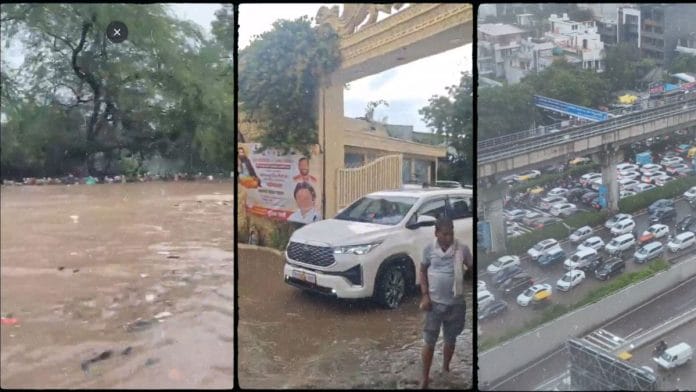

Gurugram: Like it does every year, one spell of rain floated Gurugram to the headlines Tuesday, and as is now usual, for all the wrong reasons. The big difference this time was that Chief Minister Nayab Singh Saini’s cavalcade did not escape the deluge.
Videos showed the chief minister’s convoy caught in a snarl on a waterlogged stretch near the city’s landmark Sheetla Mata temple as rain lashed the city late in the afternoon. By evening, the clips had taken pride of place amid the flotsam and jetsam of videos and reels depicting now-familiar sights from Gurugram’s monsoon season—stalled cars, wading commuters and hours-long jams on arterial roads.
The irony was not lost on residents or on social media. An X user posted that the chief minister had both seen and lived through the city’s waterlogging problem firsthand, even as the Municipal Corporation Gurugram (MCG) and the Gurugram Metropolitan Development Authority (GMDA) maintained that the city no longer floods.
सीएम नायब सिंह ने आज गुरुग्राम की जलभराव की समस्या देखी भी और झेली भी… ट्रैफिक जाम
मंगलवार शाम 4 बजे गुरुग्राम शहर में तेज बारिश हुई। इस बारिश के बाद #gurugram में वहीं पुरानी समस्या दिखी। वैसे @MunCorpGurugram और @OfficialGMDA के अधिकारियों के अनुसार जलभराव होता नहीं है pic.twitter.com/FG7zfuxMYX
— Ram khatana (@ram_khatana) August 4, 2026
Businessman and columnist Suhel Seth was more caustic, telling commuters heading into or out of the city to arrange for a boat, and thanking the administration for being “happily flooded” year after year despite the monsoon being an annual, predictable event.
Others flagged specific trouble spots. A social media user pointed to the ‘pahari wala rasta’ stretch submerged under water and free-floating garbage, tagging the deputy commissioner’s office and MCG. Another clip showing Gurugram grinding to a halt after barely an hour of rain, and captioned with a jibe at the ‘Millennium City’ tag, was widely shared through Tuesday evening.
State of pahari wala rasta in Gurgaon submerged in rubbish and water! Millennium city!
Dear @DC_Gurugram please have @MunCorpGurugram clear it. pic.twitter.com/VB0CDDLxs9
— Sanjoy K Roy (@SanjoyRoyTWA) August 4, 2026
Varun Sagar, who works with a travel tech company in the US, told ThePrint that it took him almost three hours to drive from Ambience Mall to Vatika Chowk on Sohna Road—a 25-minute commute in normal circumstances.
“I came to India to attend a wedding in a family in Gurugram scheduled later this month. On Tuesday, I decided to visit Ambience Mall with my wife and seven-year-old daughter. While we came out of the mall a little past four, the rain had almost stopped. However, it took us 2 hours and 40 minutes to cover a distance of 18 km from the mall to our apartments on Sohna Road, Gurugram,” he said, adding that he and his family will never forget this harrowing experience, and if ever he wrote an autobiography, this experience of his life will definitely appear in it.
Some videos borrowed a page from Bihar’s paper leak protests, where demonstrators had been filmed riding police barricades like makeshift scooters. In Gurugram Tuesday, similar clips showed residents sitting astride barricades and pushing themselves across flooded stretches—an improvised way to cross the water that echoed the Bihar visuals, minus the protest.
For a city that positions itself as the corporate face of Haryana, and contributes a large share of the state’s economic output, the recurring images have become an annual embarrassment. The chief minister’s experience has only come as the icing on this very messy cake.
Also Read: ‘Writing f*** off uncouth, but not sexual harassment’—HC quashes FIR against Gurugram firm director
Officials cite gains, but admit gaps
Contacted by ThePrint Wednesday, GMDA Chief Executive Officer P.C. Meena said the city’s waterlogging situation had improved considerably this year because of coordinated work between the GMDA, MCG and other departments.
He said the effort had centred on reviving Gurugram’s three main drains, which feed into the Najafgarh Drain—the city’s link to the Yamuna drainage system. Encroachments along these primary channels had been cleared this year, Meena said, though he acknowledged that some smaller drains were still encroached upon and would be taken up next.
A fourth drain, running from Vatika Chowk near Badshahpur towards NH-48 and Sector 37 before emptying into the Najafgarh drain, had also been made functional this year, Meena said, easing pressure on one of the older drains that had seen backflow in previous years.
He said a chronic jam point on NH-48 near Narsinghpur, long attributed to low-lying terrain, had been addressed this year by diverting water towards Khandsa village, though an early-monsoon jam at the same spot was, in his account, caused by ongoing construction work rather than flooding. A culvert is planned there before next year’s monsoon, he added.
Meena said he was unaware of the chief minister’s cavalcade being caught in traffic, but maintained that some stagnation of water for a few minutes after rain was unavoidable. He also cited a newly functional drain between Subhash Chowk and the Medanta underpass, and said surface drains this year were cleaned more rigorously, with contractor payments released only after camera verification and civic body councillors deployed to inspect the work. Around 50,000 new water traps had been addressed, he said, and the number of chronic waterlogging points had come down from 90 to five or six.
Gurugram Mayor Raj Rani Malhotra told ThePrint that the MCG’s focus this year had been on rainwater harvesting and reviving the city’s natural ponds. Of Gurugram’s 83 natural ponds, work had been carried out on 28 so far, she said, adding that this had made a visible difference to drainage.
On the videos of the chief minister’s convoy, Malhotra said they were shot near Sheetla Mata Temple after rain had already set in.
Meena added that new borewells for rainwater harvesting were being sanctioned only after aquifer studies conducted with the Indian Institute of Technology and Central housing ministry. The GMDA has also engaged Japanese consultancy Nippon Koei India Limited to prepare a plan for channelling excess rainwater from Nuh into Drain 8; that report is awaited.
Years in the making
The scenes on Tuesday were only the latest chapter in a crisis ThePrint has documented. Gurugram’s drainage troubles trace back to how the city itself was built — real estate came first, trunk infrastructure followed, if at all. Colonisers bought land from farmers and developers built housing colonies, while the task of laying external drains, sewer lines and master roads fell to the development authorities, funded by External Development Charges (EDC) collected from builders.
Urban planners and former officials have long pointed to a mismatch between what EDC funds were meant to achieve and what has actually been built on the ground, with large sums remaining unspent for years even as the city’s population multiplied several times over since the last census.
Encroachment compounded the problem. Natural ponds, seasonal streams and nullahs that once absorbed excess rain were built over during the real estate boom of the mid-2000s, planners have said, leaving the city with little natural capacity to soak up sudden downpours. Drains that were once wide and deep have shrunk over the years, squeezed by construction on either side.
With close to half-a-dozen agencies—the GMDA, MCG, the Haryana Shahari Vikas Pradhikaran (HSVP) and the National Highways Authority of India (NHAI) among them—sharing responsibility for different parts of the city’s infrastructure, accountability for any single stretch of waterlogged road has often proved hard to pin down.
Officials insist the numbers are moving in the right direction—chronic points down from dozens to single digits, three main drains desilted, a fourth made functional. But for commuters stuck for hours on Tuesday, and for a chief minister whose own convoy could not avoid the water, the recurring scenes suggest the gap between claims and ground reality persists.
(Edited by Nardeep Singh Dahiya)
Also Read: 226 sanctioned posts, shortfall of 44: Haryana’s IAS shortage set to worsen with 8 retirements