


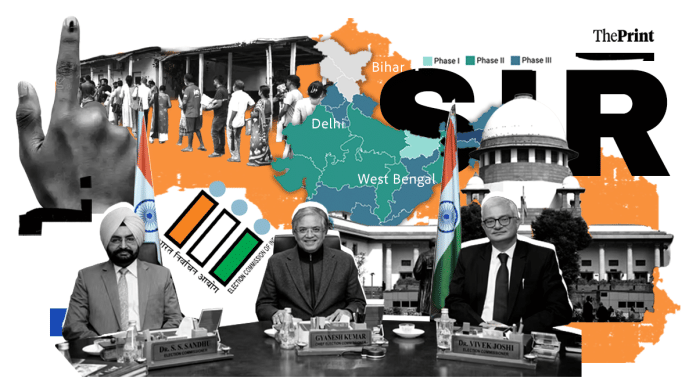
New Delhi: From orders pertaining to the Special Intensive Revision (SIR) of electoral rolls to the decision-making process, and appeals in West Bengal to the digital infrastructure of ECINET, Congress leader Rahul Gandhi and 10 other opposition leaders have sought the Supreme Court’s permission to serve 48 formal questions on the Election Commission of India (ECI).
The application has been filed on petitions challenging the decision-making process pertaining to the conduct of the Special Intensive revision (SIR) exercise, following an investigation by The Indian Express into the Commission’s functioning.
According to the investigation by The Indian Express, Election Commissioners Sukhbir Singh Sandhu and Vivek Joshi objected on record at least 14 times over 10 months to decisions being taken without keeping them in the loop. The investigation had raised several concerns over changes made in Form 6—which new voters have to fill—without adequate authority and had revealed chinks in the ECINET platform.
The commissioners even knocked on the Cabinet Secretary’s door on concerns over the integrity of voter software, according to the investigation. Questions also arose over the appeals filed in Bengal against inclusion of voters.
The ECI had responded to the petitions in a joint response filed on behalf of Chief Election Commissioner (CEC) Gyanesh Kumar and Election Commissioners Dr Sukhbir Singh Sandhu and Dr Vivek Joshi. A counter-affidavit was filed on 26 October, and another supplementary affidavit was filed on 14 November.
The application filed by the Opposition leaders on 16 November alleges that the ECI’s counter-affidavits rely on bare assertions while withholding crucial official files and records. The 48 questions now make references to these two affidavits, seeking more details on the submissions made by the ECI.
Every question lists the authority from whom the response is sought. Some of the questions are addressed to Deputy Election Commissioner Bhanu Prakash Yeturu who had filed the affidavits, while some seek responses from the Election Commissioners or the office of the Chief Electoral Officer of West Bengal, or Director General (Information Technology) Seema Khanna.
Having heard preliminary arguments of counsels representing Rahul Gandhi and the ECI, the three-judge bench of the Supreme Court hearing the case has given the ECI till 9 December to file its written objections or response explaining why it believes it should not have to answer the 48 interrogatories. The court will examine whether the Opposition’s questions are legally maintainable and relevant to the broader case regarding the SIR.
ThePrint breaks down the 48 questions posed by the Opposition to the ECI.
Also Read: All of the eight past SIRs upped the electorate. Why this is the only time voter numbers shrank
On ECI’s responses before Supreme Court
Part A and Part B of the interrogatories, including the first six questions, seeks responses from Deputy Election Commissioner Bhanu Prakash Yeturu, who filed the two affidavits in the Supreme Court.
It seeks his response on whether the submissions made in the affidavit were made from his personal knowledge. If not, he should identify the source of information, including personal records, and any persons he may have relied on.
It also seeks the date on which each of the Election Commissioners, Dr. Sukhbir Singh Sandhu and Dr. Vivek Joshi, approved the filing of the counter-affidavit, and the manner in which the approval was obtained— whether it was during a meeting of the commission, or on circulation of a file or through electronic means. Along with Yeturu’s response, the questions also demand a response from the Election Commissioners on the details of the approval granted by them.
On SIR orders and decision-making
Part C, with four questions, pertains to the decision taken by the ECI on conducting a Special Intensive Revision (SIR) throughout the country.
It seeks the number of the file in which the decision of the Commission was taken, the date of the decision, whether it was taken at a meeting, upon circulation of a file or through electronic means, and the date on which each member signified approval.
Two of the questions refer to the Right to Information application filed by Anjali Bhardwaj on 28 July 2025, seeking a copy of all the files through which the decision to initiate SIR across the country was approved by the ECI. The matter went up to the First Appellate Authority, the Principal Secretary of ECI who in his order stated, “Appellant is informed that the Commission has so far not taken any decision on initiating a Special Intensive Revision (SIR) across the country in 2025.” The Central Public Information Officer had also responded to the RTI, saying that no information in this regard was available with the Commission. Referring to these responses, the questions seek to know whether this statement was correct when it was made, and why the file pertaining to the decision on SIR was not disclosed under RTI.
On differences among Election Commissioners
Part D of the interrogatories asks six questions on the difference of opinion among the Election Commissioners, as highlighted by the Indian Express investigation in September this year.
It demands to know the number of occasions between 19 February 2025 and 26 October 2026 on which Sandhu and Joshi recorded in writing an objection, dissent or reservation concerning any matter relating to the SIR, ECINET , Form 6 or the filing of appeals. It seeks the date, file number and subject matter of each of these differences.
This part also seeks to know whether after these differences, the matter was decided unanimously or by majority under Section 18 of the Chief Election Commissioner and Other Election Commissioners (Appointment, Conditions of Service and Term of Office) Act 2023, or was not placed before the commission for decision. It further seeks to know whether any communication was issued in the name of the commission on such a matter, before the objection, dissent or reservation was resolved.
Section 18 of the 2023 law talks about the disposal of business within the Commission. Sub-section 1 says that the ECI may regulate the procedure for transaction of its business and allocation of its business among the CEC and ECs, “by unanimous decision”.
Sub-section 2 says that “all business of the Election Commission shall, as far as possible, be transacted unanimously”. It adds that if the CEC and other ECs differ in opinion on any matter, such matters shall be decided according to the opinion of the majority.
On work-allocation within the ECI, it seeks, among other things, details of the instruments through which certain powers were delegated to the CEC, as per Paragraph 13 of the 26 October affidavit.
Paragraph 13 had submitted that the constitutional, quasi-judicial and other important functions are directly under the ambit of the commission as a whole. However, at the same time, it said that “some powers are delegated to the Chief Election Commissioner (CEC) who also works as the Chairman of the Commission and some are delegated to the officers of the Commission who work under the supervision of the Commission/CEC”.
Questions have also been raised seeking details of the work allocation order issued on 28 July this year, which had prompted the two ECs to write to the Cabinet Secretary. As per the Indian Express investigation, the order in question was issued by Maneesh Garg, Senior Deputy Election Commissioner in the ECI, removing senior IAS officer Sanjay Kumar, who was serving as Deputy Election Commissioner in New Delhi, from overseeing the IT division’s work and routing its files to the three-member Commission. The two ECs had then written to the Cabinet Secretary, calling the work allocation order a “clear violation” of the law that governs the commission and asking for “appropriate action” against Garg.
The counter-affidavit issued by the ECI had submitted that in view of a joint direction issued by the two commissioners on 30 July, the work allocation order dated 28 July was never implemented. The questions now seek to know whether the CEC concurred in the joint direction, and whether any action was taken against Garg.
On appeals filed in West Bengal
Part E asks six questions on the appeals filed in West Bengal.
An affidavit filed by the Election Commission earlier this year before the Supreme Court said that there were 38 lakh appeals pending before the tribunals in Bengal to hear the appeals pertaining to the inclusion, exclusion or deletion of voters during the SIR.
It said 22.21 lakh appeals were filed by deleted voters seeking to be restored. The other 16.10 lakh were filed against voters the judicial officers had included, seeking their deletion.
According to the Indian Express article, Sandhu wrote to Commission officials in August, asking, “Who was authorised to file these appeals on behalf of EC, and by whom?” and “Who actually filed these appeals on behalf of ECI?” He recorded that neither he nor Joshi nor the West Bengal Chief Electoral Officer (CEO) was informed about the basis or process of filing the appeals.
Among other things, the 26 October affidavit filed by ECI says that as per a communication received from the West Bengal CEO, the appeals have been filed by the officers of that office, “in their capacity as authorities under The Representation of the People Act”.
The interrogatories now want details of these appeals— the total number, whether the appeals were filed with the “Election Commission of India” as the appellant, the name and designation of each officer who decided to institute those appeals and of each officer who signed or filed them, and any instruction, guideline, standard operating procedure or criterion for selecting the orders to be appealed against. It also seeks to know the status of the appeals, and whether the commission has taken any decision on whether to continue or withdraw them.
These responses have been sought from Yeturu, as well as the office of CEO, West Bengal.
On ECINET and ERONET
Part F asks 11 questions to DG(IT) Seema Khanna on ECINET and ERONET. ECINET is a mobile application that serves as a centralised digital platform for citizens and officials of the Election Commission of India. ERONET or Electoral Roll Management is a centralised web-based software system used by election officials in India to process voter registration, migration, correction, and deletion requests.
The Indian Express investigation had revealed several chinks in the ECINET platform, after which the commission announced that a committee headed by senior Deputy Election Commissioner (DEC) and including an independent expert from Indian Institute of Technology /Indian Institutes of Information Technology will review the ECINET to double-check that it complies with the provisions of the acts and rules and submit a report to the commission. Among other things, the application now asks whether this committee has been mandated to undertake a forensic examination of access logs and of alterations to electoral records since 24 June 2025, the time fixed for its report, and whether any report, interim or final, has been submitted.
The counter-affidavit of 26 October had said that various suggestions had been received for upgradation and improvement of the platform, and these alterations had “already been carried out by the operating authority”. The interrogatories now seek to know who this “operating authority” is, the date and file number of every decision of the Commission approving the design, architecture and deployment of ECINET for the preparation and revision of electoral rolls, and a list of every upgradation and alteration made in the platform since 24 June 2025, when the SIR was announced.
The questions also seek to know the categories of user accounts—whether at the level of the commission, Chief Electoral Officers, District Election Officers, Electoral Registration Officers, Assistant Electoral Registration Officers, Booth Level Officers or otherwise—that have the ability to add, delete, modify or restore entries in the electoral-roll database, or administrative or privileged access to it, and the number of accounts in each category as on 26 October.
It also seeks to know whether any person who is neither an officer or the commission nor any officer appointed under the Representation of the People Act 1950 has had administrative, privileged or write access to the production electoral-roll database. It further asks if the ECINET maintains an audit trail recording, for every addition, deletion, modification and restoration of an entry, the user account, the date and time, and the order of the Electoral Registration Officer under which it was made.
Additionally, the application asks whether any entry in the electoral rolls was added, deleted or modified otherwise than upon an order of an Electoral Registration Officer, including by means of any bulk, system-level, de-duplication or data-migration operation.
The Indian Express investigation had alleged that the centralisation of the electoral roll database ended up disenfranchising 97 potential voters in Goa. The commission told the Supreme Court that the Goa CEO had directed the concerned BLO to conduct house-to-house visits for left-out voters and to collect their forms. Following this, it said that 88 out of 97 voters had already filled Form 6 for inclusion and their applications had been accepted. The application now seeks to know how many of the 88 electors stated to have filed Form 6 were restored to their original entries and how many were enrolled afresh.
It further asks whether the proposal of Dr Vivek Joshi for an audit of the persons having access to, and the ability to alter, the electoral-roll database was placed before the commission, and whether any decision was taken on it.
On Form 6
Part G lists down 5 questions on Form 6.
The Indian Express investigation had raised several concerns over changes made in Form 6, which new voters have to fill, without adequate authority and had revealed chinks in the ECINET platform. The changes in Form 6 required applicants to choose one of three statements: whether their name appeared in the electoral roll during the last SIR held in the early 2000s, whether the name of a parent or grandparent appeared in that roll, or whether neither their name nor that of their parents appeared in it. However, this new declaration was removed a month after the investigation.
The interrogatories now seek to know the date on which this declaration was entered into the online page of Form 6, the officer or division that took that decision, and whether and when that decision was approved by the commission, identifying the file. It seeks to know whether any member objected to the incorporation of the declaration in the online Form 6, and the date of each objection and the manner in which it was dealt with.
Another question asks the number of Form 6 applications submitted online between the date on which the declaration was added to the form and 21 October, the number of applications rejected, kept pending or not processed on account of the non-furnishing of the declaration or of the mapping details sought.
Paragraph 54 of the counter affidavit had submitted that its ER (Electoral Roll) Division had decided on 21 October to split Form 6 and the declaration, separating the two. The affidavit says the SIR-related declaration had been placed inside Form 6 so that an applicant would generate a single One-Time Password (OTP) and a single e-signature rather than two, and that this “bona fide objective became a subject matter of deliberation and suggestions”. The affidavit had added that the 21 October decision of the ER division had said that as in the case of submitting the application in Form 6 in a physical format, the online Application shall also be in two parts i.e. Form 6 as prescribed in the rules and the SIR declaration.
The interrogatories now ask whether this 21 October decision was placed before, or approved by, the commission.
Paragraph 34 of the counter affidavit had said that considering the mammoth exercise of revision of electoral rolls, “there were certain steps taken by the officers to whom responsibilities had been assigned, which needed to be corrected to ensure that they are fully aligned with the steps approved by the Election Commission”. One of the questions refers to this submission, and seeks to identify these officers whose steps needed to be corrected, and the “the steps approved by the Election Commission” with which they were to be aligned.
On deletions and objections in Form 7
Part H poses two questions to the commission on the objections filed through Form 7 on the proposed inclusion or deletion of a name in the existing electoral roll.
In respect of all states and Union Territories where the final electoral roll has been published, one of the questions seeks to know the number of electors on the electoral roll immediately preceding the SIR whose names were not included in the draft roll, and (b) the number of electors included in the draft roll whose names were not included in the final roll, in each case with a break-up by reason (dead, shifted, absent, duplicate, ineligible or other) and by gender.
The second question seeks to know the number of objections in Form 7 received during the SIR; the number of instances in which a single objector or booth-level agent filed objections in excess of the limits prescribed by the commission; the number of objections found to be false or to have been filed in the names of non-existent persons; and the action, if any, taken under Section 31 of the Representation of the People Act 1950.
Section 31 of the 1950 law prescribes one year of imprisonment or a fine or both for any person who makes false declarations in connection with the preparation, revision or correction of an electoral roll, or the inclusion or exclusion of any entry in or from an electoral roll.
Also Read: Rahul Gandhi & his besties should verify electoral rolls instead of wasting time protesting
On the supplementary affidavit
Part I asks seven questions on several submissions made by the ECI in its supplementary affidavit dated 14 November.
On 4 November, the ECI had issued a new work allocation order which, among other things, reaffirmed the oversight layer over DG (IT) Seema Khanna. This was the layer of oversight that was sought to be removed by the 28 July work allocation order that ECI had said was never implemented. In the counter affidavit, the ECI had said that the internal work allocation in the commission has been continuing as per the arrangement in an office order dated 23 September 2025. In the supplementary affidavit, the commission made reference to this 4 November order, saying that on the joining of a new Deputy Election Commissioner on 2 November, it became necessary to issue a new work order. This, it said, was issued with the approval of the commission.
One of the questions now asks the identification of the record evidencing “the approval of the Commission” to the 4 November office order, with the date on which each member signified approval, and furnish the number and date of every amendment made “from time to time” to the original office order dated 23 September 2025.
Paragraph 5 of the supplementary affidavit had said the oversight on the work of the Information Technology/Information and Communications Technology (IT/ICT) division by a Deputy Election Commissioner has continued, on account of the new work order dated 4 November as well. The question now seeks to know the date from which the Director General (IT) has put up the files of the IT/ICT Division before the Commission through a Senior Deputy Election Commissioner. It also seeks identification of each officer who oversaw the IT/ICT Division during the period from 24 June last year to 4 November, and state whether, before 26 October, every new initiative concerning IT modules and portals was placed before the commission for approval, identifying the files in which such approvals are recorded.
On 3 November, the ECI wrote to all Chief Electoral Officers of states and Union Territories, clarifying that no prosecution will be launched against anyone for filing Form 6 merely on the ground that the applicant or elector was previously enrolled in the electoral rolls prior to SIR. Question 43 now asks whether this letter was issued pursuant to a decision of the commission, identifying the decision by date and file number; and whether any proposal has been made to the Central government for the amendment of the declaration prescribed in Form 6, as it applies to previously enrolled electors whose names were not included in the draft roll, with particulars.
The next question seeks to know whether an elector who was enrolled before the SIR and is included in the final roll upon an application in Form 6 is assigned the same Electoral Photo Identity Card (EPIC) number as was previously assigned to that elector. If not, it seeks to know the number of such electors in each state and Union Territory.
Another letter was addressed to the Chief Electoral Officers of the National Capital Territory (NCT) of Delhi, Maharashtra, Haryana, Andhra Pradesh, Jharkhand, Telangana and Nagaland, on 6 November. This letter conveyed the commission’s decision that the electors who were issued enumeration forms but whose names could not be included in the Draft Electoral Roll on account of being marked as ASDD (Absent, Shifted, Dead and Duplicate) shall be provided one more opportunity to get their names included in the Final Electoral Roll. Question 45 now asks whether a similar opportunity has been, or is proposed to be, afforded to electors marked as absent, shifted, dead or duplicate in the states and Union Territories in which the final electoral roll under the SIR has already been published.
Questions 46 and 47 pertain to this letter dated 6 November. It seeks to know, among other things, the number of electors marked as absent, shifted, dead or duplicate in each state and Union Territory to which this letter was addressed; and the particulars of every action-taken report received under it.
The 6 November letter had also said that partially filled enumeration forms in respect of all such ASDD electors shall be generated afresh in the ERO dashboard of ECINET. Additionally, this letter was copied to DG(IT) for making “necessary provisions”. Question 47 now seeks to know the changes made to ECINET for implementing that letter, the dates on which they were made, and the authority by which they were approved.
On approvals
Paragraph 29 of the counter affidavit had said that in situations involving exigencies, “an approval of the members of the Election Commission is obtained through electronic means, and the same is duly recorded later on the official file”.
The final question in the application seeks identification of the electronic means so employed, stating whether approvals were sought or conveyed by official e-mail, personal e-mail, WhatsApp or any other messaging application, the e-Office system, or any other channel. It also seeks to know the number of occasions since 24 June 2025 on which a decision relating to the SIR, ECINET, Form 6 or the filing of appeals was approved through such electronic means, with the date of each approval and the date on which it was recorded on the official file. The question further demands to know whether the use of such electronic means is governed by any written policy, protocol or decision of the commission; and whether the electronic communications by which such approvals were sought and conveyed, and the logs and metadata relating to them, have been preserved, identifying the person by whom and the place or system in which they are held, and stating whether any of them has been deleted or is subject to automatic deletion.
(Edited by Nardeep Singh Dahiya)
Also Read: Who is a citizen in India? The answer will determine who has rights