



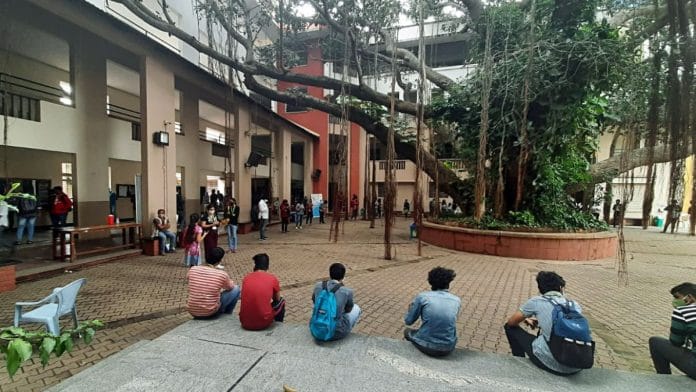
Bengaluru: After a gap of 37 years, Karnataka’s D.K. Shivakumar-led Congress government has approved student body elections in the state’s educational institutions from the 2026-27 academic year.
Student elections were last held in the state in 1989-90, after which the Veerendra Patil-led Congress government banned them. The move to restart is seen as an extension of efforts by all political parties, including the Bharatiya Janata Party (BJP) and Congress, to woo the Gen Z.
“We (the government) had banned this, but now we have decided to restart it,” said Karnataka Deputy Chief Minister G. Parameshwara.
Why were the elections banned in the first place? The answer depends on whom you ask.
Restricting new political faces from emerging, promoting family members or loyalists, containing BJP’s rise and uncontrollable campus violence were among the key reasons why student polls were banned in Karnataka nearly four decades ago. “Student elections were banned because some senior leaders with feudal mindsets and dominating groups did not want new faces to emerge,” said a senior Congress leader, requesting anonymity.
The BJP welcomed the move to resume college elections, but offered a different reason for why the practice was stopped.
“At the time (1980s), the Congress was strong and in power. But it was also the time that the ABVP (Akhil Bharatiya Vidyarthi Parishad) was winning college elections and Congress did not want the BJP to gain out of this,” N. Ravi Kumar, BJP MLC and Opposition chief whip in the Karnataka legislative council, told ThePrint.
“This is why they banned student elections,” added Kumar, who served as president of Government B.Ed College in Chitradurga in 1989.
There is also a perception that the decision by the government will help revive the sagging fortunes of the National Students’ Union of India (NSUI), Congress’s student wing, in Karnataka, which has ceded space to the Rashtriya Swayamsevak Sangh-backed ABVP and other left-leaning groups in recent years, political leaders say.
Under the new system, student bodies will have one student president, two vice presidents, one general secretary, two joint secretaries and six executive committee members.
Parameshwara said that of the two vice president posts and two joint secretary posts, one each would be reserved for women, as would two positions on the executive committee.
The latest version of these elections will have gender-based reservations, not caste-based ones. “We consciously wanted to keep caste and religion away from students,” the deputy CM said.
However, people aware of the developments say more changes or tweaks are expected, as colleges and universities are yet to embrace this idea.
Parameshwara said that it is up to the students to decide if they want elections or not and the management must act accordingly.
Lok Sabha Leader of Opposition Rahul Gandhi had approved the restart of these elections in July last year, ThePrint had reported.
Also Read: From footpaths to garbage: Minister Gowda faces Bengaluru’s tangled web of civic crises and politics
‘Colleges became hotbed of violence’
For decades, elections in colleges and universities were one of the few avenues for youngsters to enter politics.
Nationally, leaders like Arun Jaitley, Sitaram Yechury, Lalu Prasad Yadav, Ananth Kumar, Ajay Maken and Ashok Gehlot, among others, all came up through student movements.
In Karnataka, Shivakumar, incumbent state Congress president B.K. Hariprasad, legislative council chairperson Saleem Ahmed, Ramalinga Reddy, N. Ravi Kumar of the BJP and several others from the state have risen through student politics.
In the 1970s and 1980s, student elections in several parts of Karnataka, especially Bengaluru, frequently turned violent.
“Threats, intimidation, ragging, and even murders have taken place between rival gangs in colleges at the time. Noted rowdies like Kotwal Ramachandra and Jairaj, among others, were all linked to college elections where students used to identify with these rowdies to seek votes and inflict fear and violence on campuses,” B.B. Ashok Kumar, a retired Assistant Commissioner of Police, told ThePrint.
He said that the popular Kannada movie Om, starring Shivarajkumar, which gained cult status over time, was based on the life of a student who was chased and murdered near Bengaluru’s Kurubara Hostel locality in the early 1980s.
This storyline has become a genre of sorts in the Kannada movie industry, with several former and reformed criminal elements now recounting their roles during such elections as well as the larger underworld-student nexus in Bengaluru.
Several people familiar with that period said that these college campuses became recruiting grounds for the underworld, which would often get involved in student-related issues, including backing candidates during elections.
Shivakumar himself has mentioned the influence of rowdy elements during college elections during his time in Bengaluru’s Sri Jagadguru Renukacharya College of Science, Arts and Commerce, or RC College.
He has denied having any links with these anti-social elements, reiterating that he has come up through the ranks of the Congress-affiliated National Students Union of India or NSUI.
Hariprasad, who served as president of Bengaluru’s MES College in 1973-74, said that restarting college elections is a good way to bring youngsters into mainstream politics.
He, however, delinked the party’s outreach to Gen Z with the latest announcement.
“Gen Z engagement is just about three months old. I have been trying to restart college elections for the past two years. College elections will not be fought under any party banner. They will be independent,” he said.
(Edited by Sugita Katyal)
Also Read: In Karnataka, CM DK Shivakumar aims to take ‘govt to citizens’ doorstep’ with new ‘Praja Seva’ drive