



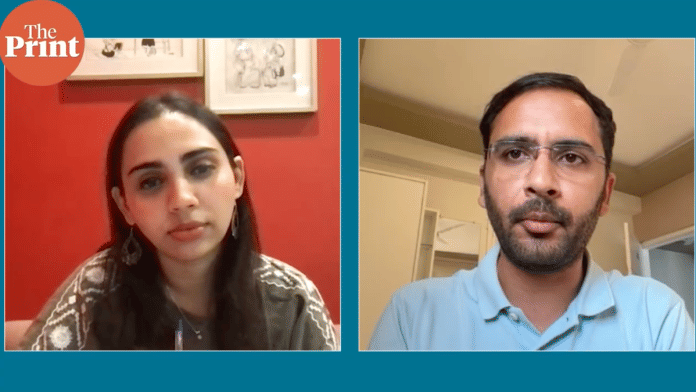
New Delhi: The Cockroach Janta Party will continue to function as an independent political pressure group, while keeping open the possibility of entering electoral politics, according to CJP co-convener Ashutosh Ranka.
In an interview with ThePrint, Ranka said the CJP’s current model of putting pressure on governments from outside the electoral system had proved effective.
“I want to be honest. I’m not saying that in life we will never do anything or in life we 100 percent will do it. The current visibility, the current understanding that we have developed, that has shown that our current model is very effective. We have been able to change things around in this country by being an independent pressure group. So for now, we want to continue this way,” he said.
“But I don’t know what the circumstances will be one year from now, two years from now. So why should I mislead the public into saying something which probably you are not? So there is never a no for us.”
Ranka described the CJP as a “political pressure group”, suggesting that politics could not be separated from issues such as education, healthcare and infrastructure.
“A political party contests elections. We don’t. Today, we are a political pressure group. Democracy is not just about elections. Democracy is also about the everyday struggle of people, about holding people in power accountable,” he said, elaborating on the CJP’s identity.
“Everything in this country is political. The air we breathe, the water we drink, the roads we walk on, the hospitals we access, the schools in which our children study — everything is being determined by the politics of this country, by the government of this country.”
From School Theek Karo to Gyanesh Kumar
The CJP, which began with its ‘School Theek Karo’ campaign following its Jantar Mantar protest that culminated in the resignation of Education Minister Dharmendra Pradhan, has now shifted its focus to Chief Election Commissioner Gyanesh Kumar and the Election Commission.
The outfit has demanded Kumar’s resignation and warned of nationwide protests from 2 October if he does not step down. It has also opposed the Special Intensive Revision (SIR) of electoral rolls and demanded the restoration of voters it says have been wrongly removed.
“School Theek Karo, the resignation of Dharmendra Pradhan, today Gyanesh Kumar’s resignation, the reforms in the Election Commission; everything is about one thing, which is accountability,” he said. “You have to make people responsible for the work they are doing. If something goes wrong, there have to be consequences.”
The electoral issue, according to the CJP co-convener, has become particularly important because the people could not hold governments accountable if they did not have confidence in the electoral process.
“If people are frustrated with bad schools, they want to change the government. It doesn’t matter, BJP and Congress and Aam Aadmi Party. If they want to change the government because the government has not been able to fix schools, but if the outcome is fixed, how does this campaign even matter?” he said.
“If these things can’t initiate political changes, if the people want to vote out those in power, if the people want to hold dissent against those in power, but that is just simply not possible, then none of this eventually matters.”
‘Elections are rigged’
Ranka asserted that the SIR exercise resulted in the deletion of 13 crore voters nationally. Referring to the experience of appeals in West Bengal, he said a large proportion of those removed could be genuine voters.
“If I were to extrapolate this number, that would mean that out of 13 crore, around 12 crore people are actually genuine registered citizens of this country who have been denied the right to vote.”
He argued that the burden of proving eligibility falls disproportionately on poorer voters.
“People like (AAP-turned-BJP turncoat) Raghav Chadha, maybe the Election Commission will come to their house. But what about the poor person who has to go to a tribunal three times? He has to travel, he has to spend money, he has to lose his daily wage.”
Also Read: CJP ‘school audit’ jolts Saini govt into action. Haryana orders demolition of 2,814 structures
‘I was in AAP. When have I denied it?’
The CJP’s political positioning has come under scrutiny because several members of its core group have had links with the Aam Aadmi Party. Ranka himself has previously been associated with the AAP like CJP founder Abhijeet Dipke.
“I’m not Raghav Chadha. Who will go and delete the tweets? I have been very open. I was in the Aam Aadmi Party. When have I denied it?” he said. “I have written articles for ThePrint, I have written for The Wire, I was a spokesperson, I used to go on news panels, I handled WhatsApp in 2020. I have always said that I was in the Aam Aadmi Party. I have never denied it.”
The CJP, he said, had deliberately separated itself from the AAP.
“After the CJP started, we made a very clear distinction between what we wanted to stand for and what other political parties, including the Aam Aadmi Party, stood for. We made a very clear distinction that today we are an independent, neutral political force.”
He rejected the argument that previous political affiliations should prevent the people from participating in the CJP’s campaigns.
“Who is stopping people who want to work on education from joining? Who is stopping them? If somebody has worked in AAP and today wants to work on education, why should he not be allowed to work?”
Soft approach in Punjab?
The AAP connection has also fuelled criticism of the CJP’s campaign in Punjab, where its team visited government schools, including a School of Eminence. Congress leader Sachin Pilot has questioned whether the CJP was applying the same scrutiny to Punjab that it had shown elsewhere. The AAP-ruled Punjab is scheduled to go to the polls in early 2027.
But, Ranka rejected the suggestion that the CJP had been soft on the AAP-ruled Punjab.
“Saurav showed bad schools also. Saurav has shown those schools also. But why will that clip not run? Again, you see the video. You open the entire video. School of Eminence was shown. After that Saurav showed four schools in rural areas where the condition is bad,” he said.
“If you are saying that we only showed the School of Eminence, the first thing is that good schools anywhere in the country should be shown. We will absolutely show them. We have openly invited everybody to tell us — you also tell us.”
Ranka said the same approach had been followed in Karnataka and Maharashtra.
“Karnataka’s education minister reached out to us. We absolutely went and met him. He actually showed us the presentation of the KPS (Karnataka Public School) model. There was a detailed discussion around the KPS initiative,” he said.
“We met the education minister of Maharashtra. But then why is the entire discussion restricted to what our meeting with the education minister of Punjab was?”
The CJP, he said, would also visit government schools run by BJP governments.
“(Uttar Pradesh Chief Minister)Yogi ji should also tell us that he must have built 10 good schools. Show us. Who is stopping him? Karnataka’s education minister will talk about KPS schools, we will absolutely talk about them. Punjab’s minister will talk, we will absolutely talk. Why won’t we?”
‘80% of education problems can be solved’
The CJP has documented more than 200 paper leaks over two decades, according to Ranka, who questioned why the examination system was able to successfully conduct tests such as Joint Entrance Examination (JEE) while repeatedly facing problems with other examinations.
“The same system is able to conduct IIT-JEE exams quite well. The same system is able to conduct CAT (Common Admission Test) quite well. The same system is conducting the UPSC exams flawlessly for all these years. But why is this system failing in almost every other exam?”
He said the problem was visible across the government-school system, where officials were aware of shortages and infrastructure gaps.
“Everybody knows infrastructure is screwed. Everybody knows which school has how many teachers. Everybody knows whether the books have reached in time. Everybody knows which buildings are dilapidated, which toilets are not functioning. It’s just that they have never feared that there will be consequences,” he said.
“If you fix accountability, 80 per cent of the problems in the education system can be solved.”
Ranka pointed to government spending on education as an indicator of political intent, saying education expenditure was around 2.1 per cent of GDP while the NITI Aayog reports have recommended higher levels of spending.
Opposition outreach
Ranka revealed that the CJP had been in communication with several opposition leaders, including Rahul Gandhi, Arvind Kejriwal, Mamata Banerjee, Akhilesh Yadav, and Pinarayi Vijayan.
“The same communication has been there with Rahul Gandhi as well. We have had the same communication with all the opposition leaders — Rahul Gandhi, Arvind Kejriwal, Mamata Banerjee, Akhilesh Yadav, Pinarayi Vijayan,” he said.
Asked why Rahul did not attend the CJP’s Jantar Mantar protest despite an earlier plan to visit, Ranka said: “That’s a question we should ask Rahul Gandhi. How can I answer that?”
He said cooperation between the CJP and opposition parties did not necessarily mean sharing a common platform.
“Working together doesn’t mean that everybody has to be on one platform. Today, if I’m not wrong, there was a protest by different Left parties. There were people from other political parties as well. Indian Youth Congress had a protest. Today also Congress had a protest,” he said.
“Everyone is working in one direction. Everyone can have a different approach. In fact, in a flourishing democracy, there will be 10 different approaches.”
(Edited by Tony Rai)
They have AAP written all over them. If they form a political party, it will directly cut into the vote base of the AAP.
By now, it’s clear that they are acting as a front organisation of Arvind Kejriwal. The facade of being apolitical has been unmasked over and over again.
The strategy is quite simple. Act as an apolitical NGO and create conditions favourable for the AAP to flourish, and hopefully, return to power in Delhi.
It would be much better if they enter the electoral fray which would make them more responsible.
A bunch of selfish opportunists – that’s what these people are.
When it suited them – because they thought they could win elections everywhere and eventually govern India – they formed a political party. When AAP failed everywhere except Delhi and Punjab – again and again, eventually losing Delhi as well – they realised that electoral politics is not really their cup of tea.
So they came up with the idea of an apolitical pressure group – the CJP. Just like the Anna movement which tapped into youth frustration and anger, they too wanted to curry favour with Gen Z voters – whatever that term means. All they ended up doing is provide a convenient space for idiots to make Insta reels and for influencers to farm fame and following. One of them, Rhiya Ahir, is all set to make her debut in Big Boss – beside, she seems to have switched to Team Rahul.
Basically, a group of vultures looking to further their own careers and fortunes – trying to put up a facade of intellectual superiority and moral authority.
In my own state, under the TMC government, massive corruption and irregularities took place in teacher appointment – right from the primary schools to the colleges and universities. And yet, these vultures chose to look the other way – never speaking even a word on this.