



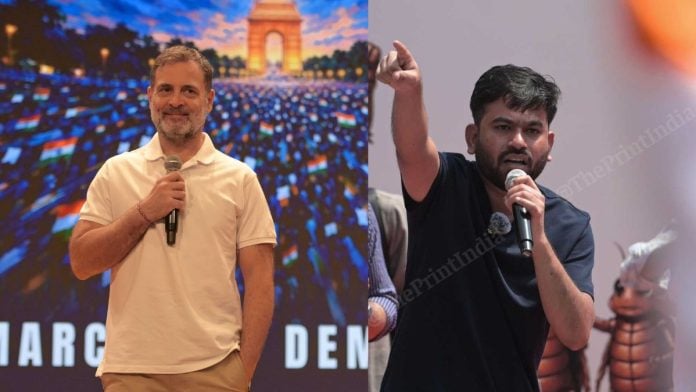
New Delhi: Having kept its distance from the pressure group until recently, the Congress now appears to be warming up to the Cockroach Janta Party (CJP), with Rahul Gandhi inviting founder Abhijeet Dipke for a high tea with INDIA bloc leaders and civil society groups, and criticising the arrest of CJP leaders by Delhi Police.
Sources in the INDIA bloc told ThePrint that Dipke reached out to opposition parties the morning after CJP leaders Ashutosh Ranka, Saurav Das and Ajinkya Shinde were arrested for allegedly trespassing at Jantar Mantar, delisted as a protest site by the home ministry.
The outreach marked a departure from Dipke’s earlier position that he “does not need the support of political parties”.
Rahul Gandhi subsequently opposed the arrest of CJP leaders in a post on ‘X’, drawing a response from Dipke who thanked the Leader of Opposition in the Lok Sabha. Earlier this week, Rahul Gandhi had categorically stated that “all protests are one” and there were “no parallel protests” in the fight to protect the Constitution.
Senior Congress leader and advocate Vivek Tankha described the shift as gradual, saying the party was not absent from the movement even before the outreach. “This has been a gradual process; it’s not as though the Congress has been completely absent from the movement. I have been the lawyer for Sonam Wangchuk, and we have had close ties. Pawan Khera has visited Jantar Mantar, as have other Congress leaders,” he told ThePrint.
Tankha added, “This is a youth movement, and it goes beyond the CJP. School and college students are also part of it. The Congress is not here to oppose the youth in any way; they need our support, and we are here to give it to them. Saurav Das also retweeted in our support. The Congress inviting them for high tea was also an icebreaker.”
Alka Lamba, who heads the Congress party’s women’s wing, said the response to Rahul Gandhi’s ‘Satyagrah’ campaign revealed that civil society groups, including those other than the CJP, wanted Rahul Gandhi to lend his support to the movement.
“Rahul ji has been fighting for the students, the Satyagrah campaign saw a response from many people, not just NGOs but many civil society groups as well, Rahul ji stands with the youth of the country. Chhatron Ki Goonj and his protests have also been happening,” she told ThePrint.
Yogendra Yadav, who has maintained close ties with both civil society groups and the INDIA bloc, had advocated that the Congress support the CJP, it is learnt.
Yogendra Yadav acted as bridge
According to a Congress source, it was Yogendra Yadav who helped along coordination between the Congress and the CJP.
Yadav told ThePrint, “I can only welcome this convergence of all streams of protest, especially the Congress and the CJP. The movement has so far been a case of spontaneous synchronisation, but there is a beginning of some coordination now.
“We should not look for ‘natural allies’ in politics; nor should we expect perfect harmony going forward. But our goal is the same and so is our fight.”
The Congress’ outreach came after INDIA bloc allies, particularly the Mamata All India Trinamool Congress and Left parties, rallied behind the CJP. Former West Bengal chief minister Mamata Banerjee and party colleagues had also staged protests in solidarity with the CJP on the day Ranka, Das and Shinde were detained and subsequently arrested.
CPI(M) general secretary M.A. Baby and CPI(ML) Liberation general secretary Dipankar Bhattacharya, too, had urged the INDIA bloc to keep the “cockroaches” close, saying they shared a common goal, it is learnt.
‘The real question is…’
The Congress had been running its own campaign to highlight students’ concerns. On 10 October, when much of INDIA bloc was in Delhi supporting the CJP’s call for a protest at Jantar Mantar, Rahul Gandhi was in Chennai for his flagship Chhatron Ki Goonj programme.
Political analyst Rasheed Kidwai said the outreach reflects a broader challenge for the Congress: working with independent groups without trying to give direction to their movements.
“Rahul Gandhi seems to understand that if the Congress alone leads a movement, the BJP can easily dismiss it as a political confrontation between two parties, but when students, women, lawyers, civil rights organisations and independent activists come together, it becomes much harder to dismiss the agitation as partisan politics,” Kidwai told ThePrint.
Adding, “The problem is that the Congress has to learn to work with people who do not necessarily subscribe to its ideology or accept its leadership. Rahul may be comfortable with this kind of politics, but the Congress is still a party accustomed to hierarchy, established leadership and organisational control. The real question is whether it can accommodate these independent voices without trying to take ownership of their movement.”
Congress’ earlier reservations
The Congress had earlier drawn a distinction between political parties and civil society-led movements.
In July, Congress general secretary Jairam Ramesh had told ThePrint: “We are a political party. Movements come and movements go, but you need to be serious players in the political system. We have nothing against them, but they are not a political party.”
A Congress office-bearer, speaking on condition of anonymity, had also asked why the Congress should have backed the CJP any earlier when Dipke had criticised Gandhi in the past. “Until a few months ago, (Abhijeet) Dipke was criticising Rahul Gandhi. Why should we suddenly support his movement? Congress has already started ‘Chhatron Ki Goonj’, which is raising the same issues on a much bigger scale. So why should we share the stage?”
The Congress office-bearer had also questioned the CJP’s political trajectory. “Dipke comes from the AAP. How do we know this will not become AAP 2.0? If that happens, it will go against our own politics.”
Clarifying the Congress’ change in stance, Tankha told ThePrint: “Even today, the movements remain separate, but the goal is the same. We are fighting for the same issues. The Congress stands with the youth of the country in any and all ways.”
(Edited by Amrtansh Arora)
Also Read: CJP protest was ‘high drama’ for TV, papers and digital news—detentions, clashes, lockdown