



New Delhi: Twenty-three years after it was notified as a designated protest site, Delhi’s Jantar Mantar has been removed from the list of venues where demonstrations are officially permitted. The Ministry of Home Affairs’ (MHA) decision, announced by Delhi Police on Monday, follows three days of protests in the national capital demanding Chief Election Commissioner (CEC) Gyanesh Kumar’s resignation.
For more than two decades, the stretch of road beside the 18th-century astronomical observatory has been one of Delhi’s most recognisable spaces for political dissent. It has drawn anti-corruption campaigners, protesting farmers, students, retired military personnel and even Olympic medallists demanding action against alleged sexual harassment.
Now, following a Supreme Court suggestion to explore alternative venues, Delhi Police has named three grounds for future demonstrations: Ramlila Maidan in central Delhi, Burari Ground in the north and CBD Ground in the east.
On Friday, a Supreme Court bench led by Chief Justice of India (CJI) Surya Kant, along with Justices Joymalya Bagchi and V. Mohana, suggested that the Centre and Delhi authorities consider an alternative venue where protesters could assemble peacefully and access basic amenities.
The suggestion came during a hearing on restrictions imposed on public transport ahead of the Cockroach Janta Party’s (CJP) protest on 10 October. The CJI orally observed that Jantar Mantar’s “geographical location” warranted consideration of an alternative site.
In Monday’s order, Delhi Police Commissioner Anurag Kumar said the MHA had constituted a committee to examine alternative venues for citizens to exercise their right to organise protests in place of the existing “designated site”. Acting on the committee’s recommendations, the police removed Jantar Mantar from the list of designated sites.
The three alternatives are considerably farther from Parliament. Ramlila Maidan is about 4 km away, while Burari Ground lies roughly 18–20 km away and CBD Ground about 13 km away.
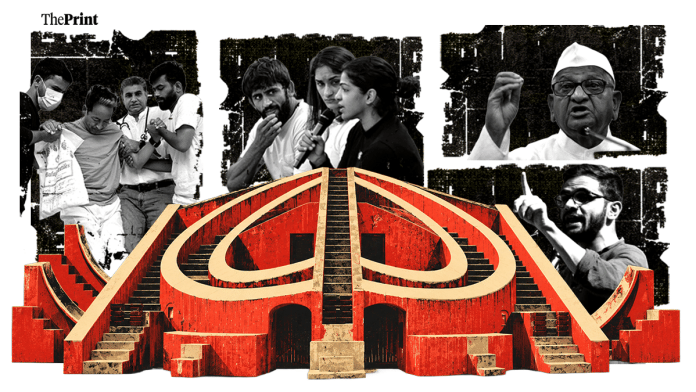
As the relocation reignites questions about peaceful assembly and policing, ThePrint looks at how Jantar Mantar became Delhi’s principal protest hub—and the movements that made it a landmark of dissent.
Also Read: CJP protest was ‘high drama’ for TV, papers and digital news—detentions, clashes, lockdown
Before Jantar Mantar
Until the late 1980s, the Boat Club near India Gate, now Kartavya Path, was Delhi’s principal venue for protests and political rallies, earning it the moniker “Resistance Square”.
A defining moment came in October 1988, when Bharatiya Kisan Union (BKU) leader Mahendra Singh Tikait led a massive farmers’ agitation in the capital. Nearly five lakh farmers gathered at the Boat Club and surrounding lawns, bringing much of central Delhi to a standstill.
The agitation ended after the then Rajiv Gandhi government gave assurances on farmers’ demands, including electricity charges and sugarcane prices.
Following Tikait’s agitation, the government cited security concerns, including the Boat Club’s proximity to the Prime Minister’s Office and the Finance and External Affairs ministries, as reasons to move protests away from key government offices in Lutyens’ Delhi.
Demonstrations gradually shifted away from the Boat Club, but Jantar Mantar was formally designated a “protest site” only in 2003, with a cap of 5,000 people and a prohibition on organisers bringing vehicles into the area.
Protests that defined Jantar Mantar
Among the most consequential protests associated with Jantar Mantar was the 2011 anti-corruption movement led by social activist Anna Hazare. He began an indefinite fast at Jantar Mantar in April 2011, demanding the enactment of a stronger Jan Lokpal law to investigate corruption in public office.
The agitation soon expanded beyond Jantar Mantar and moved to Ramlila Maidan after the crowd increased above the stipulated 5,000 protesters. The movement drew a host of prominent figures to Ramlila Maidan, including Arvind Kejriwal, Shanti Bhushan, Prashant Bhushan, Kiran Bedi, Ram Jethmalani, Medha Patkar, Swami Agnivesh, Col. Devinder Sehrawat, Sunita Godara, Harsh Mander, the Archbishop of Delhi and Justice D. S. Tewatia.
The protests captured national attention, prompting the then government at the Centre to agree to form a joint drafting committee comprising ministers and civil society representatives to prepare the Lokpal Bill. The movement also paved the way for the formation of the Aam Aadmi Party (AAP) in 2012, which went on to form the government in Delhi in 2013.
In December 2012, the gang rape of a 23-year-old student on a moving bus in Delhi triggered widespread protests across the capital. Jantar Mantar became one of the gathering points for students and young people demanding justice, stronger laws against sexual violence and better protection for women.
The Nirbhaya protests formed part of a broader national outcry that prompted the government to overhaul sexual assault laws via an amendment in 2013.
In 2017, farmers from Tamil Nadu led by activist P. Ayyakannu staged a protest for over 100 days at Jantar Mantar to draw attention to agrarian distress following the worst drought the state had seen in 140 years.
The agitation was temporarily suspended in April 2017 after Tamil Nadu Chief Minister Edappadi K. Palaniswami met the farmers and gave assurances on their concerns. The protesters later returned, saying their demands had not been adequately addressed.
Jantar Mantar also became a focal point for retired military personnel campaigning for the implementation of One Rank One Pension (OROP). Under the banner of the Indian Ex-Servicemen Movement (IESM), veterans began a hunger strike at the site in 2015 demanding a uniform pension framework for retirees of the same rank and length of service, irrespective of when they retired. Colonel (Retd) Pushpender Singh was among the veterans who undertook a hunger strike during the agitation.
During the protests against the Citizenship (Amendment) Act (CAA) and the proposed National Register of Citizens (NRC) in 2019 and 2020, Jantar Mantar again served as a gathering point for demonstrators.
In 2023, Olympic medallists and other prominent Indian wrestlers staged a month-long sit-in at Jantar Mantar, demanding action against then Wrestling Federation of India president and BJP MP Brij Bhushan Sharan Singh over allegations of sexual harassment. The protest was led by wrestlers including Vinesh Phogat, Sakshi Malik and Bajrang Punia.
In June and July this year, Jantar Mantar became a focal point for a youth-led agitation over alleged examination paper leaks in the 2026 NEET-UG exam. The CJP launched a protest calling for the resignation of then Education Minister Dharmendra Pradhan.
Days after the protest began, climate activist Sonam Wangchuk declared himself an “honorary cockroach” and went on an indefinite hunger strike at the site in solidarity with the students.
The five-week-long agitation ended with Pradhan’s resignation, while Prime Minister Narendra Modi promised fast-track courts to address academic fraud and a stringent new law to curb paper leaks.
For the ‘Jantar Mantar 2.0’ agitation, however, heavy police deployment, road barricades and metro station closures have largely prevented protesters from gathering at the site, despite calls for demonstrations by the CJP and student organisations. Protesters have instead spilled over to other locations, including Connaught Place and Dilli Haat.
2017 ban and SC’s intervention
In October 2017, a National Green Tribunal (NGT) bench headed by Justice R.S. Rathore ordered authorities to stop demonstrations, public speeches and the use of loudspeakers along Jantar Mantar Road. The order followed a complaint by local residents, who argued that prolonged protests caused noise pollution, waste and disruption to residential life. The tribunal directed authorities to move protesters to Ramlila Maidan.
The decision was overturned by the Supreme Court following an appeal by activist groups. In July 2018, the top court ruled that a blanket ban on demonstrations at Jantar Mantar was unconstitutional, as it effectively extinguished the fundamental right to peaceful assembly. It directed authorities to balance residents’ right to peace and quiet with protesters’ right to dissent through reasonable regulations, such as limits on crowd sizes and protest timings, rather than imposing an outright ban.
(Edited by Chingkheinganbi Mayengbam)
Also Read: Delhi shuts for CJP Jantar Mantar protest. 5 times it became security fortress before