



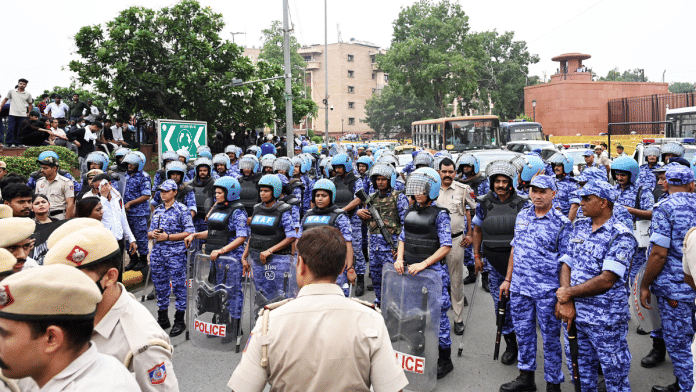
New Delhi: A protest at Jantar Mantar is set to put Delhi under an unprecedented security blanket stretching far beyond the demonstration site. Police have asked the Delhi Metro to consider closing entry and exit gates at 57 stations, trains have reportedly been cancelled and liquor shops are to shut for two days.
The protest, organised by the Cockroach Janata Party and student groups, is directed against Chief Election Commissioner Gyanesh Kumar over alleged irregularities in electoral rolls. The police have denied permission for the gathering, while organisers say they intend to go ahead.
Delhi has seen barricaded borders, road closures, metro station closures and heavy security deployments before during the farmers’ protest and global summits. But the current plan brings these measures and more together at once, including a designated detention centres in each of the capital city’s 15 districts and. The reach of these restrictions raises a fresh question: is the capital preparing for a protest or putting an entire city on lockdown? To understand the severity of these measures, let’s draw comparisons to five other occasions when Delhi turned into a fortress
BRICS summit, September 2026: A capital on restricted movement
Just weeks before the current protest preparations, Delhi witnessed major security restrictions while hosting the BRICS summit.
Thousands of police and paramilitary personnel were deployed, barricades and checkpoints appeared on major roads, and traffic restrictions were imposed around key areas. Authorities declared a public holiday for 3 days, closed government offices and schools, and urged people to work from home to reduce movement as global leaders, including Russian President Vladimir Putin and Chinese President Xi Jinping, arrived.
The restrictions were felt well beyond the summit venue, Bharat Mandapam?. Office workers, delivery riders and other commuters reported longer journeys and delays as routes were closed or diverted. Some taxi fares rose as drivers took longer routes, while commuters and office-goers complained about confusion over changing traffic arrangements.
Both episodes show how security planning can spread beyond a single venue and affect the movement of people across the capital. The difference is the trigger: BRICS restrictions were intended to protect visiting heads of government, while the current measures are being prepared ahead of a protest that police say could draw large crowds.
G20 summit, September 2023: Delhi’s quietest weekend
When Delhi hosted the G20 summit on 9 and 10 September 2023, the capital prepared for visiting world leaders with a set of restrictions that made parts of the city look unusually deserted.
Traffic regulations were enforced in the New Delhi area, access to certain roads was restricted, and taxis and auto-rickshaws faced curbs within the district. The Supreme Court Metro station was the main exception to otherwise uninterrupted metro services, with boarding and deboarding suspended during the summit period.
By 8 September, roads were unusually empty, key markets were shut and even busy metro interchanges had few passengers. Security agencies increased patrolling, deployed armed personnel and stepped up checks around sensitive locations.
The G20 demonstrated how security restrictions can change the rhythm of an entire city. But there was an important difference: the restrictions were concentrated around the summit and its routes, and the metro largely continued to operate. By contrast, the current restrictions direct shutting down entry and exit gates at 57 metro stations across Delhi, although the proposed closures are not the same as shutting down all those stations or suspending the entire network.
Also Read: Don’t use hammer to kill fly—SC cautions govt against blanket metro, train curbs ahead of CJP protest
Farmers’ tractor rally, January 2021: When barricades were breached
The security response to the farmers’ tractor rally on Republic Day in 2021 was different because the situation escalated into violence.
Thousands of farmers entered the capital during a march against the farm laws, with some groups breaking through barricades and deviating from agreed routes. Clashes broke out in several areas, and protesters entered the Red Fort complex.
The Delhi Metro shut entry and exit gates at several stations as the situation unfolded. Services across parts of central, north and west Delhi were affected. The next day, metro services resumed on all lines, but the gates at Lal Quila and Jama Masjid remained closed. Police also tightened security at the Red Fort and Delhi’s borders. Internet services were also temporarily suspended in parts of Delhi and-NCR.
But the sequence matters. In 2021, the restrictions followed the outbreak of violence. For the protest proposed on the coming weekend, the curbs are pre-emptive.
Farmers’ ‘Dilli Chalo’ march, February 2024: The capital’s borders hardened
When farmers began their ‘Dilli Chalo’ march in February 2024, Delhi’s borders became the focus of a major security operation.
Barricades and other obstacles were installed at key entry points to prevent protesters from reaching the capital. Traffic faced diversions, and the Delhi Metro closed some gates at nine stations, including Central Secretariat, Rajiv Chowk, Patel Chowk, Mandi House, Janpath and Khan Market.
The metro stations themselves remained operational, with trains running normally. The gates were reopened later that evening. Delhi Airport also advised passengers to use the metro to avoid delays caused by traffic restrictions.
The 2024 march showed how even limited metro restrictions can ripple through the commuting network. But the closures were temporary and limited to specific gates at nine stations. The current police request is much broader in geographical scope, covering 57 stations, and comes with reported long-distance train cancellations and a liquor-shop closure.
Donald Trump’s India visit, February 2020: Snipers, commandos and sealed routes
Delhi’s security apparatus was also placed on high alert when then-US President Donald Trump visited India in February 2020.
Lutyens’ Delhi and areas around the ITC Maurya hotel, where Trump was staying, were placed under multiple layers of security. Anti-drone teams, snipers, SWAT commandos, canine units and sharpshooters were deployed, while double barricades were installed along routes expected to be used by his convoy.
Traffic restrictions and diversions affected parts of Delhi, including Dhaula Kuan, Chanakyapuri, India Gate and areas around ITO. Police urged commuters to plan their journeys around the visiting president’s movements.
Trump’s visit illustrates the most security-intensive model of urban control: protect a high-profile individual by securing hotels, routes and surrounding areas. The current situation is different because the restrictions are being considered across a far wider transport network to manage the potential movement of protesters, rather than to secure a visiting dignitary’s convoy.
What makes the current restrictions different?
Delhi has been locked down in parts before, but these episodes are not identical. A summit requires officials to protect visiting leaders and keep their routes clear. A protest presents a different challenge: authorities must manage crowds, prevent clashes and protect sensitive sites while balancing the public’s right to assemble.
The current preparations stand out for their potential reach. During earlier Jantar Mantar protests, liquor shops were also ordered shut and roads in Lutyens’ Delhi were blocked, while Metro restrictions were limited to fewer stations. The latest plan extends the proposed Metro curbs to 57 stations, alongside train cancellations and designated detention centres.