





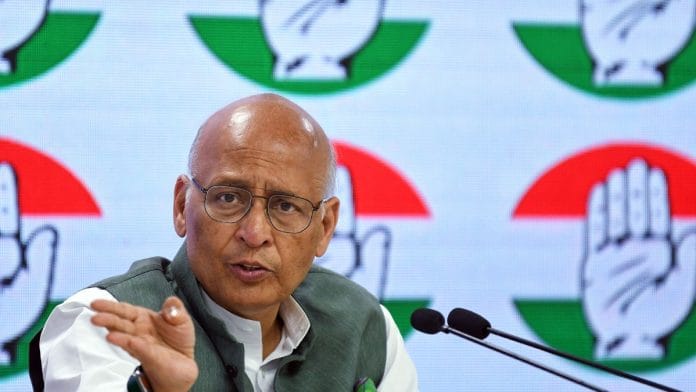


New Delhi: Saying that the manner in which the anti-defection law has been implemented has made it “look like an ass”, Rajya Sabha member and senior advocate Abhishek Manu Singhvi has called for repealing the law and replacing it with a simpler one,. The Congress leader says defectors should seek re-election after changing parties.
Singhvi expressed confidence that strained ties with long-time allies such as the Dravida Munnetra Kazhagam (DMK) and the Aam Aadmi Party (AAP) can be repaired ahead of the 2029 Lok Sabha elections.
In an exclusive interview with ThePrint, Singhvi said the anti-defection law, introduced through the Tenth Schedule in 1985 to curb political defections, has failed in practice because the Speaker, the sole authority empowered to decide disqualification petitions, is inherently a political actor. “There is an old colloquial saying that ‘the law is an ass’. I don’t believe so. But certainly the antics around the Indian anti-defection law have made it look like an ass,” Singhvi said.
He further argued that the Speaker cannot be expected to function as an independent adjudicator because he or she remains a politician elected on a party ticket. “The Speaker owes his political birth and death to the party. There cannot be expected of him the objectivity, impartiality and independence which is vital for deciding defections under the Tenth Schedule,” he said.
Singhvi said the current law should be repealed and replaced with a simple principle requiring any elected representative who changes political allegiance to resign and seek a fresh mandate from the electorate.
“I have openly called for its repeal and substitution by a simple two-three line principle. Anybody elected on the symbol of one political party who changes allegiance, directly or indirectly, should first resign and seek re-election,” he said.
According to Singhvi, “the biggest problem is that the process itself becomes the punishment. By the time a defection dispute reaches the courts and is adjudicated, the political objective has already been achieved and terms have passed.”
He cited the still-pending Maharashtra defection litigation as an example, saying legal proceedings often outlast the tenure of the legislature itself. “The law is known. People knowingly violate it because they know that by the time the courts decide the matter, the House may have completed its term,” he said.
‘Two-thirds’ exemption misunderstood
Singhvi also challenged what he called the widespread misunderstanding surrounding the so-called “two-thirds exemption” under the anti-defection law. He said there is no automatic protection merely because two-thirds of legislators cross over.
He said, Clause 4 of the Tenth Schedule requires two conditions to be fulfilled simultaneously: first, the original political party must decide to merge with another party, and second, two-thirds of its legislature party must approve that merger.
“People only discuss the second requirement. They completely ignore the first. Both conditions have to be satisfied together,” he said.
Also Read: Why should an MP lose a seat for leaving a party? It’s time to retire India’s anti-defection law
Defections fuelled by money and agencies
While acknowledging that dissatisfaction within political parties often triggers defections, Singhvi accused the BJP of institutionalising them through financial inducements and investigative agencies. “I am not one of those who believes every defection happens only because another party engineers it. There has to be dissatisfaction within the original party,” he said.
“But what has facilitated defections on an unprecedented scale is Vitamin M—money—and the misuse of investigative agencies.”
He alleged that no government in independent India’s history used these tools on such a scale to engineer political realignments. When asked about Congress leaders who defected to the BJP but later found themselves sidelined, Singhvi said the BJP’s strategy was to “lure, absorb and largely ignore” many entrants while reserving positions of influence for its long-time cadre.
Congress lost momentum after 2024
Reflecting on the Opposition performance after the 2024 Lok Sabha elections, Singhvi acknowledged that the momentum from the parliamentary polls was not sustained in subsequent state elections. “I agree it was disappointing. The momentum was high after the Lok Sabha elections but it was not sustained,” he said.
He says this was primarily due to a lack of dynamism and unity within the Indian National Developmental Inclusive Alliance (INDIA) bloc. Singhvi argued that while Opposition parties would continue to compete in state elections, they needed to minimise vote division in national elections. “When Mr Modi is at his best, he rarely gets more than 39 or 40 per cent of the vote. Around 60 per cent vote against him. The problem is that those votes get divided,” he said.
Singhvi also advocated a pragmatic approach in which alliance partners continue fighting one another in state elections while coming together before parliamentary polls. “It may appear contradictory, but Indian politics has functioned this way for decades. Pragmatism in politics is important,” he said.
‘DMK, AAP can be brought back’
On the Congress relationship with the DMK, Singhvi said he remained optimistic despite recent friction over the party’s decision to align with actor Vijay’s Tamilaga Vettri Kazhagam (TVK). “I am saddened by that example because the DMK has probably been one of our oldest and strongest allies,” he said. “I still have very strong confidence that the DMK and AAP can be brought back around.”
Rejecting suggestions that the Congress had chosen the TVK over the DMK, Singhvi said the alliance had been misunderstood. “I think somehow the DMK has not fully understood the spirit in which the Congress has tried to explain this alliance.”
He maintained that the Congress was not acting against the DMK but was responding to aspirations within its own organisation in Tamil Nadu. “Our cadre in Tamil Nadu are seeing some light at the end of the tunnel. They want to be part of governance. They want to build up the Congress organisation. The TVK approached us with respect and dignity. Why can’t we remain friends with the DMK while also engaging politically with the TVK?” he said.
Asked whether the Congress could have simply extended outside support to the TVK instead of entering into an alliance, Singhvi replied: “I think something got lost in translation.” He expressed confidence that the misunderstanding could be resolved and added that the same was true of the Congress relationship with the Aam Aadmi Party.
(Edited by Nardeep Singh Dahiya)
Also Read: Why TMC MPs may still face disqualification even if 20 or two-thirds form a bloc