






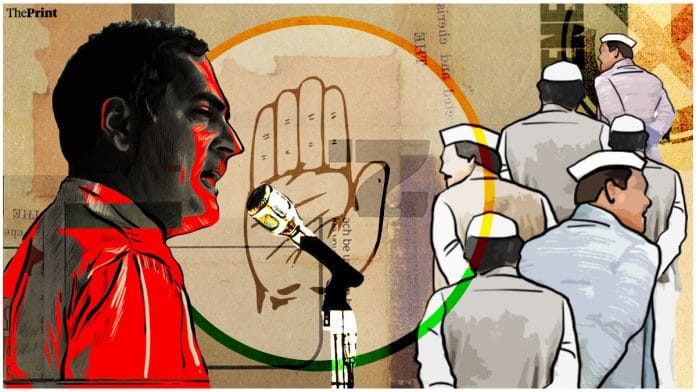


Recent discussion surrounding MPs from the Trinamool Congress and Shiv Sena leaving their parties appears one-sided — as though these MPs are ipso facto committing a wrong. It is useful to see the issue from the other end, too: Why, of all citizens, is an MP barred from freedom of thought and choice?
Even more so because that freedom was fully available to MPs under the original Constitution. The same freedom is available to Western parliamentarians. No questions asked. So, it is time to assess the consequences of this freedom being taken away from Indian MPs through the 52nd Amendment in 1985.
That amendment put the interest of political parties, or rather their leaders, above the dignity of Parliament, even though the framers of the Constitution did not even mention political parties in the Constitution. They regarded an MP’s party affiliation as a matter of individual choice and judgement. Parliament was supreme, above everything else. Such a crucial point cannot be brushed aside by frivolous, impromptu arguments.
Even in British India, elected representatives in legislative and administrative bodies were free to remain in or leave their parties. This right remained uninterrupted for more than six decades. Simply because the members of an elected body are the people’s representatives, not the parties’.
That is why major Western parliamentary democracies such as Britain, Canada, Australia and the United States do not disqualify legislators merely for changing parties. This approach is consistent with a fundamental value of democracy: liberty. Party affiliation concerns an individual’s freedom of thought and action.
The same right existed under the original Indian Constitution. It was taken away in 1985. It has given rise to various distortions in the political process. It proved to be more of a trick than a good law. The most glaring example is that the top custodians of the Legislature and the Executive help engineer defections.
On the other hand, even if a Chief Minister is repeatedly acting wrongly, an MLA from his party may remain silent and avoid leaving the party for fear of losing his position. Thus, in practice, he is forced to function only as a party representative, not as a representative of the people. It is a travesty of the Constitution and contrary to the spirit of democracy. Poor fellows, nominally called ‘people’s representatives’, cannot speak their own minds, let alone represent the views of the people.
Also read: India’s anti-defection law didn’t stop power politics. It just moved from farmhouse to resort
What the Constitution framers got right
Thus, the anti-defection law has reduced legislators to mere workers of their parties. For instance, a ruling party supremo may for years engage in theatrical, unproductive, or even counterproductive acts. It would have required him to think twice before doing so again and again if MPs had retained the freedom of thought and action they enjoyed until 1985. Now their opinions have become irrelevant. Whatever the supremo does, his party MPs can do nothing except remain silent spectators. Thus, the very place meant for free discussion, criticism, and the search for a judicious course for the country is rendered barren.
The argument that “an MP received a party ticket and therefore has no right to leave the party” is essentially false.
First, the framers of the Constitution were fully aware of the role of party tickets. Yet the Constitution and electoral system they created placed the individual above the party.
Second, Parliament is a constitutional, supreme body; a political party is merely a voluntary association among many social organisations. Even if a party dissolves itself, its MPs do not lose their seats. Parliamentary membership exists independently of party existence and possesses a higher status. It therefore cannot be subordinate to party membership.
A candidate can contest elections and become an MP without any party ticket. So the ticket is ancillary, whereas the candidate is essential. To attribute all importance to the party ticket and treat the personality of the MP as secondary is erroneous.
It is noteworthy that the Indian Constitution placed responsibility on individuals — MPs, Speakers, ministers, and others. Thus, the basis of accountability was the individual. The relationship between a party and its MPs lay outside the legislature.
The 52nd Amendment obscured the constitutional philosophy underlying this issue. It remains unchanged: membership of Parliament is a higher matter; party membership is a much lower one. Hence, in view of the fundamental principles and best practices of great democracies, depriving an MP of membership of the House merely for leaving a party is wrong in every respect. It effectively puts the MP in a party cage, to the detriment of the very purpose of Parliament, the highest body for free thought.
After this law was enacted, political parties came to dictate the entire parliamentary process. This is a betrayal of both the Constitution and democracy.
Furthermore, the anti-defection law is devoid of principle. MPs may leave their parties in groups, but doing so individually is punishable. It is as though committing fraud alone were illegal, but doing so as a gang were legal.
Also read: One lone, brave voice stood up against anti-defection law in 1985. All his predictions came true
Anti-defection law is devoid of principle
Note that modern law holds individuals accountable. If defection were truly wrong, then doing it collectively would also be wrong. But since leaving a party is not wrong at all, this law is fundamentally devoid of principle.
The fact is that Parliament and the Executive do not exist to ease the burdens of party leaders. Keeping party members satisfied is the responsibility of the party leader. Making a person’s parliamentary membership subject to a leader’s whims for the sake of his convenience amounts to an indirect contempt of Parliament.
The relationship between an individual and a political party is a matter between themselves. Parliament does not come into the picture. The same is visible in Europe and America. MPs remain with their parties because of the parties’ reputation, not because of coercion. There, leaving or changing a party is the right of every legislator. The existence of such a right does not cause legislators to wander frequently. On the contrary, party systems there are more stable and responsible.
Therefore, the real question is how much damage has been caused by constraining MPs since 1985. The separation between the Legislature and the Executive has been muddled. The stature once enjoyed by the Speaker of the House has disappeared. Today, the Speaker has become more of a factotum for the party supremo.
In Western democracies, in the absence of such constraints on MPs, party leaders act more carefully. One can observe this by comparing different political systems. Party bosses there do not indulge in theatrics, boastfulness, or bizarre announcements. Nor do they engage in arbitrary decision-making.
In India, the anti-defection law was devised by party leaders for their own convenience. Since then, ruling supremos have treated their own MPs and MLAs as subordinates and legislators of other parties as prey.
Earlier, party supremos treated their MPs with greater respect. Their relationships were characterised by cooperation and equality rather than the degrading mentality of master and slave. The party’s reputation was linked to its legislators, and theirs to the party leader.
The anti-defection law destroyed that sense of equality, handing enormous power to party supremos. It has encouraged degrading tendencies. By suppressing dissenting voices, it became an instrument for encouraging dictatorship and the arbitrariness of crafty party leaders. It has diminished the dignity of MPs and elevated the importance of party fixers, who remain invisible while holding the entire parliamentary process in their grip. They bring down and create governments while themselves remaining unaccountable for such actions.
Watching all this, thoughtful MPs of ruling parties often appear helpless, aware that nothing is in their hands — not even their own speech. A country in which such powerless legislators predominate can only be unfortunate.
Shankar Sharan is a columnist and professor of political science. He tweets @hesivh. Views are personal.
(Edited by Prashant Dixit)
Perhaps, we should adopt the German system of 2 votes — one for constituency, and another for party.
The constituency votes are fixed, but party votes are used for additional seat allocation on proportional basis.
We can allow constituency elected MP, to defect, but not the party elected MP.