





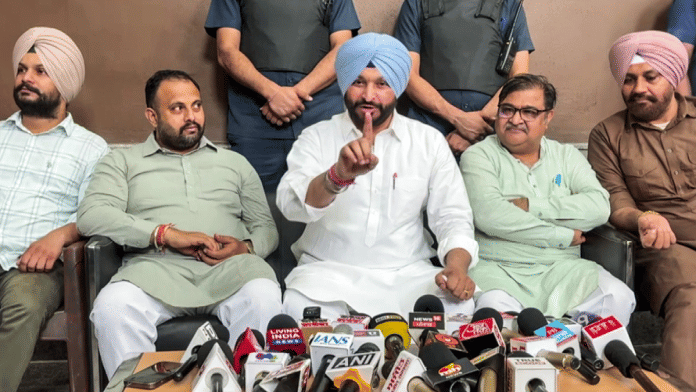


Chandigarh: Days after the Honey Trehan film Satluj triggered a nationwide debate on the legacy of Punjab’s militancy years, Union Minister of State for Railways and Food Processing Industries and Rajya Sabha member Ravneet Singh Bittu has mounted an aggressive campaign to shape a counter-narrative.
Through a series of social media posts, interviews and a press conference in New Delhi on Monday, the grandson of former Punjab chief minister Beant Singh has accused the film’s makers of presenting “half the story” and sought to shift focus from police excesses to the victims of militancy.
Over the past week, Bittu has launched a coordinated social media campaign aimed at contesting the historical narrative presented in Satluj. Using a series of infographics, archival newspaper clippings, photographs and statistical charts, Bittu has sought to document the violence perpetrated by Khalistani militants, arguing that the victims of terrorism have been largely omitted from the public discourse around the film.
Highlighting militant violence, crime statistics and stories of Sikh achievers, Bittu’s campaign appears designed to counter what he calls a “selective retelling” of Punjab’s history, simultaneously questioning the data and methodology relied upon by the filmmakers. “Punjab’s history cannot be rewritten through selective storytelling. Truth must prevail over propaganda, facts over fiction, and evidence over emotion,” Bittu said on social media platform X on Sunday.
At Monday’s press conference, Bittu unveiled two large display boards that symbolised the competing versions of Punjab’s troubled past. One carried photographs of militants along with details of attacks in which they were accused of killing civilians, police personnel and public figures.
The other showcased prominent Sikh achievers—including military officers, scientists, doctors and business leaders—to argue that Sikh identity should be represented through achievement rather than violence. The presentation reflected what Bittu described as an attempt to provide younger Punjabis with a “complete picture” of the decade of militancy.
Bittu’s list
Bittu has five major objections to the film. First, Bittu argues that Satluj presents only one side of Punjab’s recent history. While acknowledging that excesses by sections of the police have been investigated and punished through the courts, he says the film is silent on the violence unleashed by militant groups and the thousands of civilians, public servants and political leaders who lost their lives during the insurgency. According to him, any honest account of that period must include both state excesses and militant violence.
“Why has the film not once mentioned the killings of bus passengers, shopkeepers, labourers, government employees and ordinary civilians by militants?” Bittu asked. He also questioned why the sacrifices made by Punjab Police personnel, security forces and civilians who fought terrorism had been largely ignored. “Why has no film been made on those who lost their lives?”
Second, Bittu has directly challenged the figure of 25,000 disappeared of illegally cremated people cited in the film. Calling that number unverified, Bittu has demanded documentary proof and official records to substantiate the claim. He has said that if the makers can establish the figure with verifiable names and records, he would publicly support the film. Otherwise, he argues, the film should carry a disclaimer making it clear that the figure is contested rather than officially established.
In a press statement issued on Sunday, Bittu said he had called upon the filmmakers to publicly release the documentary basis for the figure of 25,000 within a reasonable time. “If they fail to substantiate this claim with credible and verifiable evidence, they owe the people of Punjab a clear public clarification that the figure is not an officially verified count,” he said.
One of the graphics shared by Bittu on X questions what he describes as the “multiply formula” adopted by the filmmakers. It reproduces front pages of The Tribune and The Sunday Tribune reporting four major militant attacks—the 7 July 1987 bus massacre near Sirsa (40 killed), the 8 August 1987 massacre in an Amritsar village (12 killed), the 5 November 1988 Batala bomb blasts (49 killed) and the 15 June 1991 train massacre (125 killed).
Together, the four attacks claimed 226 lives, averaging 56 deaths per incident. The graphic then extrapolates that average across 34,881 terror incidents recorded between 1980 and 1999 to argue that such a methodology would produce an implausible estimate of nearly 19.5 lakh deaths. Through the exercise, Bittu argues that statistical extrapolation without verified records can produce misleading conclusions.
Also Read: Diljit Dosanjh’s Satluj is Punjab’s biggest controversy. How it got here
Reopening wounds
Third, Bittu argued that films like Satluj risk reopening wounds that Punjab has spent decades trying to heal. He maintains that Hindus and Sikhs in Punjab rebuilt social harmony after the violence of the 1980s and 1990s and that presenting what he calls a one-sided account of the conflict could once again create mistrust between communities.
He has repeatedly said that Punjab today stands for peace and brotherhood and should not be pushed back into old fault lines. “I am not saying that history should not be told for the fear of opening old wounds. But it should be told objectively, dispassionately and maintaining balance. In Punjab it is impossible to divide the Hindus and the Sikhs. They are so enmeshed. Despite all the efforts being put in by radical Sikhs sitting abroad who want the dark days of militancy to return to Punjab including constant incitement to violence, communal harmony has not been affected,” he said.
Fourth, Bittu questioned the timing of the release of the film. “The film has been released on an Over-the-Top (OTT) platform over which we have no control. But the timing is questionable. When the state is headed for elections, why should such a division be promoted?” he said on Monday.
The minister also sought to distance both the Bharatiya Janata Party and Union government from the decision to remove Satluj from the OTT platform ZEE5. Rejecting allegations made by Opposition parties and the Punjab government, he maintained that OTT platforms take their own commercial and legal decisions and that neither the BJP nor the Centre directed the film’s removal.
His fifth concern related to the younger generation. Bittu argued that many young Punjabis have no personal memory of the militancy years and therefore rely on films and social media to understand that period. If those accounts omit the killings carried out by militant organisations, he says, they risk romanticising violence and creating sympathy for extremist ideologies among impressionable viewers. “Who will be responsible if a youngster after watching this film is triggered and decides to become a human bomb?”
Legacy of blood
Bittu’s grandfather, former Chief Minister Beant Singh, was assassinated in a suicide bomb attack outside the Punjab Civil Secretariat in Chandigarh in August 1995 after leading the state’s campaign against militancy. Throughout the present controversy, Bittu has repeatedly invoked that legacy while arguing that the victims of terrorism deserve equal space in Punjab’s collective memory.
Bittu’s move has met with some resistance from his own party colleagues. Former legislator Fatehjang Singh Bajwa said Bittu’s challenges to the makers of Satluj were strictly his “personal opinion”. Bajwa emphasised that the BJP supports the film and was not involved in its removal from streaming platforms.
Former National Commission for Minorities chairman and senior BJP leader Iqbal Singh Lalpura also said that Bittu should remain within his limits. Lalpura said the figure of 25,000 had originally been raised by Jaswant Singh Khalra and was later examined by the National Human Rights Commission. BJP state president in Punjab Kewal Singh Dhillon has taken a cautious but sympathetic stance towards the film, stating that the party stands with the people and their emotions. He said he had reached out to the Union Information and Broadcasting Minister, urging a review of the film’s removal from the OTT platform.
Former deputy chief minister and senior Congress leader Sukhjinder Singh Randhawa told ThePrint the controversy had been created in the first place by the BJP.
“What is Bittu crying about? Reopening those wounds is not going to help anyone. But I agree that if those dark days have to be showcased they should be done in a completely objective manner showing all aspects of the problem. What is happening in Punjab now is however as scary as those days. Gangsters have replaced militants who at least had a cause to fight for. Now Punjab is fraught with senseless violence. Bittu should give an explanation that a dreaded militant is being kept in a jail in Gujarat and is running his gang from there,” said Randhawa.
(Edited by Nardeep Singh Dahiya)