


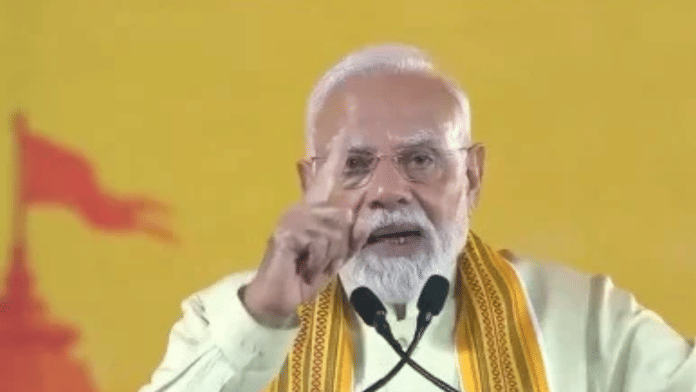
New Delhi: The first amendment to the Indian Constitution was to “stifle public opposition”, and the 38th and 39th amendments should be studied by the youngsters to understand “what a power-hungry and anti-constitutional leadership can do”, Prime Minister Narendra Modi wrote in an op-ed on Constitution Day on Thursday.
The op-ed was published on his website narendramodi.in as well as various newspapers, to mark Constitution Day or Samvidhan Divas, commemorating the day the Constituent Assembly adopted the Indian Constitution on 26 November 1949.
The article begins by listing down the manner in which the government in the last 12 years has contributed to “strengthening our Constitution”. However, the mood of the op-ed turns sombre quickly, when PM Modi feels “compelled” to share “another reality”.
“There have been occasions in our history when those entrusted with upholding the Constitution chose to weaken it. Ironically, they are the same people who had the opportunity to govern India for five decades,” he wrote.
He then talks about the first amendment to the Constitution, passed in 1951, and the 38th, 39th and 42nd amendments passed during the Emergency.
“This year marks 75 years since the First Amendment of 1951, when a government that was not popularly elected used its majority in the Provisional Parliament to restrict fundamental freedoms. Its timing, barely months before India’s first general election, proves that it was intended to influence the electoral process and stifle public opposition. It is also 50 years since the 42nd Amendment at the height of the Emergency. This curtailed judicial review and fundamentally altered the balance of institutional powers. I would also urge youngsters to study the 38th and 39th Amendments to know what a power-hungry and anti-constitutional leadership can do,” he wrote.
What do these amendments say and why are they so controversial? ThePrint explains.
Why was the First Amendment introduced
The first amendment to the Indian Constitution is also one of its most controversial and polarising.
It was brought in by the Provisional Parliament, only 16 months after the Constitution was enforced. The reason was Supreme Court judgments in various cases, including Romesh Thappar v. State of Madras and Brij Bhushan v. State of Delhi.
In the Romesh Thapar verdict passed in May 1950, the Supreme Court quashed the order issued by the Madras government banning communist magazine Cross Roads, edited and published by Romesh Thapar from Bombay. Thapar had asserted that the ban violated his freedom of speech and expression under Article 19(1)(a) of the Constitution.
The apex court upheld Thapar’s challenge to the order, and struck down a provision of the Madras Maintenance of Public Order Act, 1949, observing that it was “void and unconstitutional”, since it authorised restrictions on a fundamental right wider than what was constitutionally permissible.
In the Brij Bhushan judgment passed on the same date on 26 May 1950, the Supreme Court quashed an order issued by the Chief Commissioner of Delhi, banning RSS weekly Organiser.
Concerned about the Supreme Court’s decisions, the Provisional Parliament introduced the first ever amendment to the Constitution of Article.
Article 19(2) of the Constitution, as it stood before this amendment, allowed the government to make laws relating to “libel, slander, defamation, contempt of court or any matter which offends against decency or morality or which undermines the security of, or tends to overthrow, the State”. In other words, the provision allowed the freedom of speech and expression to be restricted on these grounds.
The first amendment changed this. Passed in 16 days, it allowed the State to make a law that “imposes reasonable restrictions on the exercise of the right conferred by the said sub-clause in the interests of the security of the State, friendly relations with foreign States, public order, decency or morality, or in relation to contempt of court, defamation or incitement to an offence”.
In effect, the amendment allowed the government to impose “reasonable restrictions” on certain grounds, including “public order”, “incitement to an offence” and “friendly relations with foreign states”. It has, therefore, been criticised for lowering the bar for the reasons on which the freedom of speech and expression can be curtailed.
Also Read: On Constitution Day, PM Modi targets opposition over defeat of women’s quota bill in LS
Why is the 42nd amendment called the ‘mini’ Constitution
The 42nd Constitutional amendment was by far, and still is, the most comprehensive of all the amendments. It amended the Preamble, 40 Articles and the Seventh Schedule, and added 14 new Articles. The magnitude of changes has earned the amendment the moniker, “mini” Constitution.
The amendment added the words “socialist” and “secular”, and added to the Constitution the fundamental duties that Prime Minister Narendra Modi and the Bharatiya Janata Party have often emphasised.
The delimitation exercise was also put on hold through this amendment. Through changes to Articles 81 and 82 of the Constitution, it effectively froze the number and boundaries of parliamentary constituencies or the delimitation exercise—based on the 1971 Census until the publication of the post-2000 Census. In 2001, the 84th Amendment to the Constitution extended the deadline from 2000 to 2026.
The amendment also made fundamental rights subservient to the Directive Principles of State Policy. It gave the Parliament unbridled powers to amend any part of the Constitution. It restricted the powers of the Supreme Court and high courts to strike down any laws that violated the Constitution. Through these changes, the amendment destabilised the separation of powers, tilting the scales in favour of the ruling central government.
The amendment also introduced changes to the Seventh Schedule, which deals with the division of the crucial lawmaking powers between the Centre and the states. It transferred five subjects—education, forests, weights and measures, protection of wild animals and birds, and administration of justice—from the state list to the concurrent list. A new entry, 20A, was also added to the Concurrent list, adding population control and family planning as a subject.
Both Parliament and state governments can enact laws on the subjects listed under the concurrent list. However, according to Article 254, if there is a conflict between laws, the central law overrides the state law.
Provisions for establishing tribunals were also introduced, as were Articles 39A (equal justice and free legal aid), 43A (participation of workers in the management of industries), 48A (protection and improvement of the environment and safeguarding of forests and wildlife), and 39(f) (protection of children and youth).
While subsequent amendments and court judgments overturned the amendments introduced by Indira Gandhi, other changes, including the fundamental duties and the changes made to the Preamble, despite periodic opposition, seem to have stood the test of time.
How the 38th and 39th amendments altered the balance of power
The 38th and 39th amendments to the Constitution were also introduced during the Emergency.
The 38th amendment, among other things, made the President’s decision to proclaim a national Emergency “final and conclusive”, keeping it outside the purview of even the courts. It also amended Article 356 of the Constitution, which allows the President to impose President’s Rule in a state when constitutional machinery fails. The amendment made the President’s satisfaction on the necessity of the order “final and conclusive” in this case as well.
In effect, it barred courts from questioning the national Emergency, President’s rule in States and financial emergency, and allowed multiple proclamations of National Emergency to be issued at the same time on different grounds.
The amendment also altered Article 359, which allows the President to suspend the right to approach a court for the enforcement of fundamental rights of the Constitution. The amendment allowed the State to make laws or take executive action which it could not have done under ordinary circumstances for violating the fundamental rights. It allowed the State to enact such laws while a Presidential order under Article 359(1) suspending the enforcement of fundamental rights was in force.
However, several of these amendments were overturned by the 44th amendment brought by the new Janata Party government.
The 39th Constitutional amendment barred Indian courts from scrutinizing election disputes involving the President, Vice President, Prime Minister, and Lok Sabha Speaker, through insertion of a new Article 329A, among other things.
However, in a judgment passed in November 1975, in Indira Nehru Gandhi v Raj Narain, the Supreme Court struck down certain provisions of Article 329A, and the entire provision as well as several other changes brought through the 39th amendment were removed through the 44th amendment.
‘Another troubling chapter’
Apart from the amendments, PM Modi also criticised “repeated misuse” of Article 356 of the Constitution, which allows the President to impose President’s Rule in a state when constitutional machinery fails.
Without naming the Congress party, he wrote, “The repeated misuse of Article 356 to dismiss elected state governments presents another troubling chapter. One party has the dubious record of imposing Article 356 almost a hundred times and one former Prime Minister has scored a half-century in this field.”
He then went on to take credit for the abrogation of Article 370 of the Constitution of India, and removal of Article 35A, asserting that the provisions “did not allow the full Constitution to be implemented in Jammu and Kashmir, thus trampling over the rights of SC, ST, OBC communities and women”.
He said that it was “only in 2019 that this historical wrong was corrected”.
(Edited by Anupama Yadav)
Also Read: Modi’s criticism of India Inc. puts weak private investment in focus