



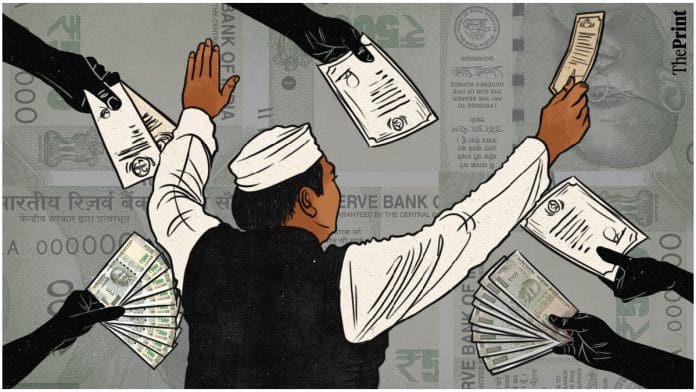
New Delhi: The Gujarat Police has filed separate cases against four state-based Registered Unrecognised Political Parties (RUPPs) for alleged forgery and misuse of political party status to facilitate money laundering by high-value donors.
The last of the FIRs was lodged Saturday against the Satyawadi Rakshak Party, its office-bearers, and a chartered accountant, for receiving funds allegedly masked as political donations amounting to Rs 415 crore; only to then route the funds back to the donors and charge a commission of up to 10 percent to facilitate the alleged laundering.
The FIR against Satyawadi Rakshak Party was preceded by three separate FIRs registered Friday against three other RUPPs—Bharatiya National Janata Dal (BNJD), Swatantrata Abhivyakti Party (SAP), and Garib Kalyan Party (GKP)—and their office-bearers, as well as chartered accountants who allegedly certified donation receipts for them.
Overall, the Income Tax department in its complaints Friday and Saturday flagged alleged tax evasion amounting to more than Rs 700 crore.
The four FIRs were filed by the Economic Offences Wing (EOW) of the state police’s CID Crime unit in response to four separate complaints from the I-T department.
Broadly, the department said that these political parties were used as channels to launder large sums of cash by donors who claimed tax exemption under Section 80GGC of the Income Tax Act. An individual taxpayer can donate 100 percent of their taxable income as donations to political parties under Section 80GGC of the Income Tax Act. The section does not propose any upper limit.
According to the I-T department, after receiving donations from individual donors, these RUPPs allegedly moved the funds to shell companies on the pretext of purchasing goods or services. The funds were eventually withdrawn in cash and returned to the donors. All of these tax evasion activities were carried out for a commission ranging up to 10 percent, the I-T department said in its complaint to the Gujarat CID.
The I-T Department’s complaint and swift registration of the cases came weeks after a report by the BBC exposed the opacity in political funding and misuse of these RUPPs as special purpose vehicles for laundering large sums.
These RUPPs are formally registered with the Election Commission of India (ECI), but do not qualify for the status of a recognised state or national party. According to data collated by the poll watchdog, donations to RUPPs surged exponentially over the past decade—from Rs 4.37 crore in FY2015-16 to over Rs 10,000 crore in the period between 2022 and 2024.
10% commission for 30% margin
In his complaint, a Deputy Commissioner-rank Income Tax officer said the department had raided the office of the Gandhinagar-based Bharatiya National Janata Dal (BNJD), as well as the premises of its president, Surendrakumar Gajera, and treasurer, Ronaksinh Chavda, in November last year.
During its raids, the I-T department found evidence suggesting that BNJD amassed funds amounting to more than Rs 1,143 crore in bogus donations between FY2019-20 and FY2024-25 from as many as 56,238 donors and issued to them issued fake receipts and donation slips, allowing them to claim and avail 100 percent tax deduction under Sections 80GGB and 80GGC of the Income Tax Act.
According to the I-T department, this pattern of fraudulent donation and exemptions in the name of political donations caused loss of around Rs 343 crore to the exchequer. It added that funds pooled from donors were subsequently transferred to shell companies—Jay Trading Company, Kajal Enterprises, and Parmar Associates—disguised as payment for purchasing grains, pulses, and other commodities from these firms.
“Finally, the funds deposited in these firms’ accounts were withdrawn as cash; after deducting a pre-agreed commission ranging from 2 percent to 10 percent, the remaining amount was returned to the original donors in cash via Angadia firms or Hawala networks,” the Income Tax officer submitted in his complaint to the CID.
The department further alleged that the chartered accountant who served as auditor for the accounts of BNJD prepared and digitally signed false audit reports without ever verifying the accounts, visiting the party office, or meeting any office bearers.
A similar pattern was observed in the functioning of the Ahmedabad-based Swatantrata Abhivyakti Party whose sketchy financial dealings emerged after the agency raided a city-based consultant last July. During searches at the tax consultant’s premises, the agency found that he had been auditing the books of accounts of several political parties, including the Swatantrata Abhivyakti Party, headed by Surendra Parsotamprakash Tiwari.
The CID is also probing the allegation that Tiwari, in the company of another chartered accountant, hatched a conspiracy to receive donations amounting to Rs 519 crore from individuals through legal routes, such as cheques or other banking channels, but with no intention of contesting elections. The party and its tax consultants then prepared forged contribution reports to the Election Commission of India, causing loss of around Rs 155 crore to the government, the I-T department alleged in its complaint to the CID.
Instead, the trio of Tiwari and two chartered accountants allegedly admitted before the Income Tax authorities that they had floated a political party with the sole purpose of recouping commission from political donations. Funds received from donations were routed to a shell company named Jay Trading Company before being withdrawn in cash and handed over to the original donors after a commission ranging from eight to nine percent was deducted, the I-T department said in its complaint to the CID.
In a similar modus operandi, the Garib Kalyan Party and its office-bearers and tax consultants allegedly hatched a conspiracy to receive donations amounting to Rs 206 crore between 2022 and 2026, which were returned to donors by routing them to shell companies—Jalaram and Krishna Enterprises—after retaining a commission of up to 10 percent.
According to the investigation conducted by the I-T authorities, Jalaram and Krishna Enterprises was incorporated by an associate of a Garib Kalyan Party office-bearer at a paltry monthly salary of Rs 5,000, and the chartered accountant prepared and signed forged audit reports in exchange for Rs 50,000.
Additionally, the Income Tax department found that the two shell companies used by the Garib Kalyan Party to allegedly route funds had received funds amounting to Rs 1,295 crore—way beyond the donations received by the party in the same time period, raising suspicions that the same companies were used as special purpose vehicles by other political parties as well.
For instance, a total of Rs 1,295,76,63,288 (over Rs 1,295 crore) was deposited into the accounts of Jalaram and Krishna Enterprises between financial years 2022 and 2026.
“Acting in collusion, the accused created false documents, used them as genuine, and submitted a fraudulent contribution report (Form 24A) to the Election Commission of India, thereby causing a massive financial loss of approximately Rs 62,02,90,092 (Rupees sixty-two crore two lakh ninety thousand ninety-two)—an amount equivalent to 30 percent of the donations received by the ‘Garib Kalyan Party’—to the government exchequer,” the Income Tax officer documented in the police complaint.
(Edited by Amrtansh Arora)
Also Read: Ghost addresses, empty offices — the shadowy world of registered unrecognised political parties