





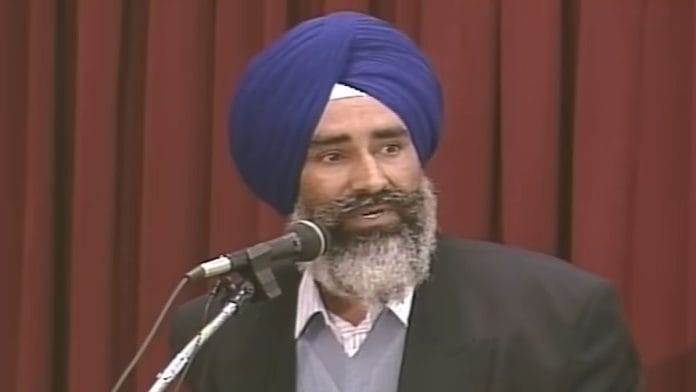


On the morning of 6 September 1995, Punjab was about to witness an event that would reshape the conversation around human rights in India. Three decades later, it has come back to haunt Indians.
At the heart of it all was Jaswant Singh Khalra, the man who spent months searching for the missing in Punjab. On 6 September, he was about to become one of them.
It was 9:20 in the morning.
Nothing seemed out of the ordinary in the bustling neighbourhood of Kabir Park in Amritsar. People went about their day, children ran across the streets, dogs barked at passersby, and vendors could be heard calling out in the distance.
In an instant, the monotony was broken.
A blue Maruti van came racing into the neighbourhood. BBN-5969 flashed on its number plate. A screech of tyres ripped through the silence, drawing startled gazes from every direction.
The blue van had come to an abrupt halt outside House No 8.
Out stepped four uniformed men, black patkas wrapped around their heads, automatic weapons slung across their shoulders. They carried walkie-talkies, the crackling static filling the air.
Without hesitation, all four pointed their guns at Khalra, who was washing his car: a Tata Mobile pickup. They grabbed him and dragged him toward the van. He resisted, but he was hopelessly outnumbered—one against four. Within moments, he was shoved inside the blue vehicle.
It wasn’t the lone car on the scene.
Close behind came an open police Gypsy carrying four or five more heavily armed men. An officer—probably their superior—sat in the front.
“He has been taken into custody,” one of the policemen reported into his walkie-talkie.
The convoy pulled away as abruptly as it had arrived, leaving behind a traumatised neighbourhood—and a trail of unanswered questions.
A bloodied Punjab
Just as Punjab’s Partition wounds were beginning to heal, the 1980s and early 1990s unleashed a fresh wave of trauma. It would scar the state’s collective memory for decades to come.
The “rule of gun” had arrived in the state. Militancy was at its peak, and fear and terror dictated everyday life.
Buses were stopped on highways. Passengers were identified by their religion. Selective killings spread panic across the state.
Train attacks, assassinations, bombings, and anonymous death threats became recurring headlines.
Caught between armed militants and security forces, people no longer knew whom to trust. The next bus ride or train journey could be their last. A knock on the door became a terrifying sound.
It was one of the darkest chapters in Punjab’s history.
“The terrorists would enter homes, force the residents to feed them. Then, they would order the men to step outside into the ahata or onto the roof, and after that, they would rape the women,” Ajai Sahni, executive director of the Institute for Conflict Management, told ThePrint.
It had become a terrifying routine.
“This is the kind of violence the Khalistani terrorists brought in Punjab,” Sahni added.
The whole system crumbled. “Even the police in the initial years completely collapsed,” added Sahni.
The cost of war, however, was appalling.
“Starting 1981, Punjab lost about 21,660 people, including nearly 11,787 innocent civilians, out of which over 60 per cent were Sikhs. The number of terrorist fatalities was around 8,112,” wrote Ramesh Inder Singh, former Chief Secretary of Punjab, in his book, Turmoil in Punjab (2022).
It was only after 1993 that the violence finally began to subside and a fragile sense of normal returned.
But that’s when one man began asking questions others wanted buried.
It was Khalra. Born into a family of freedom fighters, he set out on a new crusade of his own.
He searched for the missing: the nameless, the unspoken heroes, the forgotten casualties of a decade of bloodshed in Punjab. In the war against terror, these were the collateral damage. And Khalra would not let them remain that.
Also read: Inside a Satluj screening at a Delhi gurdwara. Elders relive 1984 horror, Gen Z seeks roots
‘Disappeared: Cremation Grounds’
The answers to some of the questions Khalra was raising lay in the city’s cremation grounds.
As general secretary of the Akali Dal’s Human Rights Wing, Khalra began documenting the secret cremations in Amritsar district.
His search led him to three crematoria—Patti, Tarn Taran, and Durgiana Mandir—where he began poring over something which seemed ordinary: official firewood purchase registers.
What he found would shake Punjab.
It would also end up sealing his fate.
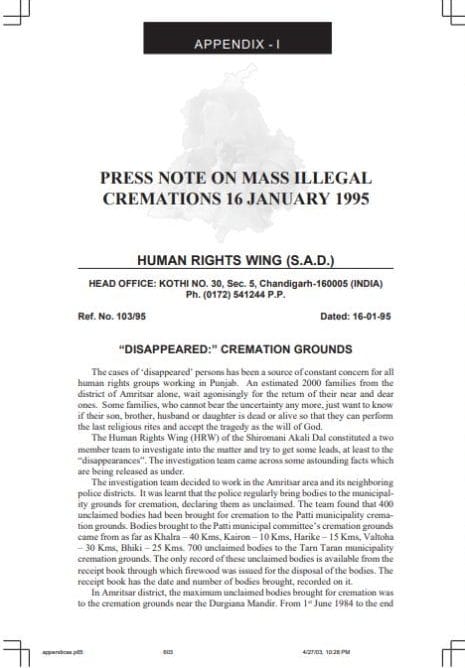
On 16 January 1995, Khalra, along with Jaspal Singh Dhillon, issued a press note titled ‘Disappeared: Cremation Grounds’.
The press note, later reproduced in the Supreme Court’s 15 November 1995 judgment, revealed a chilling pattern.
“It was learnt that the police regularly bring bodies to the municipality cremation grounds for cremation, declaring them as unclaimed,” the press note stated.
For Khalra, these were not nameless strangers.
They were people picked up illegally by the Punjab police on suspicion of links with the separatist movement that gripped the state between 1984 and 1994—only to disappear forever.
His allegations were not based on hearsay but on the state’s own records.
Every time the police brought a body for cremation, the registers recorded the purchase of roughly 300 kilograms of firewood—the amount required to cremate a single body, wrote Ram Kumar Narayan in Reduced to Ashes (2003).
The firewood invoices held a clue. They pointed to nameless cremations as well.
But the numbers told only part of the story.
“The attendants of the cremation grounds told me that the police often bought firewood for one or two bodies but dumped many more on a single pyre,” wrote Narayan.
If Khalra was right, these were more than just unidentified bodies. They were people whose names and identities had been erased into oblivion.
“So, Khalra was able to call out approximately 2,000 bodies which were stated to have been burned or cremated that were not identified,” said KBS Sidhu, former IAS officer who retired as Special Chief Secretary of Punjab.
Determined to seek answers, Khalra approached the Punjab and Haryana High Court, filing a writ petition demanding an independent investigation into the alleged disappearances and secret cremations.
“The High Court dismissed the petition, saying it was too vague and that Khalra lacked the locus standi in the matter,” Sidhu added.
Punjab police hits back
The dismissal of the petition by the court did not deter Khalra. It only strengthened his resolve. More press conferences followed.
But this time, he openly challenged the Punjab government.
On 27 February 1995, Khalra announced in a press conference in Amritsar that the state government was “highly mistaken in thinking that by eliminating him the matter relating to 25,000 unclaimed bodies… can be put to an end”, Narayan wrote in Reduced to Ashes.
Khalra knew that his life hung in the balance.
Yet, he wasn’t the only one doing press conferences. The Punjab police too hit back.
On 18 January 1995, DGP KPS Gill, addressing a press conference in Amritsar, rejected Khalra’s allegations outright.
Gill announced that the so-called missing persons were “thousands of Sikh youth who had left for foreign countries under fake names and documents”, and that they were being portrayed as “missing persons killed by security forces”, wrote Narayan.
Khalra responded the very next day.
He not only presented his evidence again, wrote Narayan, but also challenged Gill to an open debate, inviting the people of Punjab and the international human rights community to judge for themselves “who was lying”.
Several regional newspapers gave extensive coverage to Khalra’s revelations.
The Punjabi Tribune published almost the entire text of Khalra’s statement. On the other hand, Ajit led its front page under the heading, “Matter relating to youth declared missing by the police: What does police do for getting petitions withdrawn from the high court?”
Taking the campaign West
Khalra didn’t stop at the press conferences. He started a tour of the US and Canada, where he took his allegations to an international audience.
The 1990s were a decade when NGOs and media in the Western world recorded and amplified human rights violations in India a great deal. And many in the country would get nervous with every admonishing report and statement from abroad.
In March, Khalra took his campaign beyond India’s borders for the first time. Soon, he found an audience in the Canadian Parliament.
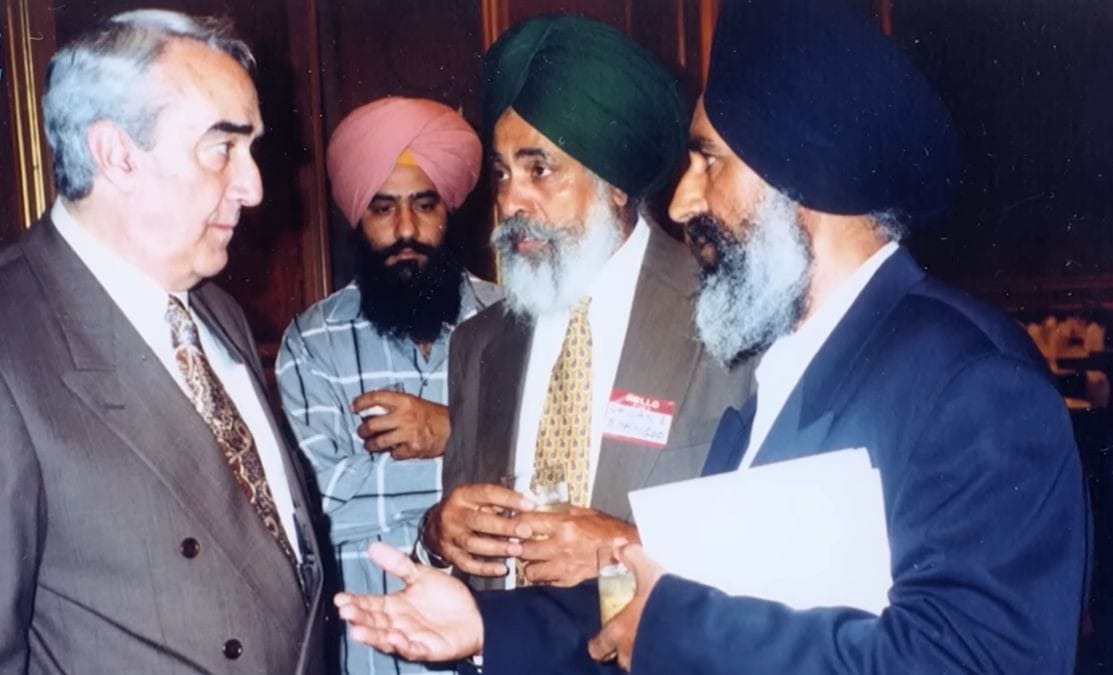
On 30 March, MP Colleen Beaumier personally introduced Khalra and Ajit Singh Bains to the Speaker of the House of Commons. A second visit followed in July.
Khalra’s global outreach unsettled many in India. No sooner had he returned to Punjab than he addressed another press conference in Amritsar.
On 28 July, he made his most explosive claim yet.
“At the press conference, he… suggested the figure of 25,000 illegal cremations for the whole of Punjab,” wrote Narayan.
Also read: What SIR in Delhi’s Shaheen Bagh looks like. Hunting for documents, avoiding rumours
SSP Ajit Singh Sandhu
A wave of unease spread after Khalra’s July press conference, and the police did not remain silent. They chose to use their Brahmastra.
Amid growing allegations of police excesses, the controversial SSP Ajit Singh Sandhu was called back from Ropar and posted to Tarn Taran, Khalra’s stronghold. Ironically, Sandhu himself was already facing mounting court cases over alleged disappearances.
Soon, blaring phone calls began to sound in Khalra’s home in the dead of night, wrote Josey Joseph in his book The Silent Coup (2021).
Anonymous callers warned him to stop—or he would join the growing list of the disappeared.
Later, Khalra’s wife Paramjit Kaur, Shiromani Gurdwara Parbandhak Committee president Gurcharan Singh Tohra, and advocate Navkiran Singh would all submit affidavits stating that Sandhu had been sending Khalra threatening messages.
Recalling his conversations with Khalra, Navkiran wrote in an affidavit reproduced in the Supreme Court’s judgment on 15 November 1995, that Khalra “apprehended harm at the hands of Ajit Singh Sandhu”.
Sandhu had warned, he further wrote, “that unless Khalra ceased his involvement in the matter, he would also become an unidentified body”.
The day of abduction
On the morning of 6 September, Rajiv Singh Khalra’s friend and a journalist, was reading a newspaper in the latter’s drawing room. They were waiting for an Indian Express reporter, Mandeep Singh. The trio was supposed to visit the Patti cremation ground.
Before that could happen, Singh heard commotion outside and rushed out of the house.
He saw armed men surrounding Khalra, their guns pointed on him. In the Gypsy behind were DSPs Ashok Kumar and Jaspal Singh.
Singh rushed forward and tried to stop them. “If you want to take Khalra, let us come with you. We’ll come in our scooter or car,” he urged. But his pleas fell on deaf ears.
“They pushed me aside and stuffed him in the van.”
About 150 metres away, at House No 36, Kabir Park, was the residence of Kripal Singh Randhawa, deputy chairman of the Punjab Human Rights Organisation.
Seeing the two cars speed past his house, Randhawa shouted, “Where are you taking Khalra?” Rajiv Singh recalled.
The words mingled with the cloud of dust left behind by the cars.
It was the last time Khalra would be seen.
The battle for justice
There was little time to lose. Rajiv Singh immediately called Paramjit Kaur, who rushed from Guru Nanak Dev University, where she worked as a librarian. Together, they headed straight to Islamabad Police Station—the local police station for the area—to report the abduction.
For two days, the police refused to act. When they finally filed the complaint on the third day, the words on the paper inflamed the family.
“Khalistanis dressed in Punjab Police uniforms had abducted Khalra,” the paper read.
“And that’s when we decided to approach the Supreme Court of India,” recalled Singh.
Paramjit Kaur wasted no time. On the advice of advocate Ravinder Singh Sodi, she took the fight straight to the Supreme Court, filing a habeas corpus petition.
It left no room for speculation.
“The petitioner firmly believes that her husband has been picked up at the instance of Ajit Singh Sandhu, SSP, Tarn Taran Police District, who has on various occasions being threatening the petitioner’s husband with dire consequences,” it read.
But she didn’t stop there, and went to meet Tohra. Realising the urgency of the situation, the gurudwara president immediately sent a telegram to Supreme Court Justice Kuldip Singh.
It was 11 September—five days after the abduction—when Justice Kuldip Singh took the matter in hand.
Clubbing Tohra’s telegram with Paramjit Kaur’s habeas corpus petition, the Court issued notices to Punjab government officials and directed them to produce Jaswant Singh Khalra—dead or alive.
They had one week.
And then came the denials.
Affidavit after affidavit poured from the police. Each struck a common tone—neither was Khalra wanted in any case nor was he arrested.
Soon, SSP Sandhu filed his own affidavit.
“I never threatened the petitioner’s husband at any time nor did I ever influence him directly or indirectly for the withdrawal of the writ petition… pending enquiries before the Hon’ble High Court… concerning police excesses, custodial deaths and police kidnappings,” stated the document.
A week passed with the police stonewalling every effort. Then weeks blurred into months.
On 15 November—more than two months after Khalra’s disappearance—the Supreme Court stepped in, handing the investigation to the CBI.
But the agency’s mandate went beyond tracing Khalra. It was also tasked with probing the illegal cremations the activist had exposed in January 1995.
The world takes notice
It didn’t take long before the world’s gaze turned to Punjab.
On 7 September, Amnesty International issued an Urgent Action titled ‘Fear of disappearance / Fear of torture’. It recorded a chilling threat made by a Punjab police officer. “It was easy to make one more disappear.”
Khalra’s abduction was no longer a missing person’s case. It had become an international human rights concern. Soon, it came knocking at the doors of the White House.
In a letter to Congressman Gary Condit dated 15 November, President Bill Clinton said he was “concerned” by reports about Khalra.
“The U.S. Embassy in New Delhi has already made inquiries into these allegations… and Ambassador Wisner has raised the issue with high-ranking Indian officials,” he added.
“U.S. Ambassador Frank Wisner has made it known in New Delhi that Washington is watching,” The Washington Post reported on 28 November.
The US Congress too stepped in.
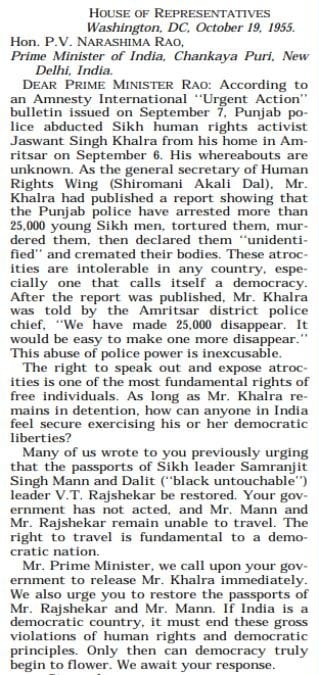
On 19 October, several members of the US House of Representatives wrote to Prime Minister PV Narasimha Rao, referring to Khalra’s allegations that 25,000 young Sikh men had been tortured, murdered, and later declared “unidentified” by the Punjab Police.
“Mr. Prime Minister, we call upon your government to release Mr. Khalra immediately. If India is a democratic country, it must end these gross violations of human rights and democratic principles. Only then can democracy truly begin to flower,” the letter read.
CBI submits its report
All hope was not lost.
Almost a year after Khalra’s disappearance, the CBI finally broke months of official silence. On 22 July 1996, it submitted its first interim report.
The document uncovered 984 illegal cremations in Tarn Taran between 1984 and 1994.
On 30 July came a second report. This one was about Khalra’s abduction. It held nine Punjab police officers serving under SSP Sandhu responsible for Khalra’s abduction.
However, a lot had unfolded between Khalra’s disappearance in September 1995 and the CBI’s first report in July 1996. Piece by piece, things began to make more sense.
On 6 September, Kulwant Singh, who was being held in a drugs case, saw Khalra being brought to the Jhabal Police Station, according to the facts recorded in the Supreme Court’s 4 November 2011 judgment.
Forty-eight days after the abduction, Kikkar Singh, himself in police custody in an unrelated criminal case, found Khalra detained at Kang police station. Kikkar helped a bruised and injured Khalra eat before he was taken away.
For SSP Sandhu, the past was slowly catching up. Before he could be charged in Khalra’s disappearance, Sandhu died by suicide on 24 May 1997, throwing himself in front of a train. A note recovered from him read, “It is better to die than live in humiliation.”
However, something still seemed amiss.
“The CBI found the evidence only for abduction, illegal detention and torture, for which it had filed a charge sheet against nine police officers in 1998,” said Rajvinder Singh Bains, counsel for Khalra.
One crucial piece was still missing—proof of murder.
“That fill-in-the-blank was SPO Kuldip Singh,” said Bains.
Also read: Delayed rains, a supercomputer & Rajiv Gandhi under pressure. How 1987 economy beat the odds
Principal Witness 16, Kuldip Singh
Kuldip Singh was the personal security guard of co-accused SHO Satnam Singh. He shadowed Satnam wherever he went.
That’s how he became an eyewitness in the case. However, he broke his silence only after Sandhu’s death.
In his testimony, as observed in the Supreme Court’s 14 November 2011 judgment, Kuldip was given the task to serve meals to Khalra.
Four or five days after Khalra was brought to the Jhabal Police Station, Kuldip recalled, SSP Sandhu arrived at Jhabal Police Station with DSP Jaspal and bodyguard Arvinder Singh in an unregistered Maruti car.
Soon after, Satnam, SHO Jasbir Singh, and head constable Prithipal Singh arrived in another car. The officers entered the room where Khalra was being held and started beating him.
One evening, Kuldip said in his testimony, Satnam drove Khalra in a private Maruti car to SSP Sandhu’s residence in Manawala village near Amritsar.
There, Khalra was questioned by DGP KPS Gill and another senior police officer behind closed doors, wrote Narayan. Hours later, Satnam drove Khalra back to Jhabal Police Station.
“On the way back, Satnam Singh said, ‘Khalra, if you had listened to Gill, you would have been saved and so would we,’” said Bains.
On 28 October 1995 at 7 pm, Jaspal, Arvinder, Jasbir, Prithipal, and Surinderpal Singh came to Jhabal Police Station. The officers began assaulting Khalra.
Kuldip was sent to fetch hot water. While outside, he heard two muffled gunshots. When he returned, Khalra was dead. His body, still bleeding, was placed in the boot of a vehicle.
The convoy then drove to Harike, where the activist’s body was dumped into the canal.
“With Khalra’s body gone, the officers gathered at the Harike Rest House. Sandhu joined them, and Peter Scott was served,” said Randhawa.
The final piece of the puzzle had fallen into place, but questions surrounding the “unidentified” remained unanswered.
Identifying the disappeared
The battle over Punjab’s secret cremations entered a new phase on 12 December 1996. Acting on the CBI’s interim findings, which described “flagrant violation of human rights on a mass scale”, the Supreme Court referred the matter to the National Human Rights Commission (NHRC).
The Commission took charge on 2 January 1997, but the road ahead was anything but smooth.
No sooner had the NHRC taken charge than both the Centre and the Punjab government challenged its powers, wrote Narayan. The governments argued that under the Protection of Human Rights Act, 1993, the NHRC could not inquire into a complaint if it was filed more than one year after the alleged human rights violation occurred.
The Commission stood its ground. It ruled that it was acting as a sui generis body under the Supreme Court’s authority and was not constrained by the Act’s one-year limitation.
Yet, within two years, NHRC itself pulled back.
In January 1999, the Commission narrowed the scope of its own inquiry, from the larger question of Punjab’s disappearances to the 2,097 bodies cremated by the police in the districts of Amritsar, Tarn Taran, and Majitha.
Years passed sifting through piles of cremation registers, police records, and witness testimony, while commissions headed by Justice KS Bhalla (2007) and later, Justice DS Bains (2012), were appointed to identify the dead.
By 3 April 2012, the Commission had identified 1,513 of the 2,097 victims, while 532 remained unnamed.
The NHRC awarded compensation of Rs 27.94 crore: Rs 2.5 lakh for each of the 194 custodial deaths and Rs 1.75 lakh for the remaining identified victims.
It was a bittersweet victory. After a decade of inquiries, reports, and judgments, the truth remained incomplete. For some families, their sons had finally been acknowledged. For many others, they remained “unidentified”.
Justice at last
Sixteen years after Khalra was abducted from outside his home, the Supreme Court finally delivered its verdict.
On 4 November 2011, it upheld the convictions of former DSP Jaspal Singh and police officials Jasbir, Satnam, Surinderpal, and Prithipal, affirming that Khalra had been abducted, illegally detained, tortured, murdered, and his body dumped in the Harike canal in an attempt to erase the crime.
“Jaswant Singh Khalra had taken the task to expose the misdeeds of the police… Tolerance of police atrocities would amount to acceptance of systematic subversion and erosion of rule of law,” the Supreme Court said in the judgment.
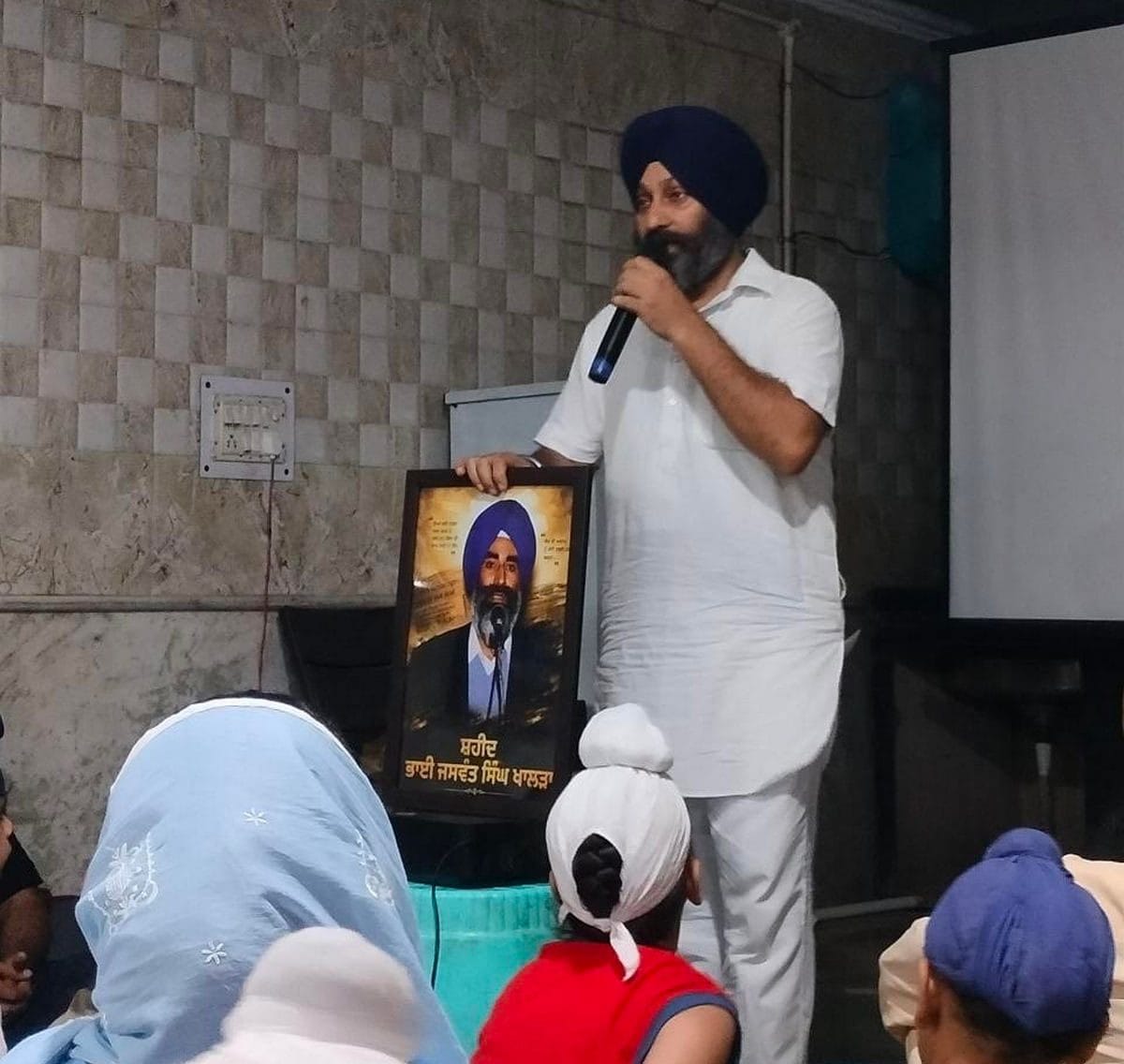
Thirty years since his abduction, Khalra has become a household name and his legacy memorialised in stone.
He lives on through books and films alike. Schools bear his name—from Jaswant Singh Khalra Khalsa School in Brampton, Canada, to Jaswant Singh Khalra Elementary School in Fresno, California.
Most recently lionised in the controversial film Satluj, Khalra’s story continues to echo across generations.
In the crowded lanes of Delhi’s Shastri Nagar stands Gurudwara Dashmesh Darbar, the heart of the community.
On 11 July, there wasn’t an inch of space in the brightly lit gurudwara. Three generations sat shoulder-to-shoulder, eyes locked onto the screen, as Satluj was being screened.
As the credits rolled, the gurudwara secretary stepped forward, carrying a framed photo of Khalra.
“Everyone should keep a photo of Jaswant Singh Khalra in their homes and offices,” he said.
(Edited by Prasanna Bachchhav)