






With a scorching sun above and not a cloud in sight, the country braced for a ruthless year – one that would test the resilience of a predominantly agrarian economy, deepen food insecurity and upend the lives of millions who depended on farming.
The year was 1987.
And it all began thousands of kilometres away, off the coast of Peru. By the end of 1986, the waters of the equatorial Pacific turned unusually warm.
It was clear – El Niño had arrived.
With that, India was about to turn dry.
Train after train moved across the countryside, rushing water and fodder from one state to another.
An unforgiving dry spell had brought much of the country to a standstill. Parched lips, withered crops, and endless stretches of barren land became the defining images.
The drought of the century had engulfed almost the entire country, hitting the northern granaries and western states the hardest. Wells dried up and reservoirs shrank to depressingly low levels.
The air was thick with fear. A sense of déjà vu set in.
The horrors of the 1979-80 drought came rushing back. The Army had been called in — not to fight but to distribute water through military trucks and trains.
The government, with sweat lining their brows, chose to maintain a calm façade. Beneath the calm, however, was a faint sense of optimism — that the rain gods will show some mercy.
Nearly two-thirds of the country’s landmass was in the grip of drought. Hanging in the balance was the fate of about 300 million people—almost 40 per cent of India’s population.
The year of great drought
At first, 1987 seemed like any other year.
The southwest monsoon had arrived on the shores of Kerala by 2 June, its usual time. The moisture-bearing winds progressed steadily along the western coast.
Soon, the Bay of Bengal branch brought heavy showers to the Andaman and Nicobar Islands before rains swept the hills and plains of northeast India. Bihar and Bengal, too, were drenched in monsoon showers.
However, all of a sudden, the winds halted.
An anti-cyclonic circulation or high-pressure zone developed over the Indian Ocean and northwest India, suppressing any advancement of monsoon across the Indian subcontinent.
It seemed the rain gods had turned a blind eye. No amount of prayers could soften their hearts.
The rains withdrew from much of the country almost as quickly as they had arrived. July was even worse and the deficiency became severe.
Regions that normally receive abundant rainfall – the Gangetic belt, central India, and the Western Ghats – were gripped by prolonged dry spells, receiving less than half their normal rainfall.
Worst hit were the kharif crops, sown in June and July on the hopes of a generous monsoon year. Yet, the prolonged dry spells in both these months quelled all hopes into despair. A question mark hung over 60 per cent of India’s foodgrains.
A sense of uncertainty also loomed over the fate of rabi crops, due to be sown in the coming winter.
In Gujarat, which produces the bulk of India’s groundnuts, no sowing was recorded in nearly 75 per cent of the groundnut-growing areas. In Rajasthan, bajra bore the brunt.
The drought was particularly severe in Uttar Pradesh – affecting 50 of the state’s 57 districts, prompting Chief Minister Vir Bahadur Singh to remark, “We have never had such a bad dry spell.” Nearly 40 per cent of rice saplings never made it out of the nurseries.
Gujarat, Madhya Pradesh, Maharashtra and Rajasthan reeled under severe drinking water stress. Water tables dwindled and wells pumped salty and brackish water.
Soon, livestock was caught in the deepening crisis. Fodder became so scarce that farmers in several villages in Gujarat put a red tilak on their bulls’ foreheads and let them loose to fend for themselves.
“As many as 4.47 lakh cattle had to be fed in emergency camps,” reported India Today on 31 August.
The list of drought-hit states grew to include Andhra Pradesh, Karnataka and Kerala, states that had initially reported good early showers.
“India’s Drought Is Worst in Decades,” read a New York Times headline on 16 August. Large parts of the country plunged into darkness as electricity was diverted to farmlands.
Even the heavily irrigated states of Punjab and Haryana were not spared.
In Haryana, as per an Economic Times report on 23 August, “Crops worth Rs 700 crore have been damaged,” while the July dry spell prevented about 60 per cent of the paddy crop from being sown.
The perils, however, do not end in the fields.
What this sets off is a domino effect—disrupting food supplies, soaring prices, shrinking disposable incomes, weakening rural demand and hurting industries dependent on agricultural output.
A year etched in memory
With the arrival of August came a glimmer of hope. Rain-bearing clouds reached even the westernmost corners of the country.
But by then, the damage was already done. The late revival of the monsoon could not undo the devastation of the previous two months.
After four consecutive years of poor monsoons, the drought of 1987 left scars that millions would never forget.
The numbers were anything but reassuring.
By the end of the season, India had recorded a 19 per cent rainfall deficit. As many as 21 of the country’s 35 meteorological subdivisions — representing two-thirds of the Indian landmass — recorded deficient or scanty rainfall.
For a country where nearly two-thirds of the population depended on agriculture for a living, and over 70 per cent of the cultivated area still remained rainfed, 1987 became a year etched into the nation’s memory.
The challenge ahead was daunting and the crisis too big to remain confined to the fields.
The 1987 drought in Parliament
The monsoon crisis and subsequent drought could not have come at a worse time.
It was a period when Rajiv Gandhi – India’s “Prince-Charming” – known for his charisma, youth and fascination with computers, was losing his sheen. Gandhi’s carefully crafted image as “Mr Clean” came crashing down under the weight of the Shah Bano debacle and the massive Bofors scam controversies that defined his tenure. By then, the stakes were already running high for the government.
For six straight days, lawmakers debated every aspect of the crisis. Every speech carried an appeal, a demand, or a suggestion, while the government found itself at the receiving end of mounting questions and growing public agony.
Bombarded with accusations and struggling with fading political appeal, the government faced rising disappointment from all quarters.
“Today the drought situation has made everybody uneasy,” said Karnal MP Chiranji Lal Sharma. “The farmer, the labourer, whoever it may be, when he looks at the sky, what does he see in the blue sky? He sees poverty, starvation and destruction.”
MPs took turns presenting the plights of their respective states and constituencies. Members from Gujarat spoke of empty fields; those from Andhra Pradesh spoke of villages parched beside the Godavari. In Madhya Pradesh, with no work available, farmers resorted to reciting the Ramayana. Many others warned that the crisis was exposing decades of planning failures. Relief alone, they argued, would not suffice—accountability, better irrigation, and long-term drought-proofing had become urgent national priorities.
A deep sense of restlessness took hold. With national resources limited, a political tussle soon emerged, as each MP insisted that the needs of their region demanded immediate attention. In Gujarat, where drought had damaged 80 per cent of the crops, Valsad MP Uttambhai Harjibhai Patel demanded Rs 187 crore in relief, insisting that “the condition of Gujarat is several times more serious than that of other parts of the country.”
Speaking for Andhra Pradesh, where 19 of the state’s 23 districts were reeling under critical drought, Shrihari Rao launched an offensive and accused the Centre of having “singularly neglected us [AP] right from the beginning.”
Invoking a Telugu saying, Rao contrasted the Centre to a “mother who neither provides food nor allows to beg.” Referring to the Polavaram and Telugu Ganga projects, Rao said, “Neither the central government takes up the execution of the projects nor allow the state government to execute them. What is the reason?”
Kammodilal Jatav, on the other hand, appealed for maximum funds for Madhya Pradesh, arguing that it was one of the country’s most backward states.
Just two days earlier, on 15 August 1987, India had marked 40 years of Independence. The celebration, however, soon gave way to a stark review of the nation’s first four decades—and the picture it painted unsettled many in Parliament.
“Mr. Chairman, Sir, the country has attained freedom 40 years ago. But has achieved very little,” said AJV Butchi Maheswara Rao, TDP MP from Amalapuram, Andhra Pradesh. “It is most unfortunate that the nation is still suffering from poverty and hunger.”
Forty years after Independence, lawmakers argued, the country still struggled to provide something as basic as drinking water to its villages and towns.
“What are our achievements for which we can take pride? Mere political independence will not do. Real independence lies in our economic independence,” added Shrihari Rao.
By then, the scope of the debate had widened significantly.
For some, decades of lopsided planning had turned droughts and floods into permanent features of the Indian landscape. For others, the pitiable state of farmers and agricultural labourers—who made up over 65 per cent of the population—was the core issue.
Even abandoned cattle and severe fodder shortages became major flashpoints.
“You know that if the cattle die, from where the milk will come?” asked Bapulal Malviya, Congress MP from Shajapur, Madhya Pradesh. Harish Rawat, MP from Almora, suggested that fodder banks, similar to Fair Price Shops, should be opened immediately at the block level.
As a parallel crisis emerged with a large-scale exodus from rural villages to cities, parliamentarians insisted that relief measures had to be undertaken on a “war footing.”
The fiercest criticism came from the South. Leading the charge was Shrihari Rao, who accused the government and the Planning Commission of lacking both vision and long-term planning.
“Sir, out of the 40 years, the Congress has been in power for 38 years. Hence, it has to take all responsibility for this kind of lopsided planning,” remarked Rao. “Bad planning is responsible to a great extent for this sad state of affairs.”
For some, the last remaining hope lay in divine intervention. It was UH Patel who urged that sanyasis and holy men be called upon to perform yajnas and “pray to God to be benign to us to make rain in this grave situation.”
From the ramparts of the Red Fort, Rajiv Gandhi reassured a worried nation. In his Independence Day address, he declared that while managing the drought would require a collective effort, “our granaries are full.”
However, Gandhi also issued a note of caution. The drought, he argued, should not become a reason to halt the country’s progress. “By stalling development, by suspending development, we will have to face a greater crisis in the days to come. We have to find resources so that without reducing or slowing the pace of development, we can face the present challenge,” he said.
Beneath every argument lay one common thread: India’s overwhelming dependence on agriculture. The elephant in the room had become impossible to ignore—would Indian agriculture, and the economy at large, ever break free from the vagaries of the monsoon?
India’s pursuit of a supercomputer
Amid the relentless attacks in Parliament, another high-stakes geopolitical controversy was unfolding in the background, one that would reshape the future of India’s technological ambitions.
India was soon to receive its first supercomputer, though it was an inferior model to what was originally sought. The road to acquiring it, however, was anything but straightforward. The lesson from the drought woes was clear: India had to be better prepared. The first step toward that preparedness lay in the early detection of extreme weather events.
The answer lay halfway across the world.
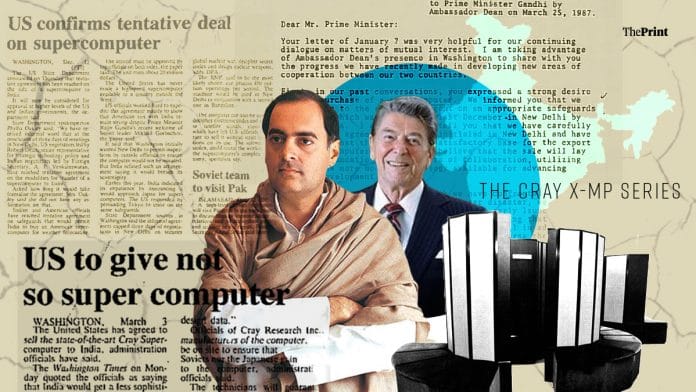
India had its eyes on the Cray X-MP/24 supercomputer, an American marvel. For India, however, it was more than just a computer; it was about survival. It was a means of rewriting the fate of millions whose lives ebbed and flowed with the vagaries of monsoon.
Gandhi’s government argued that the Cray could transform weather prediction by processing vast amounts of meteorological data in just a few days instead of weeks, a godsend for a country that remained overwhelmingly dependent on the skies.
Acquiring the machine was never going to be a cakewalk. India and the US, after all, were not exactly all-weather friends. As India knocked on Washington’s door, it found itself caught amid the looming clouds of cold war politics.
India’s neutrality and its close ties with the Soviet Union had long bred unease in the White House – even after Rajiv Gandhi and Sonia Gandhi were feted and fawned over during their 1985 visit to Ronald Reagan’s White House. A lingering fear emerged that Washington could not easily shake off: what if this technology found its way into the hands of the Soviets or that India could use it to develop nuclear weapons?
What complicated matters further were the two countries’ vastly different visions for the machine. To India, the Cray was a tool for weather forecasting; for the US, it was a strategic asset. The Cray supercomputer was a double-edged sword. As The New York Times observed on 11 December 1986, the machine’s “potential application in military and nuclear weapons programs” lay at the heart of US concerns.
Approving the sale would also break new grounds, as a Washington Post article reported on 7 July 1986. It would make India the first non-Western country to receive technology that the US had, until then, reserved only for its closest allies. With that, a commercial deal was transformed into a highly sensitive technology negotiation wrapped in suspicion, mistrust and an arduous, year-long diplomatic bargain.
The negotiations soon descended into a tedious and exhausting diplomatic barter over conditions, safeguards and inspections. No amount of Indian assurances that the Cray would be used solely for weather forecasting could ease the Reagan administration’s concerns. Washington remained adamant about strict guarantees against diversion or military misuse. Tempers flared and negotiations repeatedly staggered on the verge of collapse. Frustrated by the deadlock, India even briefly explored the possibility of buying a Japanese supercomputer instead.
After months of gruelling talks, a breakthrough finally appeared in sight.
“U.S. confirms tentative deal on supercomputer,” declared an Indian Express headline on 13 December 1986. Led by Robert Dean and AP Venkateswaran, the two negotiating teams had “reached a tentative agreement on the modalities for transfer of the supercomputer to India.”
The Cray was expected to cost up to $20 million, according to a report in The New York Times.
On 25 March 1987, John Gunther Dean, the US Ambassador to India, arrived in New Delhi carrying a letter from Ronald Reagan to Rajiv Gandhi.
“We informed you that we would agree to the sale, contingent on an appropriate safeguards agreement…. the export of a supercomputer to India,” Reagan wrote. “I believe that the sale will lay a strong foundation for a new era of collaboration, utilizing some of the more modern technology available for advancing India’s development.”
The price, however, was not just monetary.
“US to give not so supercomputer,” blared an Indian express headline on 4 March 1987. India had to settle for a less sophisticated model – the single-processor Cray X-MP/14—instead of the dual-processor model originally requested, packages with strict US conditions governing its use.
Critics at home questioned the deal, calling it a compromise on “second-rate technology.” as noted in a New York Times article on 9 October 1987.
Yet, this bittersweet Cray episode served as a powerful reminder that reliance on foreign technology was untenable. Within a year, India established the Centre for Development of Advanced Computing (C-DAC) in 1988, eventually paving the way for the nation’s first indigenous supercomputer: the PARAM 8000.
The economic resilience
Whether it was the prayers and yagnas of sanyasis or the government’s timely intervention is impossible to say. By August, moisture-laden winds swept across the Indian subcontinent. The much-awaited monsoon had finally arrived, drenching a parched country – late, yet not too late.
In the past, droughts of this magnitude had brought widespread rural distress and weakened purchasing power. So did this one. Yet, the drought of 1987 told a slightly different tale – one of resilience and one that quietly altered the course of the Indian economy.
The year 1987 marked a definitive turning point. The Economic Survey 1988-89 described the economy’s “resilience in the face of severe weather stress” as one of its defining strengths. While agricultural output declined by around 2 per cent—partly cushioned by strong rabi production—industry and infrastructure sustained high growth, allowing the real Gross National Product (GNP) to expand by 3.6 per cent. It reflected what the Economic Survey described as a “relatively subdued impact of supply shocks in agriculture on the overall economy”, a significant departure from the past.
“Structurally, the turning point came around 1979-80, when services overtook agriculture as the largest sector of the economy,” says Arun Kumar, a retired professor of economics at JNU. “So even though the 1987 drought severely affected agriculture, overall GDP continued to grow.”
The drought of 1987 thus signalled a structural shift in the Indian economy, which has since gradually broken free from the vagaries of the monsoon. However, complete independence remains an elusive goal.
“Nearly 43 per cent of India’s workforce still depends on agriculture,” says Ashok Gulati, former Chairman of the Commission for Agricultural Costs and Prices. “India’s GDP hasn’t decoupled from agriculture. The relationship has weakened over time, but it hasn’t disappeared.”
Kumar agreed with Gulati, saying while the economy is more resilient today, it isn’t immune.
“Agriculture may no longer determine GDP to the same extent, but it still shapes inflation, rural incomes and the purchasing power of millions in the unorganised sector,” he said.
An uncertain monsoon only compounds the problem, beyond the agricultural sector.
“An economy prospers only when its people prosper,” Gulati notes. “The welfare of the masses – that is the critical part of the story.”
(Edited by Prashant Dixit)