





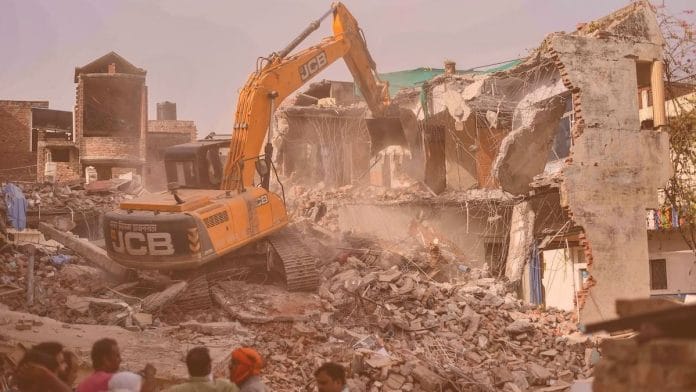

Hindutva is an ideology, but it is also a figure. If it is a figure, what does it look like? Can we think of a body, a figurative image for Hindutva? Does it look like a man, a zombie or a machine? How does it walk? How does it possess and dispossess people? After the powerful resurgence of Hindutva, I was searching for a complex definition for it. I was looking for possible grey areas. Its fetishized figure. Its coated meanings. Its tooth pattern—chiselled teeth, tiger teeth, side teeth and rock teeth, specialized to move the earth and break the family and house apart.
I was looking for a figurative image that can capture its dynamic energy and destructive power, its crushing passion and unbridled emotions, its irresistible mobility and constant automobility. I was looking for a figure made of body and machine that could capture Hindutva’s muscle and movement. Something that epitomizes the masculine, single-minded, phallic urge, as well as the muscular forcefulness that brooks no protest, clearing the way to an ethnocentric Hindu nation.
I was trying to understand the electrifying power of Hindutva that makes its words viral and puts the body in a trance. Perhaps an installation work of Hindutva that instils fear by aligning aesthetics and anaesthesia together. I was looking for an artefact. An object that has cultic and exhibitory values but equally intends to crush the body into pieces. I was looking for an image that brings its aesthetics and politics together: artillery and artefact together, body and machine together, slogan and silence together, fear and hatred together, fun and violence together, toy and tank together.
I was looking for the desire of Hindutva that steals away love and instils violence in children’s minds, like a toy gun. I was looking for an object that rolls these parts together into one, of being for Hindutva what the fascismo was for fascism—a moving bundle of iron rods and axe. Because we know where the Hindutva ideology came from.
The figurative image for Hindutva that I found was that of a bulldozer—moving and bulldozing. It was open and out there, in body and spirit, in politics and procession, in sign and sensation, in mobs and automobility, in manhood and machinehood. A body-device that becomes biopolitical as well as geopolitical in its domination. It moves to demolish; it moves to displace, to dominate. It moves to decimate, to dispossess. It helps the corporates get possession by dispossessing the commons. Its projects are often called development but end up in destruction and displacement. It moves to dismiss any prospect of dialogue. It moves to move the earth on which one stands. It moves to create a site for new settlers at the expense of the life and livelihood of the original inhabitants. It moves to become a part of majoritarian power and politics.
The connection between Hindutva and the bulldozer looks so clear, as though they were made for each other—a holy marital alliance that would probably only ends with the ceremonial death of a partner. This pairing of muscular manhood and unstoppable machine is common and regular; only the details differ. Their encounters have shaped each other geographically as well as culturally. In Israel, a bulldozer appears more Zionist, while in the United States, it carries the appearance of white supremacy. The bulldozer becomes a baba (a venerable ancestor or religious guru) when it reaches India and turns into the figure of Hindutva, as though the machine has been transported from the Vedic age.
I soon realized that Hindutva does not hold complexity. It simply cannot. It is not interested in complex viewpoints. Perhaps we do not need a complex definition for Hindutva. The bulldozer is a sign that Hindutva is flat. It wants to excavate everything: the soil that nurtures the soul, the food that nourishes the body and the home that gives us a sense of belonging. It tries to smoothen out history.
It wants to cut down raised hands and send lifted heads rolling. It wants to make everything flat and uniform, to go with the agenda of neoliberal politics. For Hindutva, everything is an exhibition—from faith to religion to nationalism. How we will know if you don’t show? It is a remarkable show of politics on a spectacular level; a neoliberal avatar of Hinduism in a destructive form.
Also read: Where are the borders of Bharatvarsha?
In India, a bulldozer does not remain a machine. It has become an artefact. It has entered into the popular culture and psyche. We all have seen it clearing the roads, deployed in construction works and so on. But have you seen it is becoming a part of weddings and processions? The video of a groom in Uttar Pradesh riding a bulldozer to his wedding was reported to have gone viral.2 The groom can be seen wearing a sherwani and sunglasses and dancing to the sound of the dhol as the procession wends its way through a lane. He stands on the blade of a bulldozer with his family members and takes selfies. What a fascination the bulldozer casts! Call it a flat attraction if you like, but it’s powerful. Though a bulldozer still moves slowly, it has left horses and elephants behind in the race for fascination.
Bulldozers are appearing at political rallies and birthday celebrations. People are offering them as wedding and birthday gifts.3 Bulldozer toys are popular among the kids. A report says bulldozer pichkaris (water guns) sold like hotcakes in Banaras during Holi.4 Leaders ride bulldozers, couples are gifted bulldozers in mass wedding, bulldozer cranes are used to unfurl the national flag. Bulldozers are getting a royal welcome by the Hindutva followers. After destroying the homes of minorities, the machine is attaining messianic proportions for Hindutva. Its teeth go up and down, it moves as your new fascist in town.
There are popular songs and music tracks dedicated to the vehicle. The media is full of news and views on it. Leaders are trying to name themselves after it—bulldozer baba, bulldozer mama and so on. The bulldozer is the new bull of Indian politics. I came across this incident of a young man asking for a bulldozer at a pharmacy in Bihar—it turned out to be a condom. I checked—in fact, there is a JCB-brand ‘Gorilla Reusable Condom’ that is actually an extender. Its promotion materials say, ‘It restores the confidence and relieves you of the inferiority complex’.5 The bulldozer is symptomatic of the insecurities of Hindutva masculinity. It has become a part of popular culture. Young men and women are getting bulldozer tattoos. They feel it is cool. They put the image of a bulldozer inside a heart. Mainstream Indian media is full of news and visuals of the bulldozer. There was a time when guns used to be the favourite toy; it is now a bulldozer.
Retailer showrooms are full of bulldozer toys in different colours. The bulldozer has become a new fad in the market, from being a banal tractor to becoming a popular mass object. The bulldozer remains flat in façade and unglamourous in appearance, but it still remains a fascinating machine. What is this relationship between flatness and fascination? It can be argued that flatness itself becomes fascinating. There is flatness in Modi and Trump’s speeches. Are they not fascinating?
Hindutva and the bulldozer have moved together as the ideology of hyper-nationalism and neoliberalism. They have come to a new home, fashioning, fuelling and flirting with each other in a ‘New India’. It looks unholy but remains the most holy alliance in history—fascism and the market. It is not surprising that as Hindutva has moved to the centre, the bulldozer has taken centre stage. Some critics have noted that this time, Hindutva has come with the bulldozer. Some have also said that Indian democracy has entered a bulldozer era. Just as the war tank emerged as a cultural icon in the United States, symbolizing its military, masculine and techno pride, the bulldozer emerged as a cultural icon to probe India’s Hindutva’s rise.
This excerpt from ‘Spectacle State’ by Brahma Prakash has been published with permission from Harper Collins.