






The idea of an ancient India, ‘Bharatvarsha’, and its inhabitants have come under scrutiny from B.D. Chattopadhyaya, a serious historian who has examined many of the ancient texts and inscriptions only to extirpate this fallacy of an eternal India. In The Concept of Bharatavarsha, he deconstructs the idea of a ‘bharatvarsha’ with references to ancient texts and inscriptions as well as to rudimentary geographical concepts. Chattopadhyaya concludes that the terms ‘swadesa’ (one’s own country) or ‘videsa’ (a foreign country) would be of no relevance in the context of ‘bharatvarsha’. The notions of a border or a frontier were absent, as, historically, there was no serious distinction between outsiders and local inhabitants.
Chattopadhyaya concludes ‘that the major divide in Indian society was perceived through the angle of “varna” (caste) which made the all-important difference between those within it and those without it.’ It is all too easy to superimpose Western geographical and political concepts retrospectively, and, for the sake of convenience, ignore what was relevant to the people of the time. The renowned historian of Indian nationalism, Sir Christopher Bayly, understood the Hindu conceptualisation of geography to mean that ‘bharatvarsha’ was a ‘sacred space’; it was emphatically not a territorial region with defined borders as is now widely assumed.
These assumptions persisted well into the nineteenth century. One of the signal signs of a sense of robust nationhood is the attitude towards foreigners or towards people not of the territory, which was never the case until relatively recently. Faisal Devji, writing on the Great Uprising of 1857, stated that:
The English therefore do not seem to have been disliked for being foreigners at all, but only for breaking the moral compact that defined India as an empire of distinctions.
The point being that the imperial push for proselytism was seen as objectionable by the Hindus and Muslims alike, and in doing so the English had crossed a line.
The true value of Chattopadhyaya’s book, however, is how he interrogates the issue which forms the bedrock of much nationalist thinking: that ancient India approximated to a civilisational state. This was clearly the understanding of both Gandhi and Nehru. This was a convenient argument. It had the virtue of neatly sidestepping the controversial fact of medieval India and its Muslim conquests, as what was sought to be represented was a historic continuum which had been etiolated by the ravages of the Middle Ages and colonialism, but had now the opportunity to regenerate itself in the sunlight of freedom.
Also read: A royal hunt—How the cheetah features in Indian history
Chattopadhyaya is, however, dismissive of this single political construct of India and presents an analysis of regional cultures and how they came about. As he puts it, ‘Modern regions like Bengal, Maharashtra or Rajasthan would not have existed throughout Indian history. Historical evidence and perspective therefore demand that we look for processes that went into the making of regions and the particular characteristics associated with them.’ He manifestly repudiates the construct of a superstructure and remarks that ‘the perspective of looking at Indian civilisational entity from above will be turned upside down, and the effort should be made to look for the historical processes involved in making of the large entity rather than widely distributed sites of diversity as all derived from one tradition.’ Sanjay Subrahmanyam further explicates this and talks of a new homogeneity being founded in the early nineteenth century, attributing it largely to Western orientalists.
In this context, the work of orientalists William Jones and H.T. Colebrooke is also relevant, as they sought to establish an overarching common origin of civilisations. As historian Dilip Menon remarks, ‘It was in the Sanskrit texts that the real genius of India’s Hindu past was looked for and not in the multitude of Hindu religious practices.’ To this extent, other popular Indian cultures which had strong roots in regions such as Bengal and Andhra Pradesh were discarded in favour of this fetish with high Brahminical culture. As Savarkar put it, there was a ‘process of assimilation, elimination and consolidation,’ adumbrating what we call Hinduism.
It would not be incorrect to assume that many of these territories, which are now West Bengal, Orissa, Rajasthan and Andhra Pradesh, had distinct languages, histories and cultural traditions divergent from each other and would have had the basis to be regarded as independent sovereign entities, but for the colonial intervention. These facts sustain the argument that the normative position for a loose federal structure was very much in place post Mughal rule and the perception of eternal India as a single political construct, in the same way as imperial China becoming one under the Qing dynasty, is baseless and illusory.
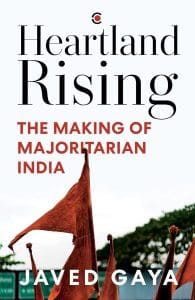 This excerpt from ‘Heartland Rising’ by Javed Gaya has been published with permission from Context.
Absurd argument. Speaking different languages dialects doesn’t mean we are different. Our culture , thought , philosophy, were same from Afghanistan to srilanka and to the east till the invaders came. We were celebrating the same festivals, following the same calender , visiting the same places of worship.