





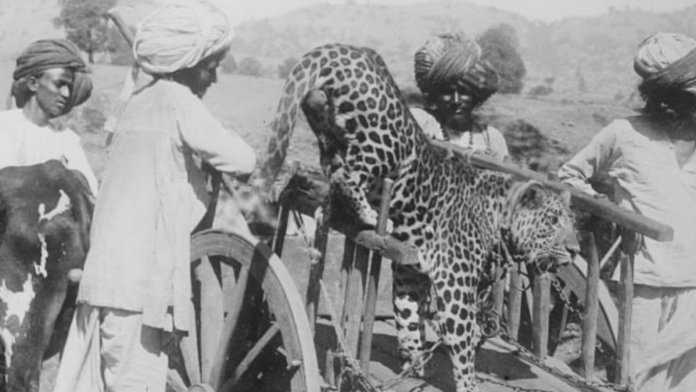

The cheetah, also called a hunting leopard, is distinctive among the felids in that its claws are only semi-retractile. Its head–body length ranges from 120‒150 cm., the tail length is 60‒80 cm. and its average adult weight is approx. 50 kg. The male is usually slightly larger than the female. The pelage is marked by black spots set close together, although stripes occur in some rare colour variants (Eaton 1974).
Cheetahs are adapted for stalking and running down their prey in their open habitats. In India, hares, blackbucks and chinkara were their preferred prey. The decline of the cheetah in Asia began in the nineteenth century due to the depletion of prey, overhunting and loss of habitat to agriculture and grazing of sheep and goats, leading to conflict with humans (Chavda 2023). From the Mughal period till the British era, cheetahs were valued and trained as hunting animals for coursing antelopes and hares. During the British period, the species was downgraded to pest status and government bounties were paid for killing not only adults but also cubs—between 1871 and 1925, no fewer than 70 cheetahs were killed (Rangarajan 1998). In December 1947, Maharaja Ramanuj Pratap Singh Deo, of the erstwhile state of Korea in present-day Chhattisgarh, chanced upon three young male cheetah siblings at night, and he promptly shot them down without hesitation. They were probably from a single litter and their parents were never traced (Chavda 2006). By the late 1950s, it was believed that the cheetah had become extinct in India. Kazmi and Chavda (Chavda 2023) have tried to trace the chronology of the cheetah’s extinction in India, suggesting that it may have persisted until at least the 1960s and possibly till the mid-1970s.
In 1952, the Indian Board for Wildlife met to discuss special means to save the species but, sadly, it was already too late. In the early 1970s, M.K. Ranjitsinh, then Director of Wildlife Preservation, Government of India, initiated talks with Iran to obtain Asiatic cheetahs (Acinonyx jubatus venaticus) from there in exchange for Asiatic lions from India. This effort did not bear any fruit. India was soon engulfed in the political upheavals of the Emergency in 1975, and in Iran, Mohammad Reza Shah Pahlavi, who was supporting this idea, lost his throne in 1979. Now the status of cheetahs in the wild in Iran is extremely precarious; their numbers may be fewer than 20 (Chavda 2023).
After a lull of several years, another move was made towards fulfilling the objective of bringing cheetahs back to India, this time spearheaded by the Government of India itself. The new push came in 2009, when the Standing Committee of the National Board for Wildlife discussed it under the chairmanship of Jairam Ramesh, then Minister of State (Independent Charge) for Environment and Forests.
The discussions progressed based on the idea of bringing Southeast African cheetahs (Acinonyx jubatus jubatus) from Namibia and South Africa to India. There were considerable objections to this idea but they were not considered seriously, as the respected late Canadian professor Val Geist and American geneticist Stephen J. O’Brien had vouched that there could be no difference between African and Asiatic cheetahs (Chavda 2023). Thapar et al. (2013) had argued that cheetahs and lions are not native to India and were only imported by royalty, but this was countered by Chavda and Ranjitsinh (2013).
The meeting was followed by surveys for potential habitats, and the identified areas were Kuno Palpur Wildlife Sanctuary (WLS); Gandhi Sagar WLS along with parts of Mukundra Hills Tiger Reserve as one landscape; Nauradehi WLS in Madhya Pradesh; and the Shahgarh landscape in Rajasthan (Jhala et al. 2021).
On 17 September 2022, a specially configured 747 cargo aircraft landed at Gwalior’s Maharajpura IAF airbase with its precious cargo of eight cheetahs—five females and three males—after a long flight from Windhoek, Namibia. Two Mi-17 helicopters of the Indian Air Force flew them from Gwalior to Kuno Palpur, their final destination. Within hours, Prime Minister Narendra Modi released the first cheetah to eventually roam free in India’s natural landscape 70 years after the animal’s plight came to the attention of the Indian government. Twelve more cheetahs, this time from South Africa, landed on 18 February 2023 after a similar journey.
The cheetahs were first released in a 6 sq. km. acclimatization enclosure, where nearly 250 chital had been introduced, and with several quarantine enclosures. As of 8 June 2023, there were 17 adult cheetahs. One female from Namibia gave birth to four cubs in March 2023, but three of them reportedly died due to the sizzling heat in Kuno. Two females and one male also died. The Madhya Pradesh Forest Department is making dedicated efforts to take care of the cheetahs, and only time will tell whether the conservation effort to reintroduce cheetahs to India will be successful or not.
Kuno, where the introduction has been carried out, has a good number of leopards, and past records of cheetah distribution show that there was no place where cheetahs and leopards occurred together. The conservationists who oppose the project believe that there is no suitable habitat—a vast scrub and grassland habitat with abundant prey such as blackbuck and chinkara—for cheetahs to survive in present-day India.
 This excerpt from ‘Mammals of India’ by AJT Johnsingh and PO Nameer has been published with permission from HarperCollins Publishers India.