



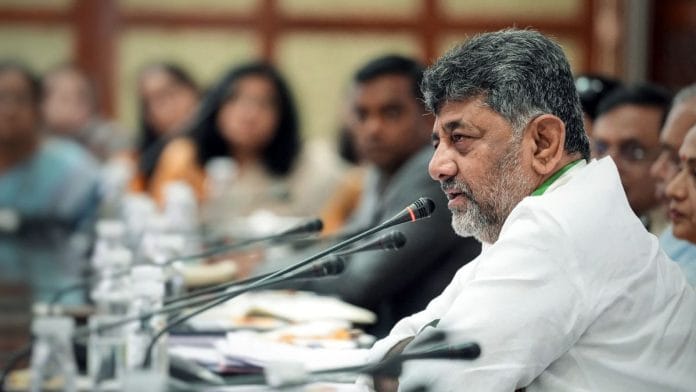

Shivakumar’s family had a tradition. If the first child born to a couple was a girl, she was named Kempamma; if it was a boy, he was named Kempegowda. When Shivakumar’s parents remained childless three years into their marriage, the couple went to seek the blessings of Shivaladappa. When DKShi was born, his mother first called him Kempegowda, and then, invoking the revered deity, she named him Shivakumar.
‘When I was born, I was very cute, and my aunts would lift me up, pamper me and play with me. I felt very happy whenever my mother narrated these incidents from my childhood,’ Shivakumar reminisces. His mother would often fill boxes with snacks like chakli, nippattu and sweets, which the young Shivakumar would gorge on.
Shivakumar and his two siblings grew up in an environment filled with love, happiness and laughter. ‘My parents never hit me; not even once,’ he says. They grew up in a large family – three generations with 25 grandchildren who were his cousins and childhood friends – in a modest house in Mallaladahalli. There was a pool within the ancestral property where the boys would go swimming. Twelve-year-old Shivakumar wanted to learn how to swim. But while the others swam, he would just splash around in one corner of the pool. Once he almost drowned; the boys grabbed him by his hair and pulled him out of the water. That was the end of his efforts at swimming. In fact, he stopped going anywhere near the pool after that.
Shivakumar’s childhood friend and cousin Kantaraju fondly remembers the pool at Mallaladahalli – which is still there – where the boys would meet to play.
Shivakumar would sometimes sneak out with his friend Paramesh into the garden next door to drink coconut water and eat mangoes.
Shivakumar’s father studied up to the tenth standard, and his mother, up to the sixth or seventh standard. Despite their own limited experience of education, they worked hard to educate their children. Although Shivakumar did not study as much as they wished he would, the knowledge he gained in childhood continues to remain with him.
Shivakumar first attended a small school in Sathanur (now called Kanakapura). At the age of six, he was sent to Bangalore (now Bengaluru) to join the National Public School (NPS) at Rajaji Nagar. His sister Manjula stayed back in the village and his brother Suresh studied in Sathanur. ‘We three siblings did not get to spend much time together; we only met during summer vacations and festivals,’ he says regretfully. In Bengaluru, Shivakumar stayed at his elder aunt’s house. His uncle worked in the military, but after a few years, gave up his job and started working in Bangalore. After NPS, Shivakumar attended Carmel and Vidya Vardhaka schools.
‘He was very mischievous,’ recollects Shivakumar’s teacher in the eighth standard, Parvathi Ma’am. ‘He never sat in one place and moved from one classroom to another. But I was strict, so as soon as I entered the classroom, he would run back and sit in his usual place.’ On 3 June 2026, Parvathi Ma’am’s student took took oath as the 17th chief minister of Karnataka vindicating her constant belief that Shivakumar had the determination and that he was destined to pull it off. ‘His belief is, “Service to people is service to God.” He has followed this principle for many years. Power comes and goes, but divine power always remains. No one can stop his rise or achievements,’ says Parvathi Ma’am.
‘She was my favourite teacher. She cared more about those who, like me, were lagging in studies and wanted us to learn well. It would be wonderful if all the teachers had this quality. Anyone can ride a fast horse, but preparing a horse to compete with others is very important,’ Shivakumar says.
According to Shivakumar’s mother Gauramma, her son would insist on travelling to Bengaluru by taxi. ‘We were not rich, but we lived peacefully. I always wanted my children to get a good education and become big officers. Instead, God blessed him with the opportunity to rise in politics and bring great honour to our family,’ Gauramma notes.
His father, the late Kempegowda, worked as a contractor. ‘Shivakumar was studying in Bengaluru. When he was home during holidays, he would visit me at work and bring food for me. We spent a lot of time together. He took good care of us and sent money every month, telling us to live peacefully and not work,’ Gauramma says.
Shivakumar’s sister Manjula says, ‘My brother always had a habit of asking about his future. Whenever he met someone who could predict the future, he would ask them about his future. Once, when a fortune teller came to our house, I went to him to ask about my future. He [Shivakumar] said, ‘Why are you showing your palm to know your future? You yourself shape your future.’ These words have stayed with me.’
Also read: We’re witnessing the dawn of an illiberal American century
Shivakumar’s years at NPS were unconventional. The school’s standards did not suit him. He was given a transfer certificate that said, ‘Study sixth and seventh standards elsewhere, and then join eighth standard here.’ ‘I felt angry and resentful towards the school and its headmaster, Gopalakrishna, because I was weak in studies,’ he reminisces. A young DKShi found sports and extracurricular activities more interesting than academics. He completed the sixth and seventh standards at Carmel School. It was Carmel School that became the training ground for Shivakumar to develop his talent as a political leader of the future.
Shivakumar has an interesting anecdote about his Carmel days. ‘The school authorities conducted elections in a democratic manner, similar to what they [the Election Commission] do today,’ he says sardonically. ‘I contested the student body elections and my symbol was a star. Four or five others contested against me, including a girl named Arthipath. I won with the highest number of votes, but they announced Arthipath as the winner and created a new post for me as Sports Secretary. However, everyone in the school knew I had received the greatest number of votes. Everybody liked my leadership and always followed me, no matter what.’
Shivakumar’s school mate ‘Ice Candy’ Kanchana was a good student. Shivakumar loved public speaking, but needed someone to write his speeches. So, whenever he needed to deliver a speech at meetings or events, Shivakumar and his friend Kishore would go to Kanchana and get him to write a speech. These speeches were very useful during school elections, as those who contested were allowed to go to each classroom and deliver their speeches. Once, there was a debate where the topic was: ‘Who is more important – a farmer or a soldier?’ Shivakumar chose the farmer, and thanks to Ice Candy Kanchana’s writing skills, he won, which boosted his confidence.
Gazing down memory lane, Shivakumar wonders how he developed his leadership qualities. He candidly admits that his leadership style was more about instilling fear than respect. He recalls how his leadership initiatives were blocked in the middle and high schools. In middle school, he won the elections but did not get the position he deserved. In high school, they did not allow him to contest. So, he got his friend to contest and helped him win. That was possibly the last time anyone blocked him from contesting an election.
Clearly, it was Carmel and, later, Vidya Vardhaka school where Shivakumar learnt his first lesson on how to navigate the crosscurrents of politics. ‘My passion for politics is the reason I did not study much. I developed a strong penchant for politics and decided, at the age of 15 or 16, that I wanted to become a politician,’ he says.
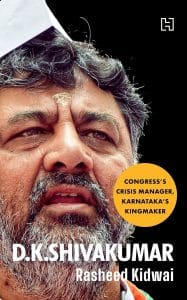
This excerpt from ‘D.K. Shivakumar’ by Rasheed Kidwai has been published with permission from Hachette India.