





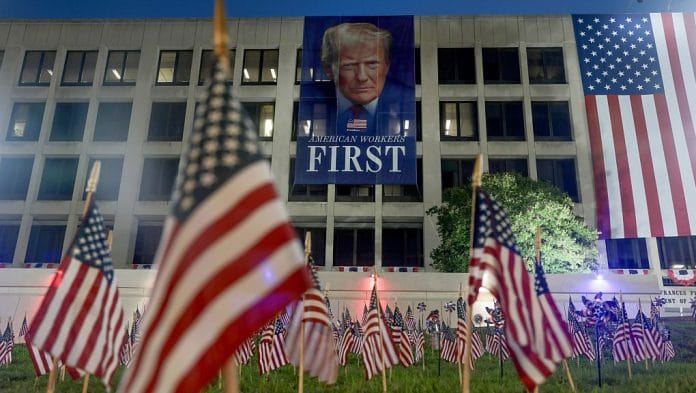

Let us not confuse Cicero’s warning with the coming of Trump. Nor should we involve ourselves with the doubt that Cicero may not have been the source of this quote. Our purpose is the validity of this quote in the present context. Is it not a fact that the US’s journey to the top of the world has been marked by the bizarre, the brazen, and the bold in its policies?
The US was born in the fires of Enlightenment, where Christianity equalled superstition. The sacred narrative that Americans are still driven by is ruled by its religion. But the US’s journey has also been a martial story, punctuated by flares and fireworks of conflicts and wars.
The core of the US’s mission since 1945 has been its selfdetermined zeal to uplift humanity abroad. Accordingly, the US has pursued with near-fanatical fervour a self-prescribed higher calling to redeem humanity, punish the wicked, and christen a golden age on earth.
The US’s whimsical adventures abroad pursued largely this course.
Statecraft became an adjunct of military might for the US. It committed itself to establishing a dominant military that could act as a global police force. But the US failed to take into account a basic law of nature that every force can meet an opposite reaction—it may or may not be potent but it does wound the US in a big or small way during every encounter.
Despite these setbacks, and humiliation in the battlefields of Vietnam and Afghanistan, the US styles itself as the trailblazer and pathfinder of humanity. But to others, its intense religiosity is troubling.
It also worries the outside world that the US hides its pursuit of power under the cloak of idealism. Its policymakers are almost always a small band of elites, pushing a story that can only be fulfilled in war.
In pursuing this domination, the US has led the world from a ‘New Order for Ages’ to a ‘New World Order’, and then to a liberal ‘Rules-based Order’.
As the world’s indispensable nation, the US became its ‘high priest’. Within the US and among its policymakers, a sense of intoxication took over. But its misguided ventures abroad, devoted to smiting evil-doers everywhere, have caused, created or underwritten only mayhem and misery. This passage from the US’s 2022 National Security Strategy confirms that the US still holds steady to its dominant role in the world:
Around the world, the need for American leadership is as great as it has ever been. We are in the midst of a strategic competition to shape the future of the international order… We will not leave our future vulnerable to the whims of those who do not share our vision for a world that is free, open, prosperous, and secure.
American strategic conclusions like this have been a fixation with the cleansing fires of war that has driven the world to the brink of downfall.
But the breakup of the Soviet Union in 1991 brought in a false dawn among the US’s narrative makers. In a knee-jerk reaction, they declared a ‘New World Order’ was upon us and celebrated the ‘end of history’.
Freed from the hesitations of the Cold War’s balance of power, the US became even more adventurous abroad.
Also read: The secret drama that torpedoed the historic Agra Summit 2001
The nearly hundred wars the US has been engaged in since 1991 squandered vast amounts of American wealth. In most cases, they have devastated the countries that the US had decided to set right. And it has cost thousands of American lives besides hundreds of thousands of non-American lives.
Yet, the basic logic that led to American interventions remains intact.
The question that is increasingly being asked by opinion makers around the world is whether the American project is still functioning. Or is the US, like the Roman Empire, entering its age of chaos and decline?
In support of their foreboding, foreign policy experts use buzzwords like multipolarity. It is a dry-sounding term which hints at a shift away from a world where the US and its allies control practically all financial, military and technological structures in the world.
But the faithful demur. They assert the US continues to possess a global empire, different from Britain’s and Rome’s, but an empire still. They add that American financial resources for its armed forces have no parallel in the world, and even in the world’s history:
The United States has spent $19 trillion on its military since the end of the Cold War. That is $16 trillion more than China spent and nearly as much as the rest of the world combined spent during the same period.
That may be so statistically, but the reality is somewhat mixed. American credibility is increasingly being questioned across the world. Its adversaries are challenging the US hegemony, and its allies worry whether Washington will come to their aid. The US itself is struggling between withdrawal from, or yet greater involvement in, ordering global affairs. But its efforts do not find the same resonance as before in the Global South. In recent instances over Gaza, the war in Ukraine and the war with Iran, it has failed to convince countries to take its side. Nor has it won great support from them in the emerging struggle between democracies and autocracies.
Rhetorically put, the US today presents a mixed bag of great achievements and failed policies.
The US still leads the world in technology—the coal and steel of modern age. People around the world watch their series on Netflix, buy books on Amazon, contact friends on Facebook, follow politics on Twitter and search information on Google.
Therefore, it is too early to say that the US has declined, but it can be said with confidence that many others have risen. The world is vastly different from what it was in 1945, or even at the beginning of this millennium. Some economists assert that the combined economies of BRICS 5 will overtake that of G7 by 2035 or even earlier.
The ‘American century’ was built on a liberal vision of America’s role in the world. But it is not over yet. It is now in sequel form. What we might be witnessing today is the dawn of an illiberal American century.
Meanwhile, America is somehow hanging on to being the sole superpower in the world. In that process, it has been behaving like a school bully, and hounds countries that do not toe its line. In this course, it is following a set of familiar historical pressures that, if poorly managed, can erode America’s powerposition in the world.
 This excerpt from ‘How Nations Fail’ by Rajiv Dogra has been published with permission from Rupa Publications.