






It is late evening. The sun dips between the Shivaliks’ sandstone cliffs. A cool breeze sweeps across the rushing Sutlej river, softening the summer heat’s brutal bite.
In the camps outside the fort, horses stomp and whinny softly as they are brushed and reshod by their farriers; soldiers sit around fires, mending their footwear and talking, their armour clinking. The frustrated commands of cooks echo across the kitchen as meals is readied for the tired army. A footman, balancing on a ladder, lights the lamps. In the distance, an elephant trumpets. The scent of leather mixed with wood smoke and dung fills the air.
In the general’s camp, however, it is deathly silent.
Wazir Khan stands over a map of the region, his eyes fixed upon its centre, where the fort of Anandpur stands. It will be night soon, yet no lamps flicker to life in that small town. For three months, Wazir Khan’s forces have been laying siege to Anandpur. For three months, the Sikh military town has resisted. But Khan, a veteran general, is determined to destroy it.
After the execution of the ninth Guru, Guru Tegh Bahadur, by Emperor Aurangzeb, the Sikh population has only exploded. Together with his vassal kings, Aurangzeb has been waging war against the upstarts. At first, he sent an army of 10,000 men under the command of Painde Khan and Dina Beg. When Painde Khan fell in direct combat with the tenth Guru, Guru Gobind Singh, the Mughal army deserted the battlefield. Four years and two generals later, Aurangzeb has sent his best man to destroy the Sikh resistance. And that is why Wazir Khan is here this evening, figuring out his next move with the mansabdars.
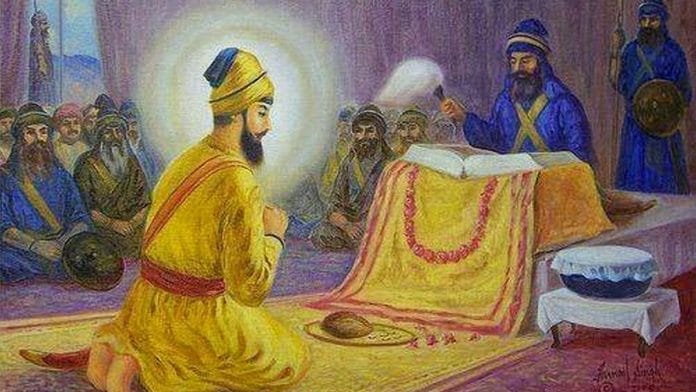
Across the river, Guru Gobind’s court, although in darkness, is humming. The soldiers have brought a matter to the Guru.
‘What is this that brings so many of you to this court at night?’ Guru Gobind asks.
‘He gives them water, Guruji!’ a soldier says, stepping up.
The Guru looks befuddled. ‘Water? To whom?’
‘To the enemy! Every day we go to battle, we give our blood, sweat and tears, and our men and sons. And this man is helping those we are trying to vanquish.’
A murmur ripples through the hall.
‘And who is the accused? Can he please step forward?’ the Guru says.
Also read: The 1949 Tata heist—how a trusted clerk robbed Bombay House for lakhs
A tall man with a well-defined jaw and broad shoulders steps into the clearing. The hall falls silent. He is Bhai Kanhaiya from Sodhara. His father is a wealthy trader, but Bhai Kanhaiya has always followed the diktats of his heart. He left home when he was still a youth, moving around with sadhus and ascetics in the quest for inner peace and spirituality. To the congregation in Guru Gobind’s court, he is an enigma.
‘Kanhaiya … it is you,’ the Guru’s voice is steady. ‘These brave Sikhs are saying that you go and give water to the enemy and they recover to fight us again. Is this true?’
There is a moment’s silence. Kanhaiya clears his throat before answering, ‘Yes, my Guru, what they say is true. But Maharaj, I saw no Mughal or Sikh on the battlefield. I only saw human beings. And … Guruji … they all have the same God’s Spirit. Have you not taught us to treat all God’s people as the same?’
Then Kanhaiya delivers his most powerful statement. ‘Aapke log dushman maar rahe hai, main dushmani khatam kar raha hoon. [Your people are killing the enemy and I am killing the source of evil],’ he says softly. ‘My job is to give water to them because I see the light of Ram, Allah and you in everybody, so I don’t differentiate.’
A smile plays upon Guru Gobind’s lips. He says, ‘Next time, you should take bandages and medicines too.’ Then he turns to the sangat and proclaims, ‘Saadh sangat, Kanhaiya is a God-fearing saintly soul. His impartial behaviour towards others has led him to achieve sehaj-avastha [a state of emotional poise and awareness devoid of ego]. Let him carry on with his mission. Many more will follow in his footsteps in the years to come and keep the tradition of seva alive.’
This is one of my favourite stories from Sikhi. There are many more like this that highlight the concept of seva. Like the one that tells us that in times of battle, Guru Gobind Singh always shot arrows with solid gold necks weighing 11.6 grams. That way, if an enemy was killed, the man’s family would be able to pay for the funeral and take care of themselves, and if the enemy soldier was injured, that gold could be used to pay for medicines for him and for food to feed his family.
But the story of Bhai Kanhaiya stands out for me because of its message. Most of us find it difficult to forgive our friends and family for small slights. What would it take to have compassion for your enemy on the battlefield?
This story also highlights how seva is built into our very essence, even in times of great adversity.
 This excerpt from ‘The Power of Doing Good’ by Harteerath Singh Ahluwalia has been published with permission from HarperCollins Publishers.