






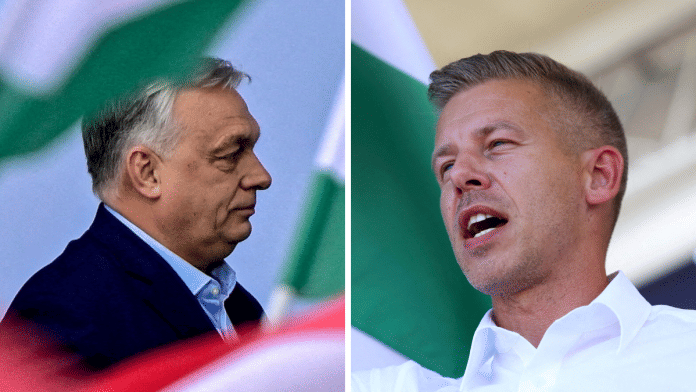


New Delhi: Hungarian Prime Minister Viktor Orbán’s defeat in elections last Sunday marks the end of the “illiberal” leader’s infallibility, leaving his successor Péter Magyar to pick up the pieces of the Central European nation’s withered democratic institutions.
Orbán’s 16-year rule fundamentally transformed Hungary, from its post-Soviet views of democracy, to a centralised state with almost all control in the hands of the outgoing Prime Minister. This is not Orbán’s first electoral defeat.
As Prime Minister of Hungary, he lost power in 2002, only to come back stronger in 2010 and build an electoral dynasty that left Budapest’s institutions weaker. That is why his reign and defeat are ThePrint’s Newsmaker of the Week.
‘Enfant Terrible’
Even when Orban couldn’t get more than 50 per cent of total votes in most elections, he still maintained a supermajority in the Hungarian Parliament. This shows how he maintained a solid grip on power.
However, his ability to win an outsized number of seats in comparison to votes cast has come back to hurt him, with Magyar winning around 53 per cent of the vote, but earning a supermajority in the incoming Hungarian Parliament.
The very rules Orbán designed to protect his power have now been used against him, leaving his party, Fidesz, licking its wounds for the next four years. Even out of power, Orbán has built a system to protect his legacy and make it difficult for any successor to govern.
His efforts to remake Hungary in his image have brought much of the media landscape under the control of his loyalists. Orbán also chipped away at judicial independence, while extending tenures of multiple government agencies such as the State Audit Office and the Prosecutor General’s Office to nine and even 12 years, ensuring his appointees remain in power long after his defeat.
If Orbán domestically remade Hungary in his vision, his foreign policy was built around being the enfant terrible within the European Union (EU), while cultivating ties with Russian President Vladimir V. Putin and Chinese President Xi Jinping. For the EU, which views Putin as an existential threat, Orbán sought to be the Russian President’s handyman within the organisation.
Brussels wasn’t the only enemy in Orbán’s campaigns; since Russia’s war with Ukraine began in 2022, Kyiv was cast as the public enemy number one. His entire 2026 campaign was about portraying Magyar as a puppet of both Brussels and Kyiv, in an attempt to woo voters back to Fidesz.
Orbán’s politics was not always this way. Fidesz, founded by Orbán and 30-odd students in 1988, was named Fiatal Demokraták Szövetsége, or the Alliance of Young Democrats.
Anti-communist and classically liberal, Fidesz underwent a reinvention in the late 1990’s before becoming the standard-bearer of the “illiberal democracy” movement a decade ago. Orbán’s star rose outside of Europe, with US President Donald Trump’s Make America Great Again (MAGA) movement pointing to the Hungarian leader as proof of concept of how the Conservative movement can keep leftists at bay.
Trump even endorsed Orbán’s campaign in 2026. Vice President JD Vance made a campaign pit stop in Budapest days before travelling to Islamabad for talks with Iran to negotiate an end to the conflict in West Asia.
The engineering of an illiberal state
One of Orbán’s first moves was the drafting and passage of a new constitution in Hungary in 2011. An ad-hoc parliamentary constitution was set up in June 2010. It began its work in July 2010.
Introduced in the Hungarian parliament in March 2011, the constitution—drafted entirely by Orbán’s party—was quickly passed along party lines a month later and signed by the President of Hungary on 25 April 2011.
Among the changes Orbán introduced was a system that preserved a veneer of democracy through elections, while enabling gerrymandering. Until 2010, Hungary maintained a two-round voting system, with a minimum turnout required for the validation of results. Under Fidesz’s control, the two-round system was changed to a single-round system. The problem is not the change, but the method by which Fidesz enacted the amendments to Hungary’s electoral system.
The number of seats in the Hungarian parliament was cut to 199 from 386. Moreover, Orbán introduced a mechanism known as the “winner compensation,” which allowed the margin of victory in single-member districts to be added to the overall party list total. In this sense, of the 199 seats in Hungary, 106 are directly elected, while 93 seats are divided based on national party lists and their overall vote counts.
The winner compensation mechanism ensured that margins of victory in the 106 seats would be added to the overall national party list count, ensuring a greater share in the division of 93 seats, and ensuring a comfortable supermajority for the winner.
This is the system that has paved Tisza’s (Magyar’s party) victory in the 2026 election, despite winning only around 53 per cent of the total vote. Fidesz retains a strong voting bloc, with Orbán’s party winning 39 per cent of the vote in the just concluded elections, despite its vastly reduced seat share.
Another thing Fidesz used to do was the absorption of opposition seats into electoral districts where it dominated, making it more difficult for opposition parties across the country. In 2014, Orbán maintained a supermajority in the parliament, despite winning only 44 per cent of the total votes cast.
The electoral blacksliding was one method by which Orbán reimagined Hungary in his image. The other is the changes to the media across the country. The longest-serving Prime Minister of a post-Soviet Hungary ensured a deep polarisation of Hungarian society through waves of conspiracy-laden rhetoric amplified by state broadcasters.
Fidesz propagandists were appointed to Hungarian state broadcasters, while loyalists and friendly businesses bought the country’s private media networks. Some estimates suggest that almost 80 per cent of Hungarian media space is owned by government-friendly oligarchs.
The state broadcasters were given large budgets from the public exchequer to promote government talking points. The government wire agency was offered free of charge, further driving private news agencies out of business in the country.
Orbán’s hold over the country’s media was absolute. Opposition candidates barely got air time, while the state was free to promote its own positions and harsh rhetoric against Brussels, Kyiv and immigrants.
Also read: Hungary’s Magyar vows to suspend state news broadcasts pending press freedom reform
Judicial control
The Hungarian Prime Minister, during his long tenure, also took away the independence of the judiciary. Following the constitutional change, Fidesz reduced the retirement age of judges from 70 to 62 in 2011.
Almost a tenth of the country’s senior judiciary was removed overnight. Fidesz also expanded the Supreme Court (now known as the Curia) from 11 members to 15 members, allowing the government to appoint four new judges immediately after the new constitution came into effect in 2012.
Fidesz changed the way constitutional judges are elected by ensuring that a simple two-thirds majority in the parliament was enough to appoint candidates to the Court. It removed the earlier system requiring a multi-party agreement, which was necessary for nomination.
The new retirement age law was eventually ruled illegal by the Court of Justice of the European Union (CJEU) and the Hungarian Constitutional law. However, Orbán ignored the rulings and eventually allowed the fired judges to return, while offering them compensation packages if they chose not to. In about two years of coming to power since 2010, Orbán had changed the entire leadership of the country’s senior judiciary.
Former President of the Hungarian Supreme Court András Baka was too young for the new retirement law. Fidesz went about introducing a new law that required at least five years of judicial experience within Hungary, a standard that Baka did not reach and was removed from his role.
Through his 16-years of rule, Orbán ensured almost all changes in Hungary were made by law. Whether it was changes to the constitution, electoral reforms, or the judicial system, all of it was done largely through acts in parliament.
(Edited by Ratan Priya)