





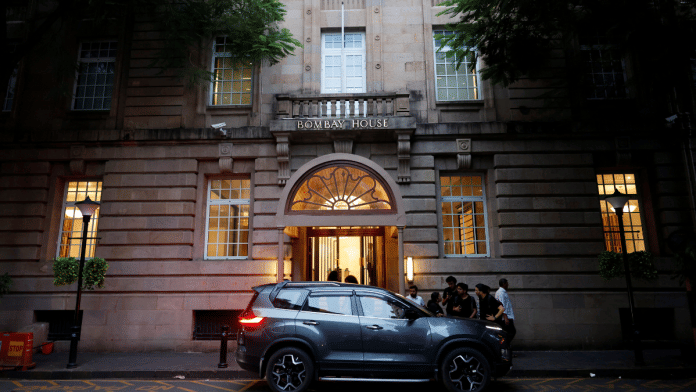


It was early in the morning of 10 January 1949, and Jamshedji Pirojsha Surti, an invoice clerk at Tata Group’s head office in Bombay, was understandably nervous. With good reason too, for over the next few hours, he would have to ensure the safe transfer of a large amount of cash to the group’s textile mill in the suburbs. It was a set routine, but that did not make his task any easier. On the ninth or tenth of each month, a truckload of cash made its way from the group’s Bombay House headquarters on Bruce Street (now Homi Mody Street) to the Tata Mills premises at Parel, there to be distributed to the hundreds of textile workers eagerly queuing up for their month’s wages. Arriving at the office a little after 6.30 a.m., Surti ran some last-minute checks to ensure that everything was in order. As it turned out, he was doubly keen that day to ensure everything went according to plan – one that had been in the works for some months. The trusted Tata employee would rob his employer on that fateful day, pulling off what was up until then one of the most daring heists in the history of the country’s commercial capital. Not for him the ethos of his Zoroastrian faith – Humata, Hukta, Huvarsta (good thoughts, good words, good deeds) – by which the group’s founder Jamsetji Nusserwanji Tata had built his vast empire. Surti would throw it all out of the window that Monday morning.
The routine in the days leading up to pay day at the mills was time-tested and unvarying. The day for payment of wages to the textile mill workers each month was fixed by the Bombay Millowners’ Association. In the first week of each month, this date would be made known to the Tatas and other mill owners, who would then make arrangements with their banks to collect the cash for disbursal to their employees. In the case of the Tatas, sometime during the first week of every month, the manager of Tata Mills would inform his bosses at Bombay House about his cash requirement for the month. This usually varied between 4.5 lakh and 5.5 lakh rupees, a princely sum in the late 1940s.The accountants at Bombay House would then prepare two cheques – one to be presented to the Imperial Bank of India (now State Bank of India) for around 10,000 rupees in small change, and the second for a larger amount to make up the balance – around 4.5 lakh rupees in currency notes, which would be drawn from the Reserve Bank of India. The cash, after being collected from the banks by officials from the Tatas’ accounts department, would be divided into small bundles for ease of distribution.
These would then be put into yellow bags, sealed and locked up in a safe, to be removed only on the day of shipment. The bags would then be placed in steel trunks and delivered by a truck to the mill compound. On 6 June, 9,100 rupees in petty cash was obtained from the Imperial Bank, and 4,75,000 rupees in currency notes of denominations ranging from one rupee to 100 rupees, were received from the Reserve Bank.
The cheques had been drawn by J.J. Tata, the chief cashier, and countersigned by B.M. Batliwalla, an assistant secretary. As was customary, the money was put into the yellow bags and locked up in the safe, to be taken out only on the tenth. Surti, who oversaw the whole operation, would be riding in the truck that day to ensure that everything went smoothly. Surprisingly, given the large amount of cash being transferred, there were no security guards in the truck. Bombay was not known for Chicago-style hold-ups and no one seemed to have given the possibility of a robbery much thought.
The truck was outside Bombay House at around 7.40 a.m. Three hamals (labourers), Jyoti, Gangaram and Rajaram, who had arrived in the truck, went into the building with five steel trunks while the two drivers, Maruti and Sajnu, waited outside. The bags of cash were placed in the trunks, which were locked by Surti’s assistants, who then handed him the keys. The hamals were then told to take the trunks down and place them in the truck.
The trunks were not too large and each could easily be carried by a single person. When three trunks had been kept in the back of the truck, Rajaram and Jyoti began arranging them while Gangaram went back into the building to get the fourth. It was then that something entirely unprecedented happened. A large black car suddenly came up the narrow street and pulled up a little behind the truck. The Mercury sedan had barely come to a halt when four men, brandishing revolvers, jumped out. A man dressed entirely in black – later identified as Sher Khan – threatened Jyoti with a revolver saying, ‘Don’t shout or create an alarm, or here is a revolver’ or words to that effect. His accomplices, meanwhile, covered the other men standing around. Jyoti got the message and raised his hands. Miya Gul Khan, the Pathan watchman stationed at the entrance to Bombay House, watched in silence as the three trunks were moved into the car.
Maruti, who had decided to lend the hamals a hand, then emerged from the building carrying the fourth trunk. Obviously unaccustomed to having a revolver pointed at his face early in the morning, he panicked and dropped the trunk. To everyone’s surprise, the lock on the trunk came off and one of the bags, containing about a lakh of rupees, tumbled out. Sher Khan, who had now grabbed Maruti by the collar, moved fast. Bending down, he quickly scooped up the bag and jumped into the car. His underlings followed suit, the driver hit the accelerator, and the sedan raced down the road towards the Imperial Bank and into the crazy warren of streets beyond. Unobserved by anyone, a man who had been waiting on a bicycle outside the (now defunct) West End Watch Company on the corner of Bruce Street, watching the robbery unfold, slipped away quietly.
The brazen daylight raid, which the press quickly named the ‘Bruce Street Dacoity’, held the city in thrall. To pull off a fast one on the venerable Tata Group in the heart of India’s commercial capital certainly called for audacity of a high order. And it was quite a haul: the dacoits had made away with nearly 3.5 lakh rupees.
Whoever had done it certainly had a lot of guts; they could also be said to have been a little foolhardy, for they could expect the full force of the law to descend on them in short order. And that is exactly what happened. The top bosses at Tata Sons, one suspects, would have been apoplectic.
 This excerpt from ‘The Bombay House Heist’ Sunil Nair, has been published with permission from Juggernaut Books.