





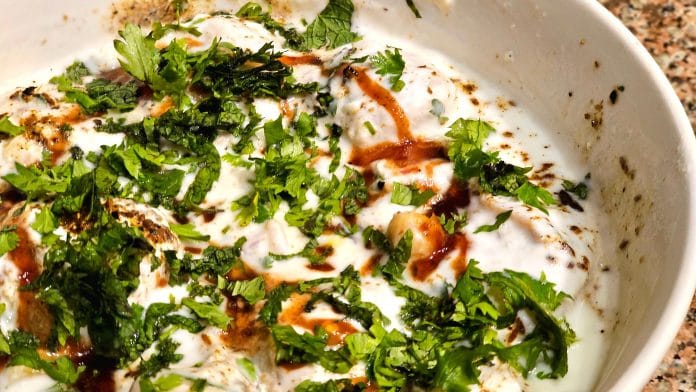


The aratikaya annam sounds like a dish that I would absolutely like to try making and serving to my tribe. Should I serve it with a raita? and if I did, which one would you suggest?’
With all his poetry and appreciation of fine food, I did not expect that King Mangarasa would manage to contort his face into a grimace that portrayed such utter disgust. I did not know where I had gone wrong. Luckily, as King Mangarasa later explained to me, he wasn’t angry but just taken aback.
‘You see, my fine sir,’ said he, ‘raitas and pachadis may appear similar to the casual observer, but they are definitely not the same. Pachadis and raitas both have yogurt as the base ingredient and both contain flavouring components. But this is probably where the similiarity ends. There are historical precedents that connect pachadis to various ancient texts. A pachadi, by all accounts, predates raita by several centuries, if not a couple of millennia.
‘Many people like to claim that raitas were a creation of the Mughals. That couldn’t be further from the truth. The Mughals were of Turkic descent. Their food is mild in flavour as compared to what is available on the subcontinent. They did not need yogurt to balance their fiery food. This is in direct opposition to the fiery, spicy and absolutely volcanic fare that seems to be a signature of the Dravidian way of life. After moving to India, the Mughals started incorporating far more spice in their food. Hence the distinction between Mughal food, Indian food and the original Turkic fare. With the added spice came the need to find the right balance. They did not have to look far. We were trading with them long before they entered here and then never went back.
‘There is even quite a funny story about the etymology of the name. Most historians or anthropologists would like to point out that the name has emerged from various Sanskrit terms. These are Mughals that we are speaking about. They are an Urdu-, Persian- and Turkish-speaking people. They had no recourse to ancient Sanskrit texts or an interface where they could learn the language! The name ‘raita’ was born out of confusion and a misheard pronunciation. The very first time someone from a Mughal entourage came across a raita they seemed very intrigued about it. When they enquired after it, the question was an enquiry as to what tarkari was being served. “Tarkari” is the local term for a vegetable dish. It was misunderstood as a reference to the tempering being used, which is “tadka”. The answer was “rai ka”, which means “one that uses mustard seeds”. Like a veritable game of Chinese whispers, the words were misheard and repeated in the same way that they were heard. The Mughals ended up with raita and we retained our pachadi.
Also read: Never cook in anger. Eating that food will make you angrier
‘The primary and singularly major difference between raita and pachadi is that a pachadi is very often a cooked accompaniment to the main dish, while a majority of the raita’s components are raw. There are a mere handful of raitas that have a spice tempering, but almost every pachadi would have a burst of flavour brought about by freshly tempered spices. I could share some of my recipes with you for you to get a clearer picture. Although I am a traditionalist and purist and I love my pachadi and I believe that they are the best, I am severely biased towards a really good gulkand raita. Gulkand is nothing but rose petal jam. It is made from some of the finest and most fragrant wild rose flowers that ever graced our lands. It lends a beautiful pairing when blended with an absolutely thick and creamy yogurt. Because a gulkand can be cloyingly sweet, you may want to pair it with something sharp like ginger and black pepper to bring about a balance.
 This excerpt from ‘A Quest for the Perfect Rice’ by Zubin D’souza has been published with permission from Penguin Random House India.