



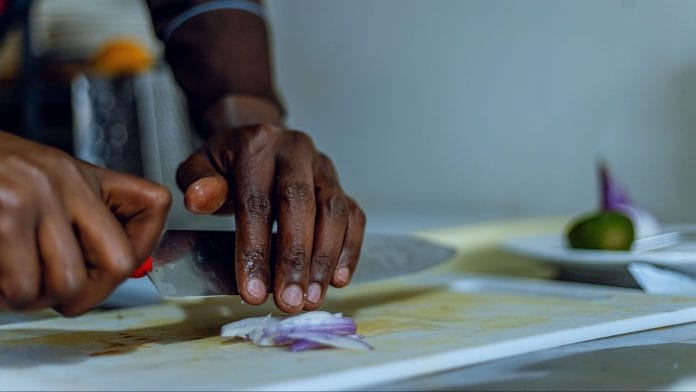

Never prepare food or engage in cooking when you are feeling angry about something or someone. This negative energy might get transferred to the food and drink you are making and could harm those who are consuming what you make. ‘Rageful cooking, when you’re running hot, has an acrid sting all its own. Rage tastes just as bitter or resentful or sad as you feel,’ says Suzamme Orrell, a culinary writer and former chef who shares her love for breakfast and food through her Substack publication, But First, Breakfast—writing about the harmful effects of negative emotions on what you make and eat or drink. She warns that it is dangerous to handle knives and hot skillets while you are busy being angry.
Why do children yearn for their mother’s cooking long after they are no longer around? That’s because mothers love their children, and when they cook for them, all that love and care gets infused into whatever they are preparing for their consumption. Says Orrell, ‘When I cook, I cook with my whole self…whatever I’m feeling when I put my apron on will show up in whatever I’m cooking.’
Japanese author and businessman Masaru Emoto’s experiments with water and ice crystals, published in a book titled The Hidden Messages in Water (2004), is legendary. He presented through his experiments that water molecules react in different ways to positive and negative thoughts, words, and sounds. He showed that emotional energies and vibrations could change the physical structure of water, and when frozen, the ice crystals would display pretty formations if exposed to positive energy like love and pleasant music, and ugly formations when exposed to negative energy produced by angry yelling and shouting and cacophony. He also found that when water was clean and pure from the mountains, it produced beautiful patterns upon freezing. When it was polluted water, it created ugly structures in the ice crystals.
When you cook with a heart filled with love and care, you are bound to pay good attention to the ingredients, their source, the recipe, and the process of cooking. Presentation will also be beautiful and you will serve, too, with love. All in all, cooking and eating become loving experiences filled with positive energy. Spiritual leaders say that we need to be careful of what we eat and how and by whom it is prepared, because food affects our consciousness and energy matrix. Food is not to be eaten dismissively, obsessively, or perfunctorily. Thich Nhat Hanh advised us all to eat mindfully. According to him, eating should not only nourish the body but also the mind. ‘Every minute of your meal should be happy. Not many people have the opportunity to sit down and enjoy a meal, eating mindfully.’
Therefore, preparing and eating food is a threedimensional process: the mood you are in when you cook, the ingredients you choose, the manner in which you present and serve the food, and the way you eat that food. Mindful eating is as important as the food preparation process. If you don’t chew food properly—you gulp it down in anger—needless to say, you are going to suffer not only physically, but also mentally. Mindful preparation, mindful cooking, and mindful eating—all go towards ensuring holistic health.
Also read: Nehru championed civil liberties during Independence struggle. And dropped them after 1947
The Harvard Medical School recommends eight steps to mindful eating:
- Pay attention to your shopping list; avoid processed food and unhealthy snacks.
- Eat when you have an appetite but not when you are ravenous after having skipped meals, because then you may just wolf down whatever is available.
- Start with small portions and choose a plate which is not too large in size.
- Before eating, look at what’s on your plate, appreciate it, and observe the food; give thanks.
- Open your senses to the meal, to the colour, texture, aroma, and chew the food unhurriedly.
- Take small bites as food tastes better that way. Between bites you could take short rests.
- Chew the food well. It will release better flavours and help digestion.
Eat slowly; eat mindfully.
Thich Nhat Hanh recommends what he calls ‘Eating Meditation’. He says:
With the energy of mindfulness, even eating can become sacred. We have a chance to get into deep contact with the miracle of food, and the people surrounding us, whether they are family, friends, colleagues or fellow practitioners on the path. Mindfulness allows us to look deeply to see the wonders of earth and sky in what we are eating and drinking. We can see the hard work and all the causes and conditions that have brought it to us in this moment, and gratitude and wonder naturally arise. Looking deeply, we can see that a simple cup of tea, a tangerine, or a morsel of bread are nothing less than “ambassadors of the cosmos”. Eating with the energy of mindfulness, we can experience our interbeing with the planet that is nourishing and sustaining us, and heal our feelings of loneliness and disconnection.
We can become fully aware of the miracle of our body—the taste buds in our mouth, and our body transforming food into energy and vitality. We also have a chance to encounter our habit energies around food, which may have been transmitted to us over many generations.
In Plum Village, the centre set up by Thich Nhat Hanh and his fellow monks and followers in France, before they begin to eat, they recite the following contemplation:
- This food is a gift of the earth, the sky, numerous living beings, and much hard and loving work.
- May we eat with mindfulness and gratitude so as to be worthy to receive this food.
- May we recognize and transform unwholesome mental formation, especially our greed and learn to eat with moderation.
- May we keep our compassion alive by eating in such a way that reduces the suffering of living being, stops contribution to climate change, and heals and preserves our precious plants.
- We accept this food so that we may nurture our brotherhood and sisterhood, build our Sangha, and realize our ideal of serving all living beings.
The Brahma Kumaris also believe in conscious cooking and eating, and they offer some helpful tips to follow while preparing and eating food.
- Before preparing the food, take a shower to cleanse the energies you may have picked up during the day or night. Turn on some gentle music in the kitchen to set the mood to make meal preparation time a quiet, meditative process. Stay present and enjoy as you chop, clean, and cook.
- While you eat, be fully present. Resist the urge to check your cell phone or search the web. Set the intention to eat calmly. Chew each bite well, as this will improve digestion. Be aware that eating is a way of filling the body with good, healthy fuel.
- Emotional eating and binge eating due to anger, frustration, and stress could be overcome once you start practising mindfulness. Emotional stress eating can lead to you eating unnecessarily large portions, weight gain, obesity, and other related disorders.
- When you train yourself to become aware of your emotions, accept them, and observe them rather than give in to them; mindfulness practice can prove to be a big help.
- When you are angry and you eat your meal, you are likely to not chew or savour the meal properly, resulting in indigestion and dissatisfaction, leading to a spiral of discontent and possibly more anger.
Since food is vital to our survival, it is only logical that what we eat, when, and how we eat are all important activities that contribute to our physical as well as mental health. Sharing meal times with family and friends is also said to promote well-being.
 This excerpt from ‘Anger’ by Narayani Ganesh has been published with permission from Aleph Book Company.