





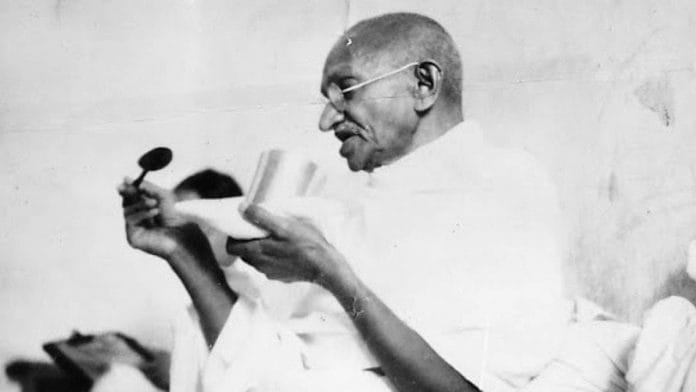


The Vidyodaya College monks patiently listened to the Mahatma’s words, which may seem a bit problematic to some sections of society both in Sri Lanka and India in the twenty-first century. However, Buddhist monastic colleges traditionally have encouraged debates among their students and encouraged them to hear contrarian views.
He also spoke at some of the most prestigious schools in Colombo, such as Zahira College, which was established to give Muslim boys a modern education, and Ananda College, the brainchild of American colonel and Theosophist Henry Steel Olcott.
There were, however, meetings in Colombo where the expression of his views came off as awkward. One such gathering was a public meeting of Sinhalese ladies in the colonial capital that took place in between his travels to the hill country and the south of the island.
‘Gandhiji had looked forward to a meeting like one of those women’s meetings in South India attended by thousands,’ Desai wrote. ‘But instead, there was a meeting of little more than a dozen ladies in the drawing room of a stately palace. It was a misnomer to call it a public meeting.’
The Mahatma said he was used to ladies’ meetings where ‘thousands came in their naturalness’, but he felt this was a ‘stiff ’ meeting. ‘And stiff it was and a perfect study in contrasts,’ Desai said. ‘Gandhiji in his simple loin-cloth, in all his ease and grace and absence of self-consciousness, inquiring where the simple women he wanted to meet could be, and finding instead a fashionable drawing room meeting.’
Desai was worried that Gandhi would leave the room, but then the latter realized that the ladies were not at fault and decided to address them.
‘So he gave them a talk, and I do not think that the friends had ever had in their lives a more uncomfortable half hour,’ Desai said, adding that Gandhi ‘went for them with all the fervour and fire that he could command.’
Looking at the small group, the Mahatma drew from the history of Lanka and the story of Emperor Ashoka’s son Mahendra (referred to as Mahinda on the island) coming from India to preach the Buddhist Dharma in the third century BCE.
Gandhi then delivered a speech that left the fashionable ladies in complete shock:
When Mahendra came to Ceylon, the children of the motherland were not starving either materially or spiritually, our star was in the ascendant and you partook of the glory. The children are starving today and it is on their behalf that I have come with the begging bowl, and if you do not disown kinship with them, but take some pride in it, then you must give me not only your money, but your jewellery as sisters in so many other places have done. My hungry eyes rest upon the ornaments of sisters, wherever I see them heavily bedecked.
There is an ulterior motive too in asking for ornaments viz. to wean the ladies from the craze for ornaments and jewellery. And if I may take the liberty that I do with other sisters, may I ask you what is that makes woman deck herself more than man? I am told by feminine friends that she does so for pleasing man. If I was born a woman, I would rise in rebellion against any pretension on the part of man that woman is born to be his plaything. I have mentally become a woman in order to steal into her heart. I could not steal into my wife’s heart until I decided to treat her differently than I used to, and so I restored to her all her rights by dispossessing myself of all my so-called rights as her husband. And you see her today as simple as myself. You find no necklaces, no fineries on her. I want you to be like that. Refuse to be the slaves of your own whims and fancies, and the slaves of men. Refuse to decorate yourselves, don’t go in for scents or lavender waters; if you want to give out the proper scent, it must come out of your heart, and then you will captivate man, but not humanity. It is your birthright. Man is born of woman, he is flesh of her flesh and bone of her bone. Come to your own and deliver your message again.
Also read: 3 problems Kerala must solve by 2036—demography, welfare, labour markets
Gandhi then spoke about Sita from the Ramayana and how she was ‘defiant in her purity’, Desai said. The Mahatma then switched back to Ceylon of the 1920s and its problems:
Do you know the hideous condition of your sisters on the plantations? Treat them as your sisters, go amongst them, and serve them with your better knowledge of sanitation and your talents. Let your honour lie in their service. And is there not service nearer home? There are men who are rascals; drunken people who are a menace to society. Wean them from their rascality by going amongst them as fearlessly as some as those Salvation Army girls who go into the dens of thieves and gamblers and drunkards, fall on their necks and at their feet, and bring them round. That service will deck you more than the fineries that you are wearing. I will then be a trustee for the money that you will save and distribute it amongst the poor.
At the end of this talk to the stunned high-society women, Gandhi added, ‘I pray that the rambling message that I have given you may find a lodgement in your hearts.’
While some of his more radical ideas did not have takers on the island, such was the respect for the man that even after word of his ideas got around, people from all classes still flocked to see him.
 This excerpt from ‘Colombo’ by Ajay Kamalakaran has been published with permission from Penguin Random House India.