





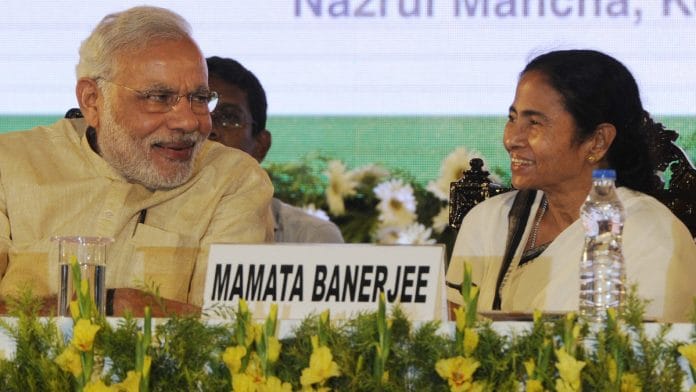



The rise of Bengal Chief Minister Mamata Banerjee has been extensively documented by numerous authors, and I will not delve into those details here. Instead, to understand the BJP’s growing aggression towards its ‘Mission Bengal’ (as mentioned by senior journalist Snigdhendu Bhattacharya in his book of the same title) after 2014, it is essential to reflect on how the party once engaged with Banerjee during the era of leaders like Advani and Vajpayee. This context offers crucial insight into the shift in BJP’s strategy to claim the land of Syama Prasad Mookerjee—making a brief historical overview necessary.
In West Bengal’s complex political history, the period from 1998 to 2013 stands out as a time of unlikely alliances and strategic maneuvering, particularly between the BJP and Mamata Banerjee’s TMC. This era, marked by the TMC’s formation and its rise as a formidable force against the CPI(M)-led Left Front, saw the BJP play a pivotal role as an ally in Mamata’s quest to challenge the entrenched communist regime. The alliance, driven by mutual interests in dislodging the Left Front, was characterized by electoral partnerships, shared political platforms, and significant support during key agitations like Singur and Nandigram. However, it was also fraught with internal discontent within the BJP’s Bengal unit, revealing tensions between national ambitions and local sentiments.
The genesis of the BJP–TMC alliance can be traced to 1998, when Mamata Banerjee, disillusioned with the Indian National Congress’s inability to effectively challenge the Left Front’s dominance in West Bengal, founded the TMC. Her departure from Congress was fuelled by ideological and strategic differences with the state Congress president, Somendra Nath Mitra, and her ambition to confront the CPI(M) head on. The TMC’s early years were marked by a need for allies to bolster its electoral prospects, and the BJP, seeking to expand its footprint in a state where it had historically been marginal, saw an opportunity in Mamata’s fiery anti-communist stance.
In 1998, the TMC joined the BJP-led National Democratic Alliance (NDA), a move that aligned Mamata with the Central government under Prime Minister Vajpayee. This alliance was mutually beneficial: the TMC gained national legitimacy and resources, while the BJP secured a regional partner to challenge the Left’s hegemony in West Bengal.
The electoral outcomes of this alliance in its initial phase were promising. In the 1998 Lok Sabha election, the TMC, contesting as part of the NDA, won seven seats in West Bengal, a significant achievement for a nascent party. The following year, in the 1999 Lok Sabha elections, the TMC–BJP alliance improved its tally, securing eight seats, with the TMC consolidating its position as a viable opposition force.
Mamata’s personal charisma and her ability to connect with the masses, combined with the BJP’s national organizational strength, gave the alliance a competitive edge. The BJP, though a junior partner in terms of seats, benefited from increased visibility in Bengal, where its vote share had previously been negligible. The alliance’s success extended to the 2000 Kolkata Municipal Corporation election, where the TMC, with the BJP’s support, ended the Left Front’s fifteen-year control, signalling a shift in urban voter sentiment.
Mamata’s role in the NDA government further cemented her relationship with the BJP leadership, particularly Vajpayee and Deputy Prime Minister L.K. Advani. In 1999, she was appointed Union minister of railways, becoming the first woman to hold this portfolio. Her tenure was marked by a focus on West Bengal, with the introduction of trains like the New Delhi–Sealdah Rajdhani Express and the Howrah–Purulia Rupasi Bangla Express, which bolstered her image as a leader prioritizing her state’s connectivity. Despite her success, Mamata’s tenure was not without controversy. In 2001, she briefly resigned from the railway ministry over disagreements with the NDA’s policies, particularly its handling of the Tehelka sting operation exposing corruption in defence deals. However, her strong rapport with Vajpayee and Advani ensured her return to the cabinet in 2004 as the minister of coal and mines, a testament to the BJP’s recognition of her political value in Bengal. Her ability to navigate these exits and re-entries underscored her pragmatic approach and the BJP’s willingness to accommodate her to maintain the alliance.
The alliance faced challenges in the 2001 West Bengal legislative assembly election, where the TMC, now allied with the Congress rather than the BJP, won sixty seats, becoming the principal opposition. The BJP, contesting separately, failed to make significant inroads, highlighting its dependence on Mamata’s regional appeal. This electoral setback, coupled with the TMC’s losses in the 2004 Lok Sabha election (where it won only one seat) and the 2006 assembly election (thirty seats), strained the TMC–BJP relationship. By 2006, the TMC formally exited the NDA, citing ideological differences and the BJP’s growing emphasis on Hindutva, which clashed with Mamata’s secular, populist image. However, the BJP’s support for Mamata did not end with the formal dissolution of the alliance, particularly during the transformative agitations in Singur and Nandigram.
The Singur and Nandigram protests, between 2006 and 2008, were pivotal in reshaping West Bengal’s political landscape and marked a high point of the BJP’s support for Mamata’s cause. In Singur, the Left Front government’s attempt to acquire 997 acres of farmland for Tata Motors’ Nano car plant sparked widespread protests from farmers facing displacement. Mamata, positioning herself as the champion of ‘Maa, Mati, Manush’ (Mother, Land, People), led a twenty-five-day hunger strike in December 2006, demanding the return of land to farmers. The BJP, despite no longer being in a formal alliance, extended significant support. Then-BJP president Rajnath Singh visited Mamata during her fast, offering solidarity and criticizing the Left Front’s land acquisition policies. Local BJP leaders, including Tathagata Roy, president of the Bengal unit, participated in rallies and public meetings, amplifying the TMC’s agitation. Roy, known for his articulate defence of Hindu nationalism, saw the protests as an opportunity to align with Mamata’s anti-Left crusade, even as he navigated the BJP’s broader ideological agenda.
In Nandigram, the Left Front’s plan to establish a chemical hub with the Salim Group led to violent clashes in March 2007, when police and CPI(M) cadres allegedly killed fourteen villagers. Mamata, supported by a broad coalition including the TMC, Socialist Unity Centre of India (Communist) (SUCI[C]) and civil society activists, led protests that drew national attention. The BJP, though not at the forefront, provided moral and logistical support, with leaders like Rajnath Singh condemning the Left Front’s actions in Parliament and party forums. Tathagata Roy and other local BJP leaders attended demonstrations, framing the violence as evidence of the CPI(M)’s authoritarianism. The BJP’s involvement, while secondary to the TMC’s leadership, was strategic: it sought to weaken the Left Front while aligning with a movement that resonated with Bengal’s rural electorate. The Singur and Nandigram agitations catapulted Mamata to national prominence, with the BJP’s support playing a crucial role in amplifying her narrative of resistance against forced industrialization.
As Tathagat a Roy said, ‘Had Mamata Banerjee not broken her alliance with the BJP, she might have become the chief minister of West Bengal in 2001.
Despite this cooperation, the BJP’s Bengal unit harboured significant discontent towards Mamata, particularly among leaders like Tapan Sikdar, a former Union minister and influential figure in the state party. Sikdar, who had won the Dum Dum Lok Sabha seat in 1998 and 1999, was critical of Mamata’s dominance in the alliance and her secular posturing, which he thought was diluting the BJP’s Hindutva agenda.
He argued that the BJP’s role as a junior partner undermined its ideological identity and long-term prospects in Bengal. Sikdar’s faction believed that Mamata’s populist rhetoric and her subsequent exit from the NDA in 2006 betrayed the BJP’s early support, leaving the party with little to show for its efforts. This discontent was compounded by the BJP’s poor performance in the 2004 and 2006 elections, where it failed to capitalize on the TMC’s losses. Sikdar’s vocal criticism, echoed by other local leaders, highlighted a rift between the BJP’s national leadership, which prioritized pragmatic alliances, and its Bengal unit, which sought a more assertive ideological stance.
The internal discord within the BJP’s Bengal unit was not merely ideological but also structural. The party’s weak organizational base in the state, compared to the TMC’s grassroots network, limited its ability to assert itself as an equal partner. Leaders like Sikdar and Roy, while influential, lacked the mass appeal of Mamata, whose ‘sheer ordinariness’22 and dramatic style resonated with voters. The BJP’s national leadership, under Vajpayee and Advani, prioritized maintaining ties with Mamata to counter the Left and Congress, even at the cost of alienating local cadres. This tension was evident in 2009, when the TMC, now allied with the Congress-led United Progressive Alliance (UPA), won nineteen seats in the Lok Sabha elections, while the BJP, contesting alone, was relegated to the margins.23 Mamata’s second stint as railway minister under the UPA further distanced her from the BJP, though her earlier rapport with Vajpayee and Advani ensured that personal ties remained cordial.
The culmination of this period came in 2011, when the TMC, allied with the Congress and SUCI, achieved a historic victory in the West Bengal legislative assembly election, securing 184 seats and ending the Left Front’s thirty-four-year rule. The BJP, no longer an ally, played a minimal role in this election, winning no seats and garnering a vote share of less than 5 per cent.24 Mamata’s landslide victory, fuelled by the momentum from Singur and Nandigram, marked the TMC’s transformation into Bengal’s dominant political force. Her decision to return 400 acres of land to Singur farmers as one of her first acts as chief minister underscored the lasting impact of those protests, where the BJP’s support had been instrumental. However, the BJP’s marginalization in 2011 highlighted the limitations of its alliance with Mamata, as the TMC reaped the electoral rewards while the BJP struggled to establish an independent identity in Bengal.
By 2013, the BJP–TMC relationship had fully unravelled, with Mamata firmly entrenched as chief minister and the BJP shifting its focus to a more aggressive Hindutva-driven strategy under Narendra Modi’s leadership. The Singur and Nandigram protests, once a point of convergence, became a distant memory as the BJP began targeting the TMC as its primary rival in Bengal. The internal discontent led by figures like Tapan Sikdar foreshadowed the BJP’s later efforts to build a distinct identity, culminating in its rise as the principal opposition in 2021. Yet, from 1998 to 2013, the BJP’s support for Mamata was a critical, if underappreciated, factor in her ascent, shaping the trajectory of both parties in West Bengal’s volatile political landscape.
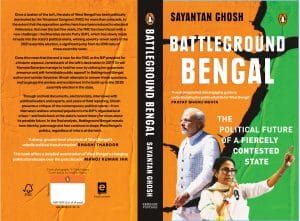
This excerpt from ‘Battleground Bengal’ by Sayantan Ghosh has been published with permission from Penguin Random House India.