





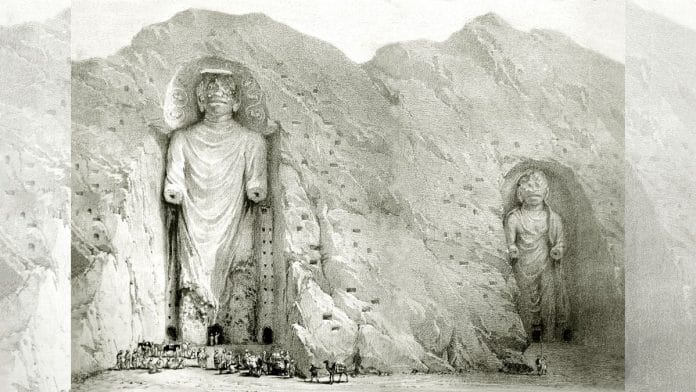


Two monumental statues of standing Buddhas carved into a cliff face in Bamiyan, Afghanistan, the Bamiyan Buddhas are dated to the sixth and seventh centuries CE. They were the largest known Buddha statues in the world until they were demolished, along with many of their surrounding murals, by the Taliban in 2001.
Site
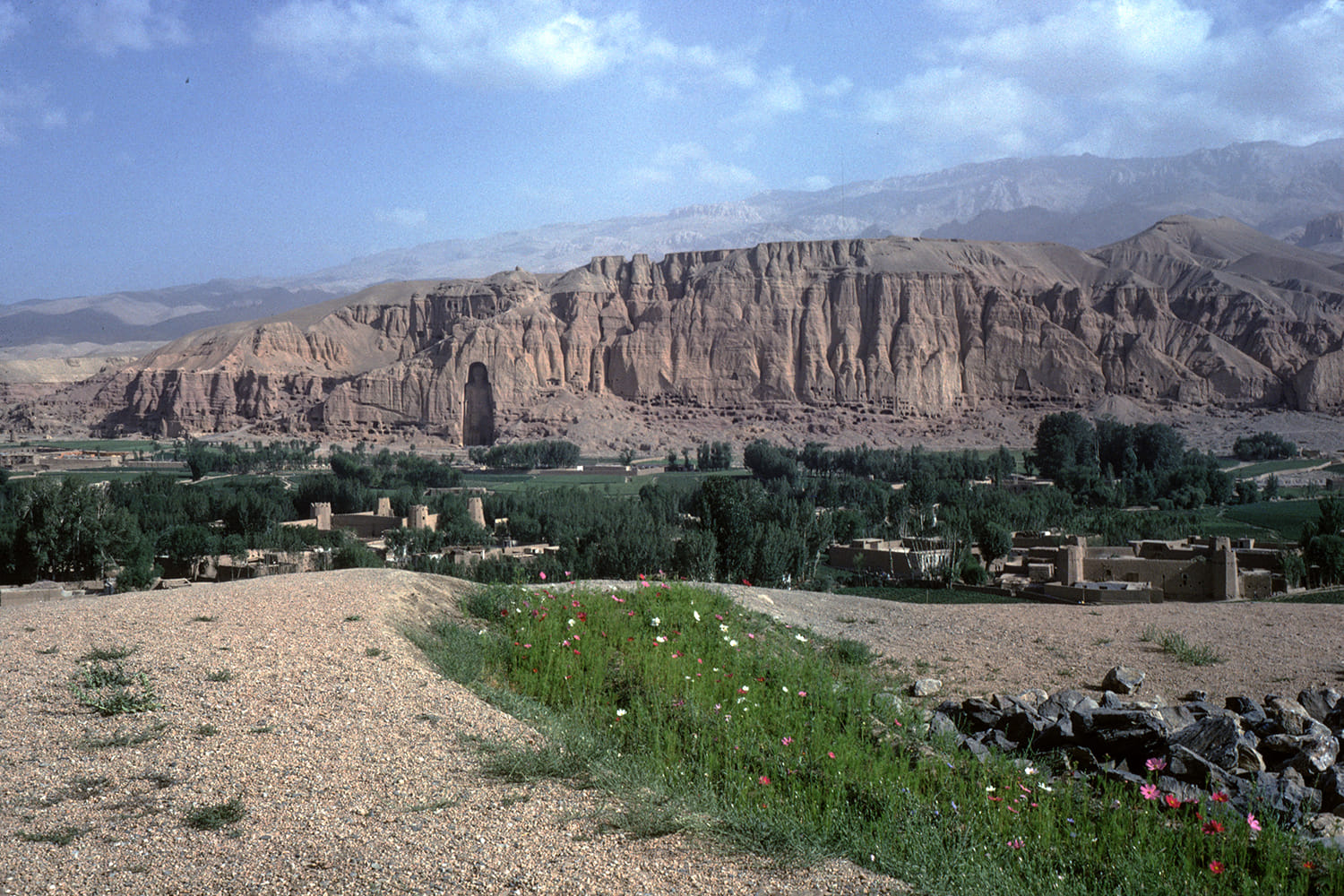
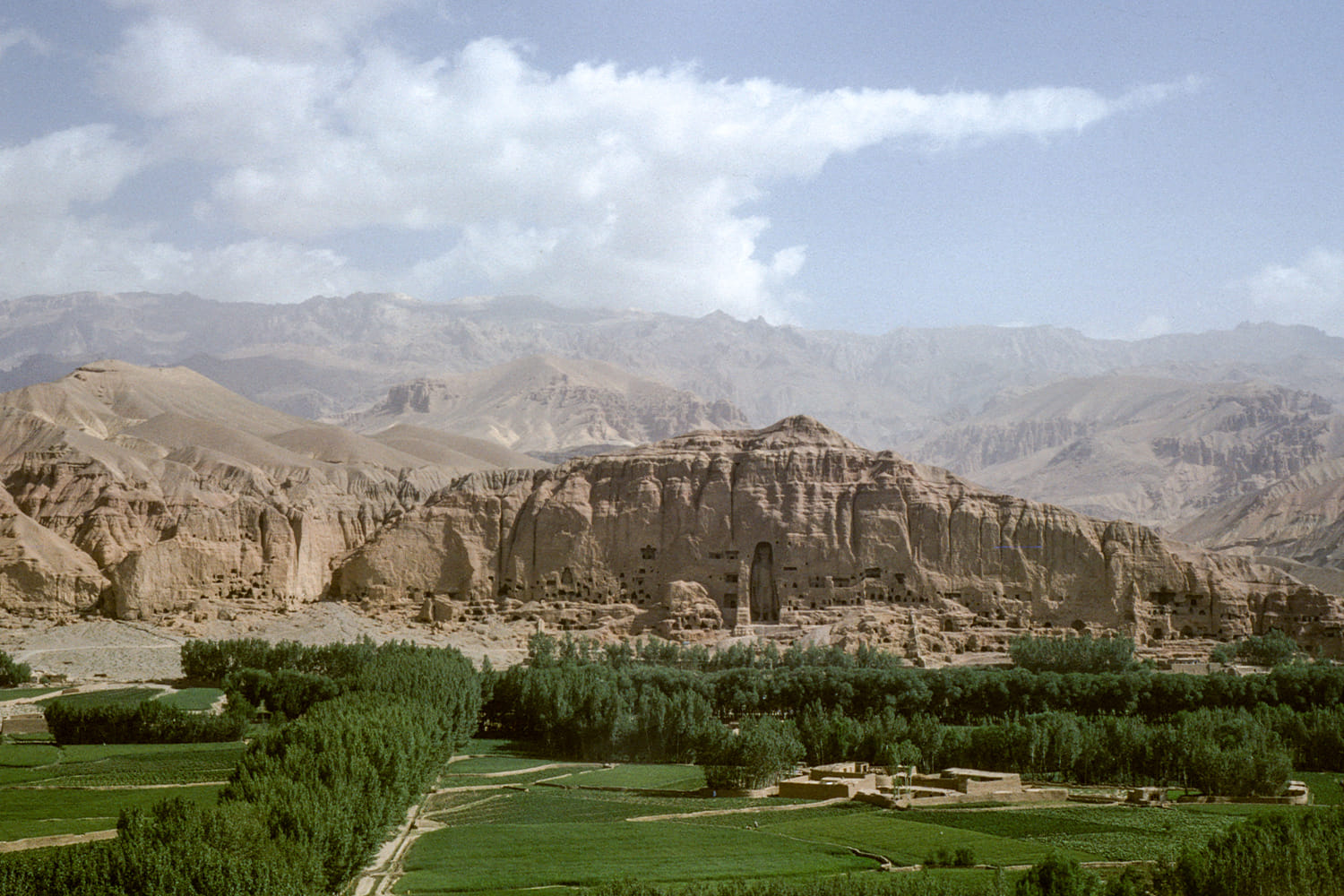
A series of sheer cliffs amidst the Hindu Kush mountains overlook the Bamiyan Valley in central Afghanistan; the two statues were carved near either end of a roughly 1 kilometre long cliff face as the centrepieces of the site. Three much smaller niches between them housed additional Buddha statues, parts of which still remain. The cliffs also host 751 caves dated to the fifth century, which formed a Buddhist monastic complex of residences, prayer halls, and shelter for travellers and pilgrims.
Historical background
Located about halfway between Central and South Asia on a branch of the Silk Road, Bamiyan was an important commercial and monastic centre from the second century CE; it was a meeting point of Persian and Indic cultures, whose blended influences were also seen in the statues and their surrounding murals. Buddhism had been known in the region since the third century BCE, and flourished under Kushan rule between the first and third centuries CE. Bamiyan saw a second phase of Buddhist activity and economic prosperity as the centre of the relatively tolerant Western Turk regime from the sixth century until Islam became dominant here in the tenth century.
The Bamiyan monastic site expanded in this period, and the two statues of the brihad (giant or colossal) Buddha were constructed. This representation, suggesting the transcendental or supramundane nature of the Buddha, was specially favoured by the Lokottaravada sect, the popular Buddhist persuasion in Bamiyan at the time — other examples of such monumental Buddha sculptures are also seen in Sri Lanka, China, Japan, Thailand, and India. The tradition of monumental statue-making may also have arrived in Bamiyan from the west — Egypt, Greece, Rome, or Sassanian Iran — where such colossal statues were made. Recent radiocarbon dating of the statues’ remains traces the eastern Buddha to around 550 CE and the larger western Buddha to around 615 CE.
The seventh-century writings of Chinese monk and traveller Xuanzang are a key source that sheds light on the site as it was at its peak — far more urbanised, with numerous freestanding stupas and mud-brick monasteries, and, according to his account, an additional 304 metre long reclining Buddha. This statue has not been found despite extensive efforts, though fragments of a smaller, 19 metre long one were found in 2008 by Afghan archaeologist Zemaryalai Tarzi, who also uncovered the ruins of a large stupa to the east of the cliff, dated approximately to the second century.
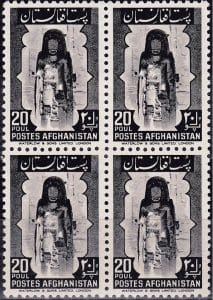
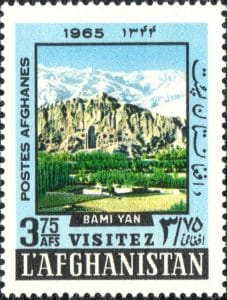
Extensive archaeological activity and study at the site began in the 1920s, led by the French Archeological Delegation in Afghanistan (DAFA), who worked actively in Afghanistan in subsequent decades. Photographs of the Buddhas appeared on the first Afghan banknotes to feature images, issued in 1939, and later also on postage stamps. In the 1970s, German and Japanese archaeologists and researchers, though focused more on the murals, proposed tentative dates for the statues’ construction that were later confirmed by the radiocarbon dating of the 2000s. The Archaeological Survey of India also carried out reinforcements on the statues in the 1970s, and an excavation that revealed their feet. However, with the Soviet invasion of Afghanistan in 1979, all archaeological activity was abruptly stopped. It was only after the demolition of the statues in 2001 that archaeologists returned to the site.
Identification
It is generally agreed that the eastern Buddha was likely Buddha Shakyamuni, the historical Siddhartha Gautama. The western Buddha was likely either the Buddha Vairochana or Dipankara. While Vairochana is more intimately associated with the Lokottaravada cult of the colossal Buddha, the statue has multiple deep holes in its left shoulder, which may have held a framework representing the shoulder flame that began to appear in the iconography of Dipankara in Gandhara and elsewhere in Afghanistan in the fourth century CE.
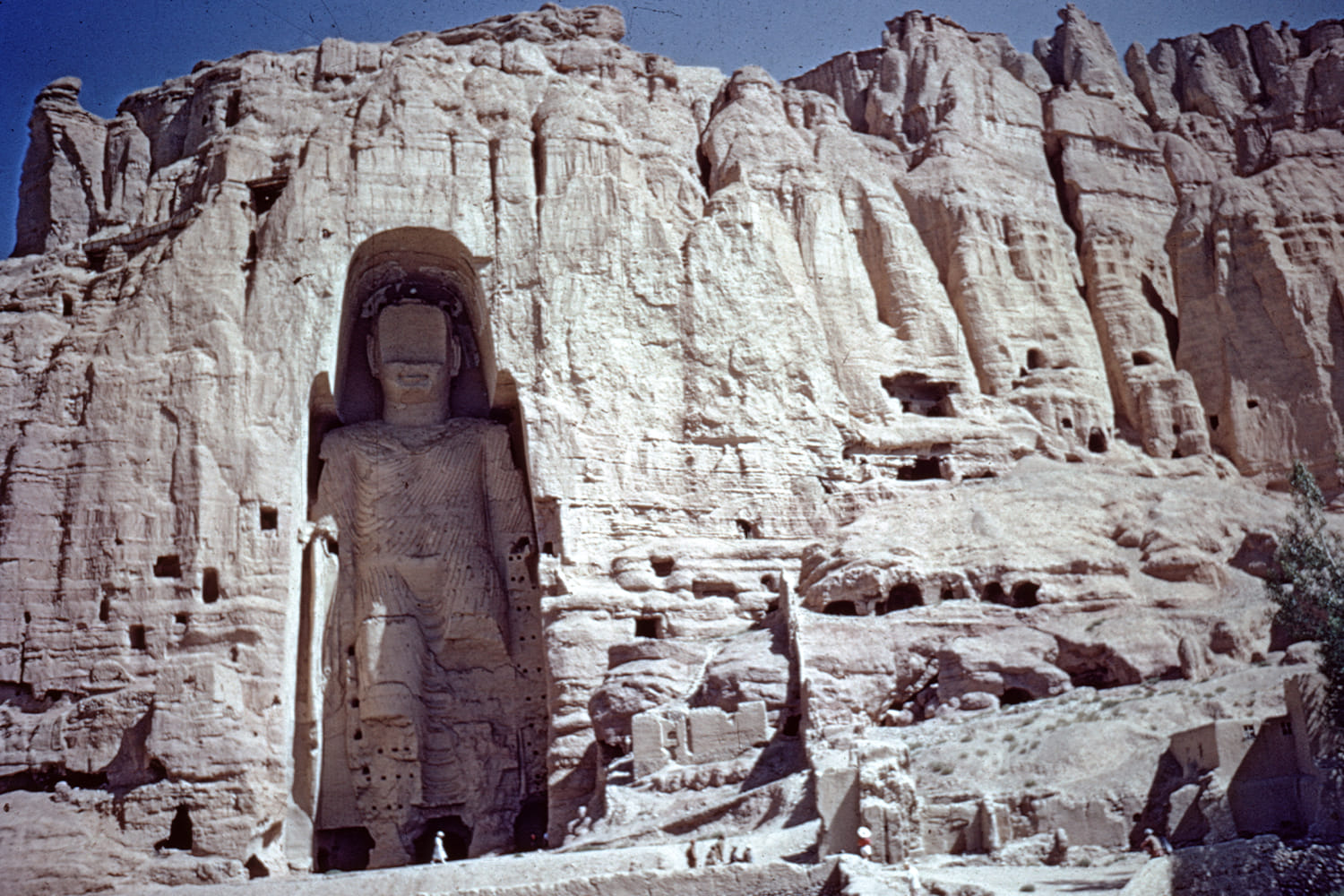
Bamiyan Buddha, Afghanistan, c. 1951 | Photograph: Bevin Kacon (2019) | Wikimedia Commons
Visual features
The larger Buddha was 55 metres tall and located at the western end of the cliff, and the smaller one, near the eastern end, was 38 metres tall. They showed a slight difference in style, possibly reflecting the fifty-year interval between their making, as well as different patrons. Both were carved in high relief into deep niches with arched tops that framed the head and shoulders, with the heads and feet carved in the round. Various superficial features and details had to be made in other materials and added to the figures, rather than carved, as the soft conglomerate rock of the cliff is prone to crumbling. The head and feet had tunnels and walkways around them for the Buddhist practice of circumambulation (pradakshina). Around the feet of both statues are variously shaped caves created as chapels; the eastern Buddha has an internal stairway leading from the ground level to the head. The western statue, standing on a double-lotus pedestal, had a gallery around the head accessed by a separate path on the cliff — this was restored in the twentieth century after having been eroded.
Except for the left forearm of the western Buddha, the statues’ forearms projected outward, supported by wooden beams. By the twentieth century, the hands of the statues had long been missing and the legs of the western Buddha were severely damaged, with large sections missing, though these sections appeared to have been deliberately cut, possibly in some attempt at restoration soon after construction. Holes on this cut section suggested that there was an attempt to reinforce the statue with a system of beams. Based on similar Buddha sculptures from the region, scholars speculate that the eastern Buddha’s left hand was held in varadamudra — the gesture of compassion, with the arm hanging down, palm facing out — and the right hand in abhayamudra — the gesture of fearlessness, with the hand held up near the chest, palm facing out.
Both Buddhas were depicted in monastic attire, wearing the uttarasanga (upper garment), the antarvasaka (lower garment), and the sanghati (outer cloak) which covers most of the other two. They also featured the ushnisha, the cranial protuberance signifying the Buddha’s wisdom, and elongated earlobes to indicate the heavy earrings he would have worn as a prince. The statues’ faces were flat surfaces showing only lips. This has been variously interpreted by scholars — some assume that iconoclastic regimes in the region may have cut off the faces, and others suggest that the faces would have been mounted as wooden or metal masks.
Many of the statues’ details were rendered through a painted cladding of clay, straw and lime plaster applied on various parts; this layer has long eroded and no visual record of the statues with the cladding exists. Holes and grooves on the stone surface served to hold this cladding in place, sometimes additionally secured with stones embedded in the holes. The western Buddha’s cloak was created by cladding over ropes hung from wooden pegs fitted into the stone, which helped shape the folds; only the folds between his legs were carved from the rock. The style of the Buddhas reflects some of the Hellenistic influences from earlier Buddha images of Kushan-ruled Gandhara (c. first to fifth centuries CE) — in the heavy cloak and in the stylisation of the Buddhas’ hair as wavy curls — as well as the influence of contemporaneous Gupta (c. fourth to sixth centuries CE) sculpture, seen in the diaphanous rendering of the drapes following the contours of the body.
Analysis of the remains of the statues shows that they were frequently repainted from the time of their construction until the site fell into disuse: the cloaks were likely painted pink, later vermilion, and then white. In Islamic accounts from the tenth century on, the western and eastern statues are described respectively as red and white. The lining of both statues’ cloaks were painted blue with a pigment derived from lapis lazuli. Traces of gold paint have also been seen on the smaller Buddha. The figures were likely heavily embellished, and perhaps adorned with jewellery.
Relics
The demolition of the statues revealed a cloth pouch that had been buried between the feet of the eastern Buddha, likely at consecration; its contents include two clay pellets believed to contain the Buddha’s ashes, the remains of a birch bark manuscript of Buddhist teachings written in Sanskrit, and a fragment of a leaf from a bodhi tree (Ficus religiosa) speculated to have come from the original tree under which the Buddha is said to have attained enlightenment, which was destroyed in 600 CE.
Murals
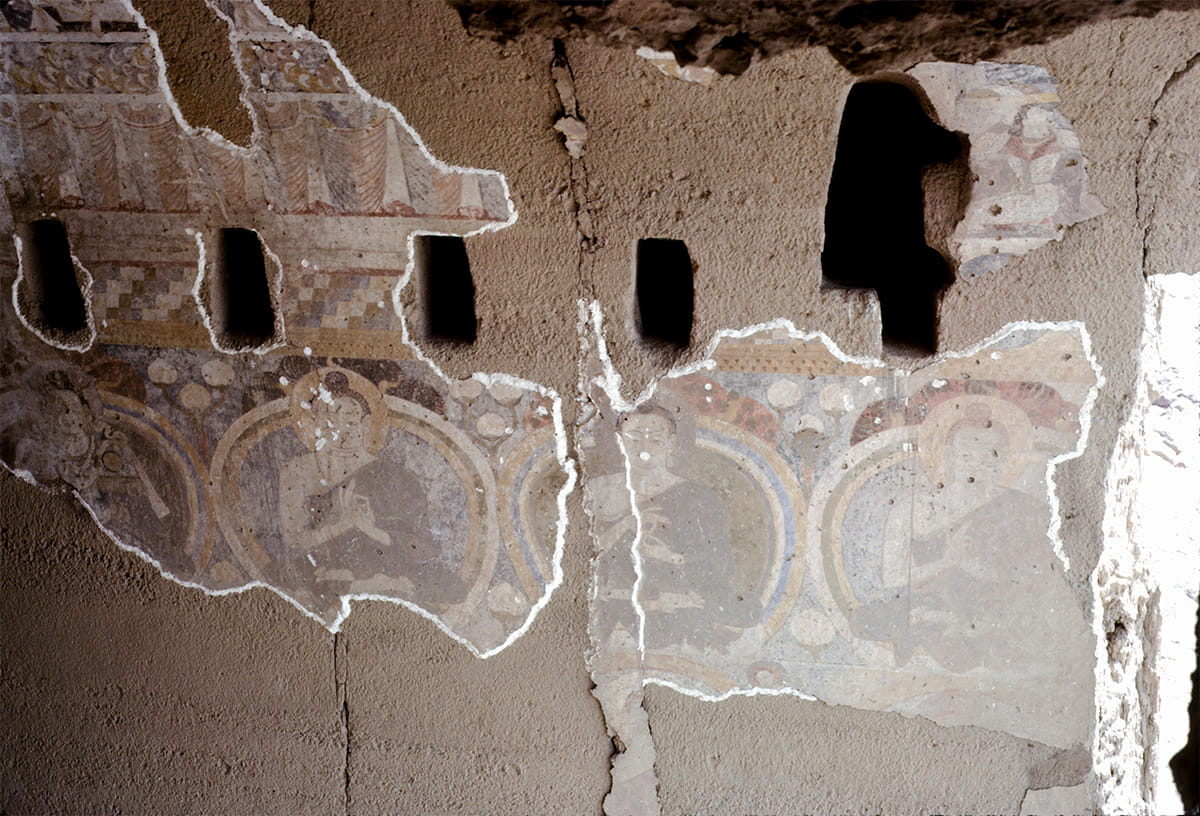
Both niches and the surrounding caves were extensively covered with murals created between the fifth and eighth centuries CE, most now destroyed or severely damaged. They showed images of Buddhist patrons and monks, ritual offerings, forms of the Buddha, bodhisattvas, female celestial figures, and mandalas, among others. The earlier murals near the eastern Buddha show stronger Sassanian and Central Asian influences. A figure on a horse-drawn chariot painted above the eastern Buddha’s head has been interpreted by some as the Vedic deity Surya. Notably, the paint used for these murals used drying oils as binding agents, and may be the earliest known oil paint in the world.
Destruction
Before their destruction in 2001, the Bamiyan Buddhas had suffered minor damage from corrosion, seepage, and earthquakes. Attacks by Genghis Khan in the thirteenth century and later by Mughal emperor Aurangzeb in the seventeenth century also caused more serious damage. In the modern period, the statues were largely untouched. Following the Afghan Civil War (1992–96) Bamiyan was captured by Taliban member Abdul Wahed in 1998; he attempted to destroy the statues using explosives, damaging the heads and limbs of the figures, but further attempts were halted on orders from Taliban leader Mullah Mohammed Omar.
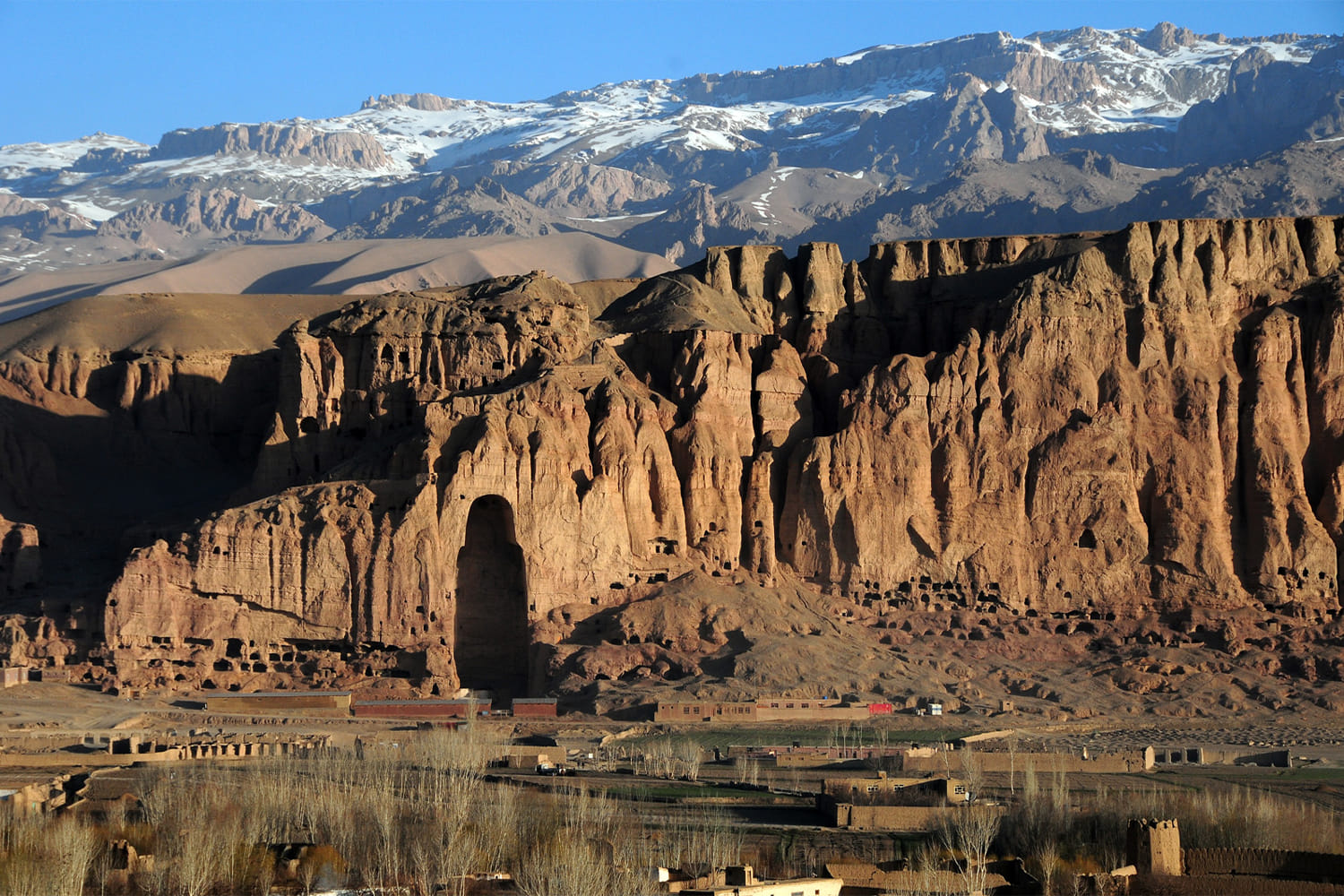
However, this position was reversed in early 2001. On February 26, Omar publicly expressed the government’s intentions to destroy the Bamiyan Buddhas and other pre-Islamic sites in Afghanistan. The destruction of the Buddhas took several weeks owing to their robustness; Taliban members used artillery, dynamite, and explosives placed in holes drilled into the statues. The murals in the niches were erased. What remains today are the western Buddha’s feet and some of the eastern Buddha’s right arm and the folds of his cloak. On March 26, foreign journalists were invited to see the empty niches that had once housed the statues. The destruction was followed by great outcry from scholars and institutions around the world. In India, protests by the Hindu nationalist group Vishwa Hindu Parishad (VHP) and its militant youth wing the Bajrang Dal resulted in communal violence in several parts of the country.
The Taliban claims that the decision to destroy the Buddhas was motivated by the United Nations’s unwillingness to lift economic sanctions on Afghanistan, and what they saw as the West’s hypocritical concern for the Bamiyan Buddhas instead of suffering Afghan citizens. The decision was unpopular even among members of the Taliban, many of whom were local to the area and considered the Buddhas part of their cultural heritage. The move is also believed to be an attack on the largely Pashtun Shi’a Hazara community of the Bamiyan Valley; the Taliban, orthodox Sunnis, had previously burned down the homes of the valley’s Hazara people, who then moved into the caves in the cliffs. Many remain there today.
After the Taliban government fell in October 2001, archaeologists proposed restoration projects for the Bamiyan Buddhas, such as gathering and reassembling pieces of the surrounding debris to recreate the statues, but these were ultimately scrapped for their expense and the uncertainty of success. The eastern niche has been reinforced with scaffolding. In 2003, the remains of the Bamiyan site were included on the UNESCO World Heritage and World Heritage in Danger lists. In June 2015, Chinese filmmakers Janson Yu and Liyan Hu used projection mapping to create images of the two figures in their empty niches for one night, showing the Buddhas with a golden outer layer and various accessories that would have adorned ancient and medieval Buddha statues in the region.
This article is taken from Impart‘s Encyclopedia of Art with permission. Impart is a non-profit, open-access educational platform committed to building equitable resources for the study of art histories from South Asia. Through its freely available digital offerings—Encyclopedia of Art, Online Courses, and Stories—it encourages knowledge-building and engagement with the visual arts of the region.