





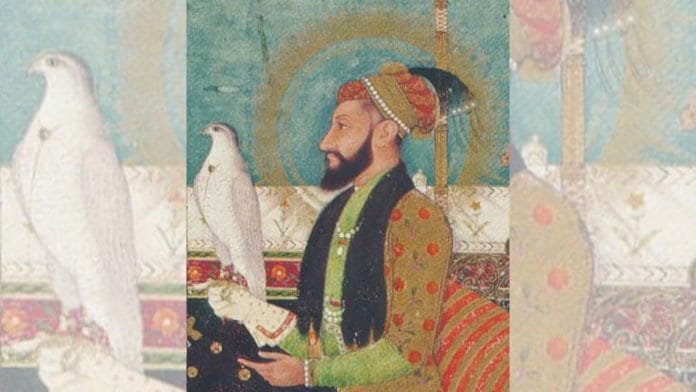


Starting in the 1560s Emperor Akbar began forcing the most powerful imperial actors to take up short-lived political and military assignments within the nascent Mughal Empire; this meant that the imperial elite were never in the same place long enough to create regional power bases, and were thus largely beholden to the emperor for income and power. To keep abreast of events at the imperial court and each other’s courts, peregrinatory Mughal elites began hiring agents (wakils) or secretaries/scribes (munshis) to send them news reports (akhbarat). These reports were based on bulletins compiled by officials at a particular court, and were read aloud to assembled wakils and munshis the next day, much like modern-day press briefings. The bulletins largely comprised two kinds of information. The first dealt with events in and around the royal or noble court in question. The second included information, usually official but sometimes also informal, that had made its way to the court from other parts of the empire. After producing their reports (based on the officially produced bulletins), wakils and munshis sent them out, via imperial or private courier systems, to a distant princely or noble master.
We can only speculate about the spaces, networks of information exchange, and editorial judgments that underpinned these akhbarat. What we do know is that, between the late 1500s and the early 1700s, on any given day, hundreds, if not thousands, of one- or two-page news reports, rarely including more than twenty individual news items, traveled across the empire. What happened in the multiple courts was deemed crucial information for the masters of other courts, and many went to great lengths to keep tabs on the others. Judging by the occasional presence of two sets of sometimes non-overlapping akhbarat for the same day, nobles may have employed multiple teams of wakils and munshis. They may have done this to avoid relying on a single source of information or to gather additional news. Mughal emperors seem to have largely tolerated the production of akhbarat even if they occasionally tried to limit the practice, as ‘Alamgir attempted to do in 1699 (likely due to military setbacks, low morale in the imperial camp, and a fear of information about imperial movements falling into the hands of the empire’s enemies). However, he was unsuccessful, judging by the continued production of akhbarat over the remainder of his reign.
The akhbarat were produced by many hands. However, because of similar forms of scribal training, the scripting is broadly consistent. The paper they were written on, judging by its brittle quality and tendency to smudge, was not of the best quality. The akhbarat were clearly treated as ephemera and not expected to stand the test of time or be stored safely. Only the akhbarat connected with the Jaipur royal family survived into the nineteenth century, through a combination of luck and some care. They were stored in bundles and deposited in cool and dry basement chambers in Jaipur fort. Between the 1810s and 1822 the East India Company official, collector, and Orientalist James Tod – probably working through his Jain tutor/scribe/collector, Gyanchandra – persuaded Raja Jagat Singh of Jaipur or officials connected to the Jaipur court to loan him large numbers of akhbarat. At this time Tod was a political agent for the company across certain parts of Rajasthan (but not Jaipur, which was closed to the British between 1805 and 1817). When Tod resigned from the company and returned to the United Kingdom in 1823, he took the loaned akhbarat with him rather than returning them to Jaipur. Sometime between 1828 and his death in 1835, Tod donated his purloined collection of akhbarat to the library of the Royal Asiatic Society (established in 1823 with Tod as its first librarian). In the meantime, the original collection of akhbarat in Jaipur spent decades in storage before being “discovered” by Jadunath Sarkar in the early to mid-1920s. Sarkar was already familiar with the Royal Asiatic Society collection, having consulted it extensively to write his five-volume History of Aurangzib (which was published between 1912 and 1924). Sarkar’s efforts to find and copy non-duplicate bundles of the Jaipur akhbarat continued in fits and starts until at least the early 1940s. He was especially obstructed in his efforts by Jaipur’s bureaucracy, which was not particularly interested in working with him or most other scholars for fear of, among other things, revealing the extent of Jaipur’s collaboration with ‘Alamgir and the Mughals. The entire Jaipur collection was moved to the Rajasthan State Archives in Bikaner in 1955, but remained very difficult to access until the late 2010s.
Besides being the first person to really introduce the London and Jaipur akhbarat to the world, Sarkar did something else that was extraordinarily important. Recognizing their immense value, he commissioned two hand-scribed copies of all collected akhbarat. One he gave to his patron, Raghubir Singh (d. 1991), the ruler of the then princely state of Sitamau. It remains in the Raghubir Library in Sitamau, Rajasthan. $e other copy Sarkar kept in his personal library. After his death in 1958 it became part of the Sarkar Collection, now housed in the National Library of India (Kolkata). This book has largely relied on the Kolkata version. In 2022, to improve access to the akhbarat, the Royal Asiatic Society made a digitized version of the entire London collection. About a year later the Rajasthan State Archives did the same for its holdings. Today, these are available to anyone who is interested.:
The Akhbarat-i Darbar-i Mu‘alla in its Kolkata form is an extraordinary col lection. Of the twenty-eight volumes that are part of this archive, twenty-one are dedicated to ‘Alamgir’s reign. They span almost 6,600 pages, with the lon gest volume (covering January and December 1703) clocking in at 696 pages, and the shortest (focused on the last two weeks of ‘Alamgir’s life) 44 pages. The total number of individual entries for ‘Alamgir’s reign are in the tens of thou sands. Although the coverage for the first twenty years is relatively thin, from the early 1680s onward the akhbarat become increasingly dense, with almost daily reports for some years. All told, around one-third of ‘Alamgir’s reign is covered by the akhbarat. This is a gold mine for social, political, military, and economic historians. No topic, it seems, was too trivial to be included in the news bulletins. Although events at the imperial court are the predominant focus of the akhbarat, there is much reportage about people and happenings elsewhere in the empire. $is highlights the central role of ‘Alamgir’s court as a node to take in and disseminate news from across the Mughal Empire. But the akhbarat also include a small number of surviving newsletters produced at princely or noble courts in Gujarat, Malwa, Agra, and Bengal (highlighting the presence of officials connected to the raja of Jaipur or his family in those courts). In many instances these provide the only available information on how princely and noble households operated, how Mughal rule unfolded in that region, and how Mughal provincial administrators contended with the deteriorating political, military, and economic conditions in the final decades of ‘Alamgir’s life. Another collection that had a big impact on this book, even if nowhere as sig ni(cant as the Akhbarat, is the Dastawizat (Az ‘Ahd-i Mughaliya) (Papers/documents (from the Mughal period). I came across them in the now-defunct Barkat Ali Collection (formerly in Karachi, Pakistan). Between the 1890s and his death in 1943 Sayyid Barkat Ali, a wealthy landholder in the North Indian region of Awadh, built a large private manuscript collection. At its height this collection is said to have numbered more than a thousand handwritten texts. When the family left India for Pakistan in 1947 following Partition, they took what they could of the collection with them. Family lore says that it survived an attack on their train as they were traveling between India and Pakistan. Over the decades that followed, the collection survived intense street clashes in 1977 between the police and opponents of the then prime minister Zulfiqar Ali Bhutto in the area of the family home; gun battles in 1993 between rival ethnic groups in surrounding streets; and a 2010 bomb blast that damaged some nearby shops and homes. There was one force, however, that the collection could not ward off: the gradual impoverishment of Barkat Ali’s descendants. In 2011-2012 the family decided to sell the entire collection for an untold sum of money (but likely at a steep discount) to a consortium of UK-based private collectors.
In the months before the collection’s removal from Pakistan I had a single opportunity to work with some of its texts. Although I barely scratched the surface of this spectacular collection, I did home in on the Dastawizat. They comprised eight bundles of unpaginated and unindexed documents. Each bundle contained anywhere between 87 (Bundle 6) and 513 (Bundle 3) random and highly idiosyncratic handwritten documents, all likely acquired over many decades by Barkat Ali. The earliest was a receipt for candle wax that, to my best reading, seemed to date to the 1530s, the last an anonymous couplet sent for improvement to a patron or poetical master, dated to 1791 and signed by one ‘Abd al-Nisar “Khaliq.” The documents that I encountered were in varying states of preservation. Some looked as if they could have been written yesterday. Others were so worm-eaten or brittle that I dared not lift let alone read, them. Although the majority of the documents were written in the cursive shikasta script there were some – notably imperial, princely, and noble orders (farmans, manshurs, hasb al-hukms, nishans, hukums, etc.) – that used the nastaliq script. There was no discernible organization to the bundles. My guess is that they were simply thrown together as Barkat Ali acquired them or his heirs parceled them up as they departed for Pakistan. As a result, intermingled with imperial land grants, orders, and draft notes are more pedestrian documents relating to land deeds, property division, revenue claims, muster requirements, stall fees, confirmation of stipends, and a qazi order commanding the execution of a murderer. A small but significant number specifically related to ‘Alamgir’s reign. Crucially for me, where some merely confirmed actions or events captured elsewhere in the archive, others offered me extraordinary insights into meetings, itineraries, interactions with Shah Jahan and other members of the Mughal elite, gifts to shrines or members of his harem, jizya collection, punishments, and orders to buys things and people, etc. Most valued of all were a few documents that highlighted ‘Alamgir’s daughter Zinat al-Nisa’s powerful presence at the Mughal court.
It is a lasting regret that I did not have enough time to do full justice to this spectacular collection. By 2013 it was gone. It has vanished, likely broken up, with the most valuable parts entering private collections, and those requiring time and money to salvage simply thrown away. The story of the Barkat Ali Collection is, lamentably, all too common across South Asia. Economic insecurity, political instability, the rise of religious nationalisms, government inaction, and societal indifference to the value of premodern materials (especially in Persian, truly an orphan language because no one in either India or Pakistan claims it as their own) have created the conditions for a loss of both heritage and the ability to tell more complicated historical stories that we desperately need and can only benefit from.
The original publication contains attributions/citations in the footnotes, which have been omitted from this excerpt.
 This excerpt from Aurangzeb ‘Alamgir and the Mughal Empire by Munis D. Faruqui has been published with permission from Juggernaut Books.