



US elections have never been just about American voters. The people who cast their votes may be Americans, but the consequences of their choices are often felt across the world.
And this time, the world seems to be watching with even greater interest. Driven by escalating wars, shifting global alliances, and growing cultural divisions, American politics now serves as a critical barometer—not only for the nation’s internal future but also for the trajectory of the wider world.
There is no doubt that people across the world are watching the US midterm election closely, many feeling that their own future, or even the future of the world, may depend on its outcome. Wherever you look, people are discussing the results, analysing what they mean and wondering what comes next. Few elections in the world attract this kind of attention beyond their own borders.
Beyond culture wars
The election results are clear, and to be fair, they are not entirely surprising. US President Donald Trump returned to power with big promises about the economy, ending wars and using tariffs to make America stronger. But many voters do not seem happy with what they have seen so far.
Look at what voters themselves are saying.
According to an election-day survey conducted by SSRS, 39 per cent of voters said the economy was the most important issue, followed by 32 per cent who chose the state of democracy. Nearly 65 per cent believed Trump’s policies had made the economy worse, while 79 per cent said inflation had caused their families severe or moderate hardship.
And it was not just the economy. Around 62 per cent believed the US had made the wrong decision to take military action against Iran.
What I find interesting about these results and surveys is that people seem to have voted based on their everyday concerns and the problems affecting their lives. All the culture wars we have been watching on social media seem to have become background noise, and it now seems to be over.
It does not look like voters were particularly impressed by images of Immigration and Customs Enforcement (ICE) detaining immigrants or by tougher restrictions on H-1B visas. These issues may dominate social media discussions, but when people are struggling to pay their bills and worrying about their future, perhaps those cultural battles are not as important to them as they appear online.
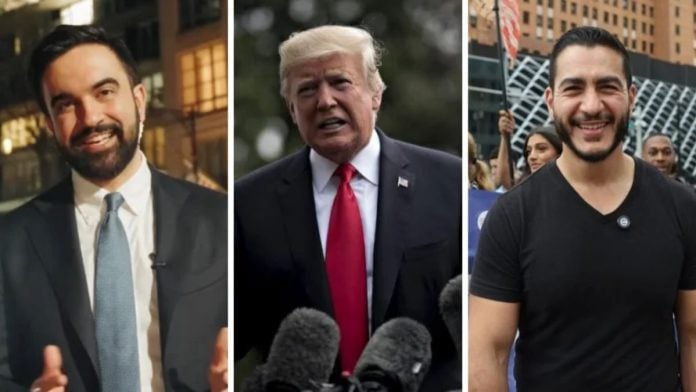
Take the example of Senator-elect Abdul El-Sayed in Michigan.
During the election campaign, Trump called El-Sayed a “jihadist” and accused him of having links to the Muslim Brotherhood, without providing evidence to support those claims.
The president of the US was using such language against a Muslim candidate running for public office. The idea was to focus on his Muslim identity, perhaps hoping that associating a Muslim politician with extremism would be enough to discredit him. For years, we have seen how religion, race and immigration have been used to fuel cultural divisions in American politics.
But it did not work. El-Sayed’s victory suggests that these cultural attacks have their limits or are simply losing their impact. Voters were willing to look beyond his religious identity and consider his political ideas.
And there is another interesting aspect to his victory. El-Sayed is openly Muslim but he emphasises more on his progressive economic policies, including universal healthcare.
And El-Sayed’s victory becomes even more interesting when we look at the political obstacles he faced. He had to compete against powerful figures within the Democratic Party, overcome opposition from pro-Israel political groups and eventually defeat the Republicans. In doing so, he also made history as the first Muslim elected to the US Senate.
Also read: Narendra Modi isn’t Donald Trump. India’s electoral math makes it harder to humble BJP
Changing political fault lines
Before El-Sayed, there was New York Mayor Zohran Mamdani. His victory as a democratic socialist in one of the world’s most important centres of capitalism had already attracted attention. But many saw it as something that could happen only in a progressive city like New York.
Michigan tells a different story.
Unlike New York City, Michigan is a swing state where neither Democrats nor Republicans can take victory for granted. El-Sayed’s success suggests that progressive economic ideas may have an audience beyond America’s traditionally liberal cities.
The Democratic Party is becoming a place where different identities and political ideas are finding representation. From the first Muslim senator to politicians advocating democratic socialist ideas, the party seems to be bringing together people from very different backgrounds.
We also saw historic victories involving the first Black female governor, the first openly gay male senator and the first female Native American governor. Jewish politicians, too, continue to hold an important place within the party.
This election has also brought attention to something that once seemed almost unthinkable in American politics. On the issue of Israel, parts of the American Left and Right are beginning to question the same policies, although for very different reasons.
Politicians like Mamdani and El-Sayed have been critical of Israeli government policies, particularly over the treatment of Palestinians. Their criticism comes from a progressive political perspective, focused on human rights, equality and opposition to war.
But interestingly, criticism of American support for Israel is also coming from sections of the right, including parts of the MAGA movement. Their concerns are different. They question why American taxpayers’ money should be spent supporting another country when Americans themselves are struggling with economic problems. For them, it is a question of putting America first.
Of course, this does not mean the Left and Right ideologues suddenly agree on Israel or on foreign policy. Their reasons for questioning American support are often very different, and many Republicans remain strong supporters of Israel.
There is something El-Sayed said in his victory speech that I think goes beyond American politics.
He reminded people that America is big enough for everyone, regardless of what they look like or how they pray.
And I think humanity will truly move forward when this becomes a reality not just in America, but in every part of the world, regardless of who lives there, what they believe or how they choose to live; they belong.
Because in the end, shouldn’t that be the vision of every society?
Amana Begam Ansari is a columnist, writer, and TV news panellist. She runs a weekly YouTube show called ‘India This Week by Amana and Khalid’. She tweets @Amana_Ansari. Views are personal.
(Edited by Saptak Datta)