






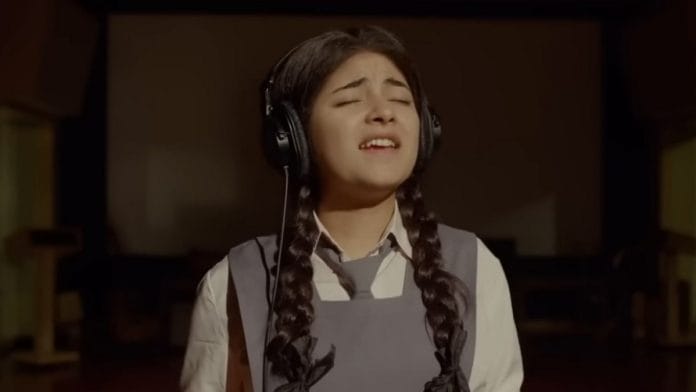

I still remember Zaira Wasim in the Hindi film Secret Superstar as Insia Malik, a 15-year-old schoolgirl from Baroda who dreams of becoming a famous singer. Unable to pursue that dream openly because of her abusive father and the strict patriarchal environment at home, she hides her identity behind a burqa and shares her music with the world.
The film made me happy at a very personal level. Bollywood has made countless films about patriarchy, but most of those stories place Hindu families and society at the centre. It is much rarer to see the realities of an Indian Muslim family explored in the same way. For me, Insia’s story was familiar, like many stories of women in my home. Trust me, many Muslim women watching it would recognise parts of that story from real life. Far more often than we would like to admit.
That is why it feels particularly strange to watch Zaira Wasim now take such a different position on the public visibility of girls. The actor, who also starred in Dangal, recently criticised the J&K Waqf Board for allowing children, particularly girls, to perform publicly at an Independence Day event.
“Isn’t Waqf Board a religious body entrusted with serving the Muslim community, and ideally doing so while upholding Islamic values?” she posted on X.
Wasim left acting and chose to live in a way that, to her, was more in accordance with her faith, even if that meant withdrawing from a public career that had given her enormous opportunities.
That, of course, was her choice. While I disagree with such values, everyone has the right to choose their own value system. What they don’t have is the right to make that value system the standard for everyone else.
Why shouldn’t Muslim girls perform?
Zaira Wasim’s issue with the Waqf Board is not its incompetence in serving the community or allegations of corruption, but children performing. What a misplaced priority for someone claiming to care about the betterment of the community.
What exactly is wrong with Muslim children taking part in an Independence Day celebration? For Wasim, such celebrations “reduce our children to stage props and performers”.
Since when did singing, dancing, reciting poetry or simply appearing on a stage become something degrading? These are perfectly normal ways for children to participate in celebrations. They build confidence, creativity and, most importantly, a sense of belonging.
A girl dancing on a school stage does not suddenly become less intelligent, less capable of learning or less valuable to society. She can dance and study. She can sing and become a doctor. She can perform on a stage and grow up to become a scientist, teacher or leader. These things were never mutually exclusive.
What kind of value system is it that is bothered only when girls become visible in public? Kashmir’s daughters do not need to disappear from public spaces in order to be respected. They should have the same freedom as its sons to speak, perform, learn and celebrate without every public appearance becoming another debate about their modesty.
Also Read: What Abdul El-Sayed’s victory says about progressives, outsiders and the Democratic Party
Not just regressive but dangerous
This is not merely an isolated, outdated opinion; it is the beginning of total erasure. The ideology that equates a woman’s purity with her invisibility is the foundation on which the Taliban built their regime.
The trajectory is as predictable as it is horrifying. First, society questions why a girl performs; then, why she sings, why she studies and why she works. Eventually, the question becomes why she exists in the public eye at all. Modern civilisation cannot be built by making half of humanity disappear.
So Zaira Wasim’s post may look like a harmless but regressive opinion, but it is dangerous to the modern world.
Also Read: Who is the voting Gen Z? The Kanwariyas or the Jantar Mantar youth
Are Muslim values at odds with patriotism?
Calling patriotic songs or cultural performances “irrelevant” at an Independence Day celebration is a strange argument in itself.
If children cannot sing patriotic songs, perform and celebrate together on Independence Day, then when exactly are they supposed to do it? The entire occasion is about coming together, celebrating our shared citizenship and allowing children to feel that they are part of something bigger than themselves.
Or is this actually the problem—that these children are seeing themselves as part of a nation that belongs to everyone? A nation built on a shared identity as citizens, regardless of religion, where you can look at someone from a different faith with the same dignity and sense of belonging that you extend to someone from your own religious community.
Who decided that Muslim values are somehow at odds with patriotism?
There is nothing un-Islamic about Muslims celebrating their country, taking pride in their citizenship or allowing their children—girls included—to participate in an Independence Day programme. Creating religious suspicion around something as ordinary as a Waqf institution celebrating Independence Day only creates a divide between faith and belonging.
This narrow, exclusionary framework does a profound disservice to the faith it claims to protect. Muslims do not need anyone’s permission to be visibly Muslim and visibly patriotic at the same time.
There are millions of Indian Muslims whose understanding of Islam does not require them to constantly prove their distance from India. I grew up with one of them. My father was a deeply devoted Muslim who performed Hajj seven times, but he was equally proud of having served his country. He would tell us that if he ever died in the line of duty, Jannah would be written for him. For him, there was never a contradiction between the two. Hubbul watani—love for one’s homeland—was part of his faith.
Like my father, I refuse to accept the idea that my faith becomes purer when my belonging to my country becomes weaker. Muslim children should never have to choose between their identity and their nationhood. They must be empowered to carry their faith in their hearts and the Tiranga in their hands, without anyone telling them that one makes them less loyal to the other.
Amana Begam Ansari is a columnist, writer, and TV news panellist. She runs a weekly YouTube show called ‘India This Week by Amana and Khalid’. She tweets @Amana_Ansari. Views are personal.
(Edited by Asavari Singh)