




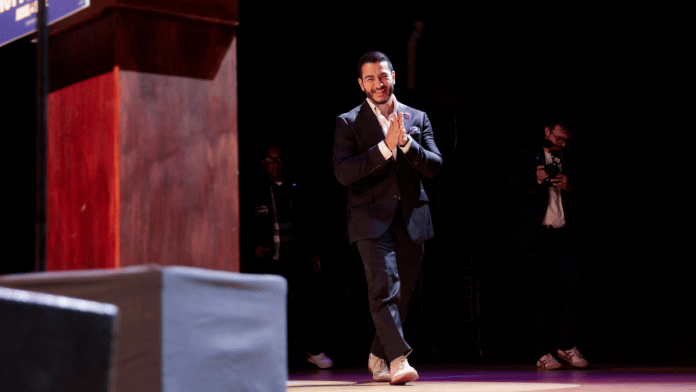

After Zohran Mamdani’s victory in New York, the political rise of Abdul El-Sayed can be read in many ways. But perhaps the most interesting interpretation could be that something is changing within the Democratic Party itself.
El-Sayed is hardly a traditional establishment candidate. He is a Muslim, an epidemiologist, the son of immigrants, and considerably more progressive than many mainstream Democrats. After Mamdani’s victory, some centrist Democrats argued that such politics can work in New York because, well, New York is New York – deeply Democratic, liberal, and hardly representative of the rest of America.
But Michigan challenges that argument. Unlike New York City, it is a swing state where elections can go either way.
And money was certainly not on El-Sayed’s side. His primary opponent, Representative Haley Stevens, benefited from more than $60 million in campaign and outside spending. A significant part of the outside spending came from a Super Political Action Committee (PAC) backed by the American Israel Public Affairs Committee (AIPAC)
Yet El-Sayed won despite being heavily outspent, raising questions about whether voters are growing wary of the influence wealthy interests have over politics.
Is this about progressive politics or distrust of the establishment?
It is not only about suspicion of wealthy interests. Across the world, there seems to be growing distrust, or perhaps simply exhaustion, with traditional political establishments. In such an environment, being an outsider can actually become an advantage. Outsiders can be seen as fresh political faces—people who have not been corrupted or compromised by the establishment and are not part of the so-called “deep state”.
There is already a tempting interpretation of El-Sayed’s success: progressive politics is moving beyond liberal places like New York, and winning in a swing state like Michigan could signal something bigger happening inside the Democratic Party. It could suggest that progressive politics can become a national movement instead of remaining concentrated in liberal cities.
Maybe. But I think there is another possibility worth considering.
What if El-Sayed’s real political advantage is not simply that voters are becoming more left-wing, but that they are becoming more distrustful of the establishment itself?
And this is where El-Sayed and Trump, despite being almost completely opposed ideologically, have something structurally in common. Both can appeal to voters who believe the political system is controlled by insiders and no longer works for ordinary people. What they offer as solutions, and whether those solutions work, is, of course, another matter.
If that is true, then the political shift we are witnessing may be much bigger, and far less ideologically predictable than either the left or the right would like to believe.
A different idea of who gets to represent America
There is another, more positive way to look at the rise of politicians like Mamdani and El-Sayed. They represent a different kind of American political identity. Both come from immigrant and minority backgrounds, but neither seems to believe that political success requires them to erase or soften that identity to become acceptable to mainstream America.
At the same time, they are not positioning themselves as outsiders who reject America. Their message seems much simpler: this is my country too. I do not have to become less of who I am to belong here, and I have as much right as anyone else to help shape what this country becomes.
It can be seen as another victory for progressive politics, another sign of frustration with establishment Democrats, or simply an important moment for Muslim representation in America.
But there is a broader lesson here – one that extends beyond America. A society tells us something about itself when people are willing to give political power to someone who does not come from its traditional majority. That is what a successful and healthy collective society should look like.
It is not simply that a Muslim American can become a serious candidate for high office. It is that being Muslim does not have to be the main reason to support or oppose him. He can be questioned on healthcare, wages, immigration, foreign policy, corporate influence, and the cost of living, just like any other politician.
For me, that is a much more meaningful sign of representation. It also made me think about something beyond America. If Muslim Americans can enjoy these opportunities and serve their society without their religious identity automatically becoming a barrier, how many other countries can honestly say the same?
The question for every majority society
There are countries such as Pakistan where non-Muslims face serious constitutional or legal limits on reaching the highest political offices. Even today, several countries constitutionally restrict their highest political offices on the basis of religion, and Muslim-majority countries make up a significant share of them. At the same time, there are Muslim-majority societies such as Senegal, whose first president was Christian.
That contrast matters to me. I feel fortunate to come from a vibrant Hindu-majority democracy like India, where religious identity has not automatically closed the door to the highest levels of public life. Muslims, Christians, Sikhs and others have all held major constitutional and political offices.
If political leadership is restricted to people from a particular religion, ethnicity, caste or cultural background, a society is also limiting its own pool of talent. A society may deny itself the talents of a brilliant administrator, reformer, economist, doctor, or political leader simply because the first question asked is whether that person has the “right” identity.
And the loss is not only for the person being excluded. The entire country loses the possibility of being served – or even led by some of its most capable people.
Seen from this perspective, El-Sayed’s significance goes beyond Muslim representation or progressive politics. His rise raises a question that every majority society should ask itself: Can a society look beyond identity and trust the person best suited to lead, even if they do not look, worship, or share the same culture as the majority?
A society that can answer ‘yes’ has expanded its choices and opened itself to more talent. A society that cannot may never know how many capable people it has excluded simply because they had the “wrong” identity.
Inclusion is not only about giving minorities an opportunity. It is also about allowing society to choose from the best people it has.
Amana Begam Ansari is a columnist, writer, and TV news panellist. She runs a weekly YouTube show called ‘India This Week by Amana and Khalid’. She tweets @Amana_Ansari. Views are personal.
(Edited by Maryam Hassan)
This whole piece is the scam it’s describing.
Begam’s talking about voter distrust like it’s some authentic political moment, but she’s doing the exact thing that *creates* that distrust. She’s running Al-Taqlid here. Just following the established progressive script without actually thinking it through. The “anti-establishment outsider,” the “representation and inclusion” frame, the comparative democracy angle. It’s all template.
But when it gets specific, when AIPAC spending and Israel actually matter, she switches modes. That’s Al-Taqqiya. She “knows” to pivot away from the concrete disagreement and toward the vaguer, safer “outsider energy” narrative. It’s not accidental. It’s strategic concealment.
So she’s doing both at once. blindly following the framework while strategically hiding what doesn’t fit it.
And the trust thing? She keeps using that word like voters are reaching for something real. But the distrust she’s celebrating is “manufactured by” this exact move. Refusing to look straight at what actually happened, wrapping it in narrative fog instead.
She’s not explaining the problem. She’s the machinery of it. And she’s teaching everyone who reads this exactly how to do it too.
Very nice AB auntee.