


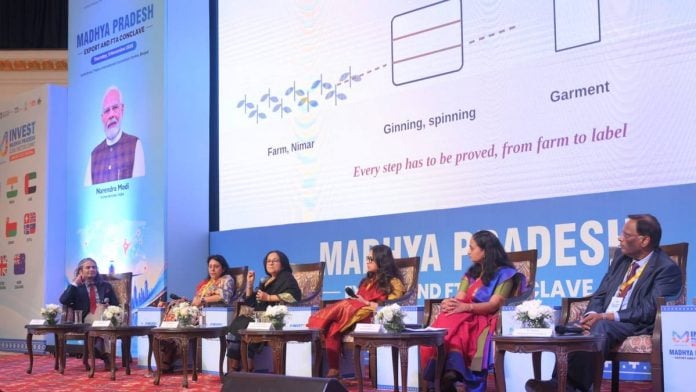
Last Thursday in Bhopal, the Madhya Pradesh government introduced five initiatives to help its firms leverage India’s free trade agreements, before an audience of over 800 exporters. The initiatives include a strategic plan, a handbook, a portal module and an accelerator, but the most unassuming yet potentially most beneficial is a dedicated FTA helpdesk. It provides exporters with a single telephone number and email address and commits to responding to inquiries on rules of origin, certificates and standards within two working days. The inquiries it receives will offer insights into how India’s trade agreements work in practice for manufacturers.
I happened to be in that hall on Thursday, sitting among weavers, printers, and component makers, and it made me question something we rarely ask about India’s trade deals: who is equipped to claim them? One hypothetical inquiry, and how the helpdesk handles it, can answer that better than any statistic.
Consider a small block-printing workshop in Bagh, a village in Dhar district known for its hand-printed cotton and holding a GI tag since 2008. Suppose it receives an email from a homeware buyer in Britain. The order is modest, amounting to £25,000 worth of printed bedsheets, but it includes a crucial question that determines whether it will proceed: can the shipment be made under the India-UK free-trade agreement?
This scenario captures the practical challenges of putting India’s trade agreements into action. New Delhi has entered into agreements with the UAE, Australia, the EFTA countries, Britain, Oman and New Zealand, and expects to sign one with the European Union next month. But turning these agreements into actual orders hinges on the responses provided by workshops like this one.
Also Read: The two faces of India-Vietnam trade—rivals in America, partners at home
Who keeps the twelve per cent?
Until 15 July, when the India-UK agreement came into force, a bedsheet of this type incurred a 12 per cent base duty at the British border. Currently, it incurs no duty, which equates to approximately £3,000 for this order. While it may seem that the printer benefits directly, economic theory suggests otherwise.
The theory of tax incidence, first formalised by Fleeming Jenkin in 1872 and later refined by Alfred Marshall, explains that the burden of a tax, and the benefit of its removal, falls mainly on the party least able to avoid it. The British buyer can easily opt for alternatives, as Bangladesh already exports bedsheets to Britain duty-free. As a result, most of the £3,000 will likely show up as a lower landed price rather than higher profit margins for the printer. The agreement does not confer a competitive advantage to the printer; rather, it eliminates a longstanding disadvantage, allowing factors such as price, quality, and delivery to determine outcomes.
In order to qualify, a bedsheet must undergo a change in tariff heading in India and contain approximately 40 per cent local value. Many exporters who utilise imported fabric find this requirement challenging. However, this particular exporter does not face such difficulties, as the entire production chain is located within the state: cotton from the Nimar belt, yarn from Indore and Burhanpur, and printing in Dhar. The bedsheet is entirely Indian, from the cotton boll to the hem, and the rule of origin, often a hindrance, becomes advantageous. Cumulation even permits garment manufacturers in partner countries to use yarn from Madhya Pradesh and still meet qualification criteria.
The paperwork wall
Trade ministers rarely highlight the subsequent steps. In order to qualify for zero duty, a printer must secure a digital signature linked to the firm’s Importer-Exporter Code, submit a self-declared certificate of origin on the DGFT’s Trade Connect platform, and maintain supplier records for five years in anticipation of inquiries from British customs.
While these requirements pose little challenge for a firm with an export manager, they represent a significant burden for a family workshop. The costs are similar regardless of whether the order is £25,000 or £2.5 million. For the printer, the issue is not the £3,000 saving, but whether it justifies a week spent navigating unfamiliar documentation.
Marc Melitz’s 2003 trade model explains these dynamics. Exporting entails fixed costs that only larger, more efficient firms can distribute across sufficient sales, and claiming a trade preference operates similarly. Consequently, according to the Global Trade Research Initiative, Indian exporters utilise the reduced duty for only 20 to 30 per cent of eligible shipments.
Geographic factors further complicate the process. The bedsheet must travel about 600 kilometres to reach Nhava Sheva port, and exporters told the state during consultations this year that inland freight costs can exceed the duty savings for their buyers.
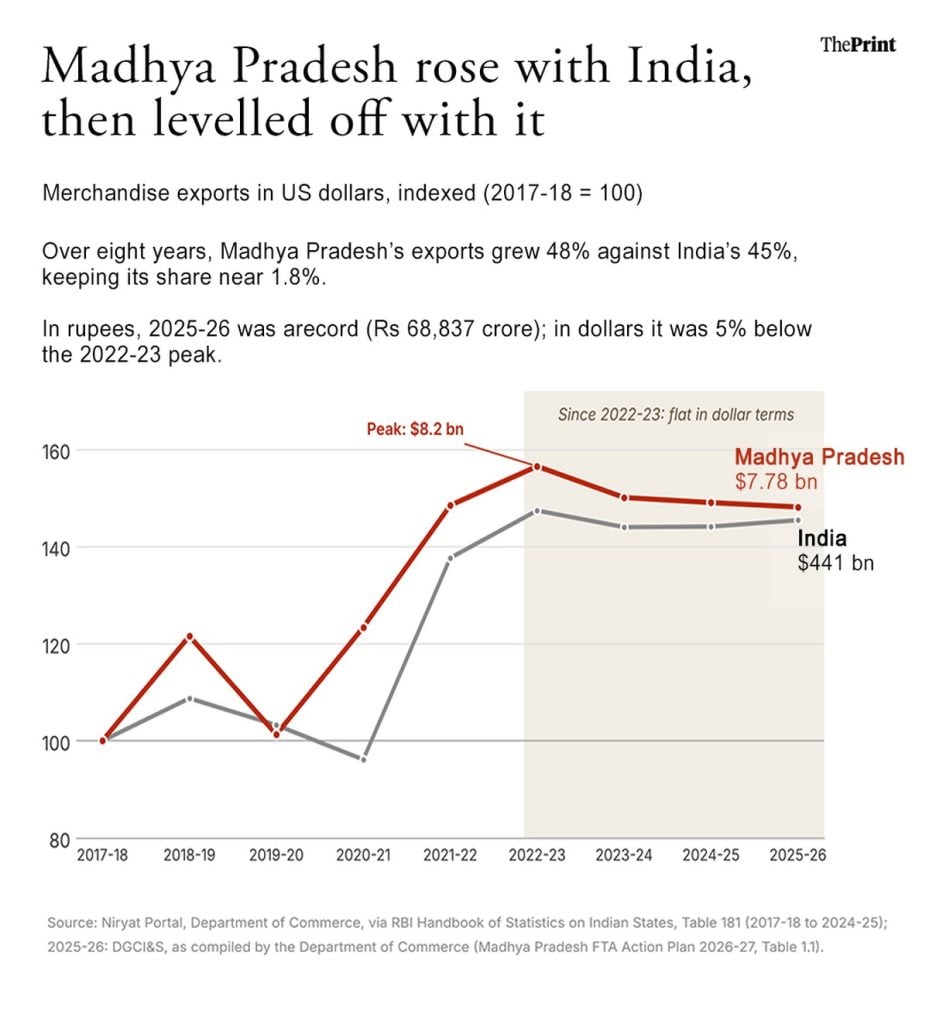
The significance of a small order to Madhya Pradesh is evident in the first chart. In dollar terms, the state’s exports peaked at $8.2 billion in 2022-23 and have since plateaued, mirroring India’s trend, despite record-setting figures in rupees. Reaching the state’s target of Rs 1 lakh crore requires an approximate 45 per cent increase, which must come from new markets.
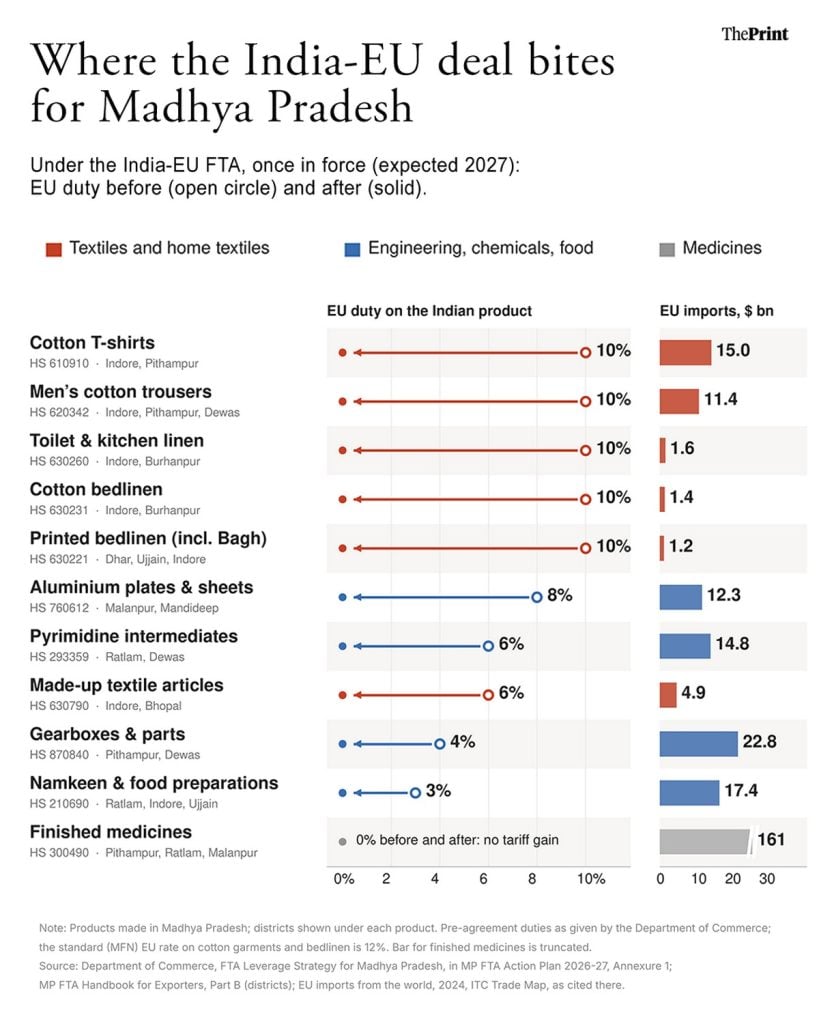
The second chart illustrates where these markets benefit the state, which is not necessarily where one might expect. Pharmaceuticals are Madhya Pradesh’s leading export sector, but the European Union imposes no tariffs on finished medicines, either before or after the agreement. In contrast, bedsheets, T-shirts and trousers originating from Dhar, Indore and Burhanpur are subject to a 10 per cent duty.
The third chart corroborates the pattern: among the 107 pharmaceutical product lines analysed by the Department of Commerce, only 11 experience a reduction in tariffs.
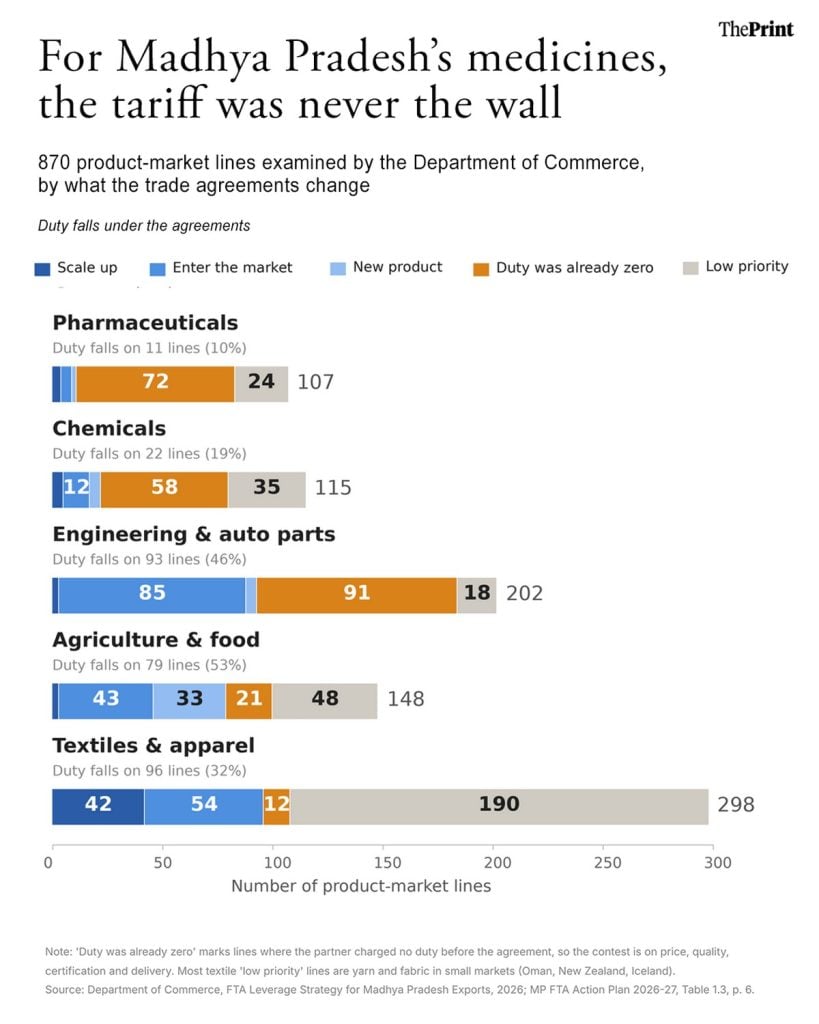
When the charts and the order are analysed together, a central irony emerges. The trade agreements primarily benefit small textile, food and engineering enterprises, which are the least prepared to capitalise on them. In contrast, the large pharmaceutical plants in Pithampur face significant challenges from drug regulation rather than trade barriers.
Also Read: Fast money is leaving, patient money is arriving—and RBI quietly rewrites the rules
What the printer should do next
Where should a small exporter commence operations? The United Kingdom presents the most straightforward initial step: the agreement is already operational, origin can be self-declared online, and there is no associated fee. The United Arab Emirates offers the most lenient conditions: the 5 per cent Gulf duty on most of the state’s products has been abolished, and a certificate from a notified agency can be issued up to twelve months after shipment, allowing first-time exporters who overlook this requirement to still benefit from the savings. Since January, Australia has eliminated duties on all Indian products. The European Union represents a significant opportunity, with approximately $785 billion in imports within the state’s product lines; however, benefits will only materialise after ratification, likely in 2027, so companies should prepare now.
In addition to the helpdesk, the state has pledged a free accelerator programme to help 80 firms secure their first shipment under an agreement, freight support covering half the cost of transporting goods to port (up to Rs 40 lakh per unit annually), and a commitment to track certificates of origin by district. Although 80 firms represent a modest start, the certificate count and the helpdesk’s call log will be the true indicators of success.
Nevertheless, several questions remain unresolved, both locally and across India. Who ultimately benefits from the duty savings — the exporter or the buyer? Will district-level data on claims be made public? Does freight support render inland claims feasible? Furthermore, how should exporters strategise while the United States, which accounts for nearly one-fifth of the state’s exports, remains outside India’s agreements pending a bilateral deal? Although the Union List governs trade, these questions will be addressed at the state and district levels.
In Dhar, a printer with an order from Britain may have already contacted the new helpline. If a response is received within two working days, enabling the printer to confidently confirm the order to the buyer in writing, India’s trade agreements will have achieved their intended purpose.
Bidisha Bhattacharya is ThePrint Consulting Editor (Economics) and an Associate Fellow, Chintan Research Foundation. She tweets @Bidishabh. Views are personal.
(Edited by Asavari Singh)