





Power bank catches fire on Indigo flight. Air India’s consolidated loss more than doubles to Rs 22,238 crores in FY 2026. 40 SpiceJet pilots refuse to fly Q400 aircraft till salary dues are cleared. DGCA flags lapses at Akasa Air.
Gloomy headlines such as these, which were infrequent till about a year ago, are now common. The June 2025 Air India AI171 crash in Ahmedabad, which killed 260 people, seems to have been a tipping point for the downbeat state of Indian aviation.
What has precipitated the rising turbulence now?
Global headwinds
Geopolitical conflicts across the world have had a cascading effect on the global aviation industry. Wars in West Asia have led to the cancellation or rescheduling of flights to and from India. The Hormuz issue has disrupted the regular flow of fuel supplies, resulting in shortages and higher prices. Large-scale re-routing of aircraft due to airspace restrictions imposed by many countries has driven up flying costs for airlines.
It is estimated from Directorate General of Civil Aviation data that fuel accounts for nearly 40 per cent of airlines’ operating costs. Uncertainty over how long the war will last makes it difficult for airlines to have definitive business and revenue plans.
Supply chain constraints, including delays in aircraft deliveries by Boeing and Airbus, engine-related replacement costs, cyber security issues and unpredictable environmental impacts, have also contributed to the turbulence in the aviation sector.
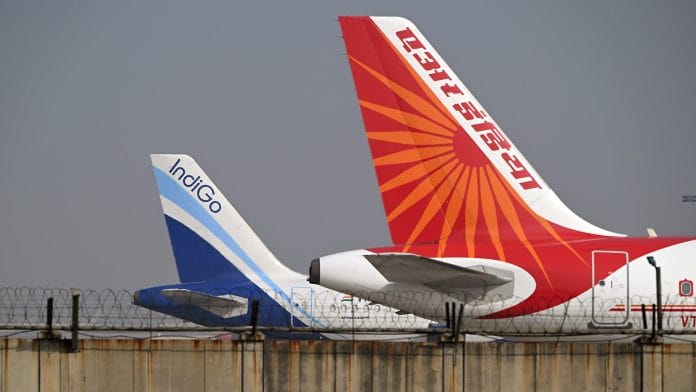
Well-known consultancy firm Grant Thornton Bharat attests that these factors have amplified structural stresses that the industry was already grappling with and widened the divide between well-capitalised airlines and those with limited financial flexibility. This has created a virtual duopoly in the Indian marketplace, with DGCA data showing that IndiGo and Air India together have about 90 per cent of the market share.
Ashish Chhawchharia, partner and aviation industry leader, Grant Thornton Bharat has said: “For India, the effects of global aviation disruption are beginning to surface unevenly. While domestic demand is resilient, international operations, especially long-haul routes, face cost pressures. Any prolonged escalation could lead to higher fares and cautious capacity deployment.”
Also Read: India’s aviation oligopoly is a regulatory failure, not just a problem of airport contracts
Domestic disruptions
While the above challenges are external, internal disruptions such as unforeseen technical faults, safety concerns, poor on-time performance and rising customer complaints have led to passenger disquiet and slower traffic.
The September 2026 market data from DGCA says that India’s domestic air passenger traffic declined 6.34 per cent year-on-year to 12.126 million in August 2026. Go Air has gone belly up while SpiceJet is hanging by a thread. The untimely death of Akasa Air co-promoter Rakesh Jhunjhunwala in 2022 left a profound void for the airline, though it was soon stabilised by the other co-promoters, Aditya Ghosh and Vinay Dube.
Earlier this year, there was a buzz that the Adani Group, which operates eight airports, might wade into the airline business. The group denied any such move, but there were concerns among existing players that this could result in a conflict of interest.
On another note, DGCA numbers reflect that IndiGo’s market share dropped sequentially by 2.4 percentage points, from 67.4 per cent in July to 65 per cent in August, while crisis-ridden SpiceJet’s share declined from 1.6 per cent to 1.2 per cent. In December 2025, a JP Morgan report highlighted five factors, including rupee depreciation and fuel inflation, that could hamper the growth of the aviation industry.
Finally, the ongoing storm in the Tata Group has raised questions about whether the current group management is paying adequate attention to Air India’s priorities and difficulties. News reports that Air India has asked its stakeholders, including Singapore Airlines, to pump in additional equity of US$ 1.5 billion raised immediate concerns among lawmakers in the Singapore parliament. And new regional airlines like Air Kerala and Alhind Air, which were to be launched last year, have yet to take off.
Also Read: The three tests for India’s corporate boards in 2026: Geopolitics, AI and family feuds
A modest blueprint for take-off
Can the situation be reversed? Tall claims and grandiose visions will not help the sector. What will help are realistic short- and medium-term plans, a laser-sharp focus on implementation and greater trust and cooperation between the government and the private sector.
Build resilience, bring back the confidence
While the ability of airlines to manage external factors like geopolitical developments is limited, companies can put greater focus on internal challenges such as leadership rejigs, improving employee morale, better corporate governance, honest internal communication and effective reputation management.
The ongoing debate over whether expat or domestic CEOs are better is not new. Both IndiGo and Air India had expat CEOs, who have since been replaced by other expat CEOs. Rahul Mishra, professor of strategy at IILM University, argues that expat leadership had not made any “perceptible difference”.
“Last year’s Indigo disaster with the pilot roster happened when the expat CEO was leading the company. The objective of appointing an expat CEO is to follow international standards in Indian airlines. But while the goal is right, the context needs to be understood,” he says.
He points out that Aditya Ghosh, who was the CEO of IndiGo for a good 10 years from 2008 to 2018, did a “great job” as the business model of IndiGo was clear and processes were followed. He also adds that one of the most important reasons for IndiGo’s early success was the involvement of co-promoter Rakesh Gangwal, who was educated in India and led two US airlines, including Southwest Airlines.
Beyond passenger growth, build the entire ecosystem
Despite the external shocks and domestic challenges, one of the best strategies for Indian airlines going forward will be to diversify their business model beyond passenger traffic toward mid- to long-term opportunities like air freight, maintenance, repair and overhaul (MRO), airport infrastructure and aerospace manufacturing.
Cargo volumes are estimated to double by 2030, on the back of more dedicated freighters, logistics hubs and specialised maintenance facilities. Similarly, India’s MRO market is projected to reach US$ 5.7 billion by 2030, driven by infrastructure development and the induction of more new aircraft.
The new airports at Noida International Airport (Jewar) and Navi Mumbai have been developed with cargo and MRO capabilities alongside passenger operations. Additionally, newly planned MRO facilities from Akasa Air, Aerotech and Air India could reduce India’s reliance on overseas hubs. The number of airports in India has more than doubled in the last decade.
India is integrating more into global aerospace supply chains, with Airbus planning to procure US$ 2 billion worth of components and services from India annually by 2030. The company said its Bengaluru technology centre will be the largest outside Europe and will employ about 5,000 people. But there is a catch: India remains dependent on imports for materials and technology. India’s airlines should shift to clean fuel in a phased manner.
Even though the above picture reflects optimism, the sector still needs greater resilience against external and internal shocks. The path to this goal is to develop the entire aviation ecosystem, from airline operations and airport development to more open skies policies, transparent regulations and, most importantly, much higher levels of customer service and satisfaction.
Till that happens, Indian aviation will continue to face rough weather.
George Skaria is the former Editor of Indian Management and Asian Management Review. Views are personal.