


In late 1971, amid concerns over currency instability among European finance ministers, US Treasury Secretary John Connally reportedly remarked that the dollar “is our currency, but your problem”. Half a century later, this statement has gained renewed significance. The United States itself now faces persistent inflation and escalating borrowing costs, and the repercussions are being felt internationally. This includes India.
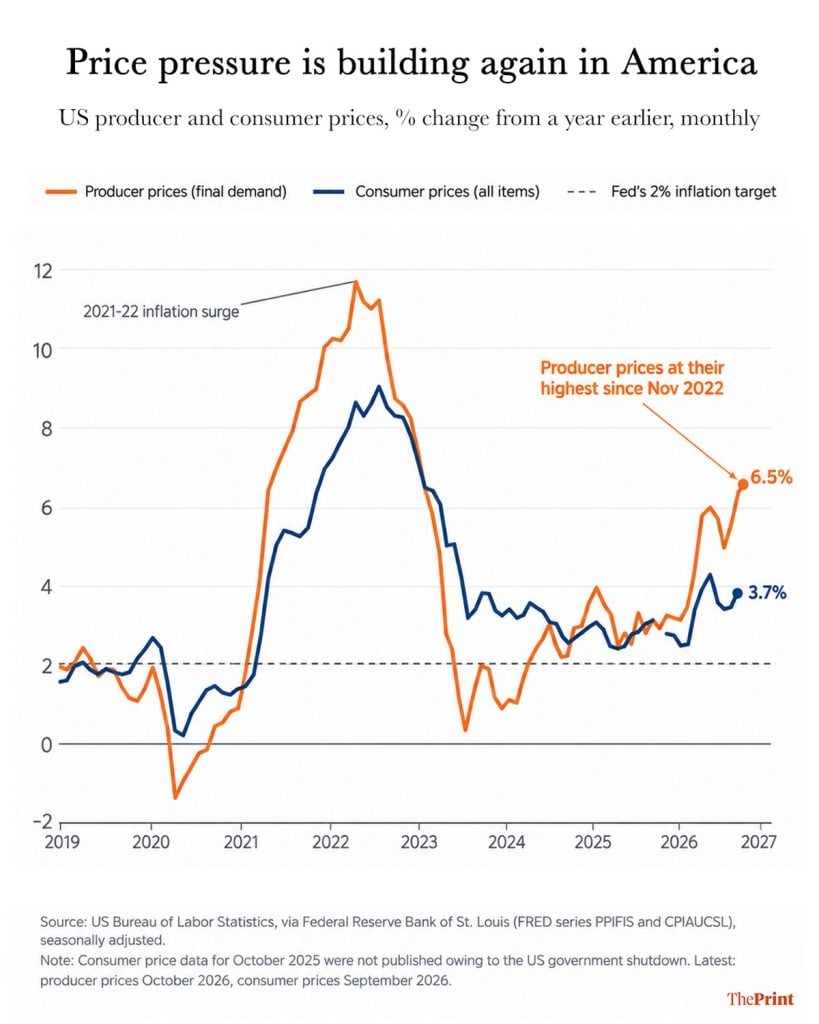
In several respects, the United States is exhibiting characteristics akin to those of an emerging market. This is not reflected in the magnitude of its consumer inflation, which, at 3.7 per cent, is disconcerting but not alarming. Rather, it is evident in the pattern: persistent inflation, investors demanding higher returns for lending to the government, and a central bank compelled to consider significant interest rate hikes to maintain its credibility. This scenario mirrors the typical emerging-market narrative, now unfolding in the nation that issues the world’s reserve currency.
The emerging-market symptoms
First, consider the prices earlier in the supply chain. In the United States, producer prices rose 6.5 per cent in the year to October, the largest increase since November 2022. Consumer price inflation, which peaked at 4.2 per cent in May, has stayed above the Federal Reserve’s 2 per cent target all year, driven primarily by energy costs. The 0.4 per cent monthly increase in October did not alleviate concerns.
Consider the demands of investors regarding lending to Washington. On 13 November, the yield on the 10-year Treasury, the global benchmark borrowing rate, closed at approximately 5.15 per cent. At the same time, the Federal Reserve is experiencing pressure akin to that typically faced by central banks in emerging markets. On 10 November, Federal Reserve Governor Christopher Waller, speaking in London, suggested that a 50-basis-point increase “should be considered” in December if inflation remains persistent. Additionally, Dallas Federal Reserve President Lorie Logan advocated for at least two further quarter-point increases.
Why America gets the symptoms, and others get the bill
In the 1960s, France’s finance minister, Valéry Giscard d’Estaing, criticised the United States for enjoying an “exorbitant privilege” due to the dollar’s global dominance. The term was later popularised by economist Barry Eichengreen in his book title. Global demand for dollars for trade and savings allows the United States to borrow in its own currency, avoiding the financial constraints faced by other nations.
This situation diverges from typical emerging-market dynamics. In a genuine emerging market, persistent inflation and increasing yields would typically drive investors away, causing the currency to depreciate. Conversely, in the United States, these conditions attract capital, as higher yields draw in investments. As a result, the dollar index has risen approximately 5 per cent this year, reaching its highest point since April 2025.
Thus, the United States exhibits the characteristics of an emerging market without the associated penalties, which instead shift to the currencies and bond markets of countries dependent on foreign capital.
Who pays in India?
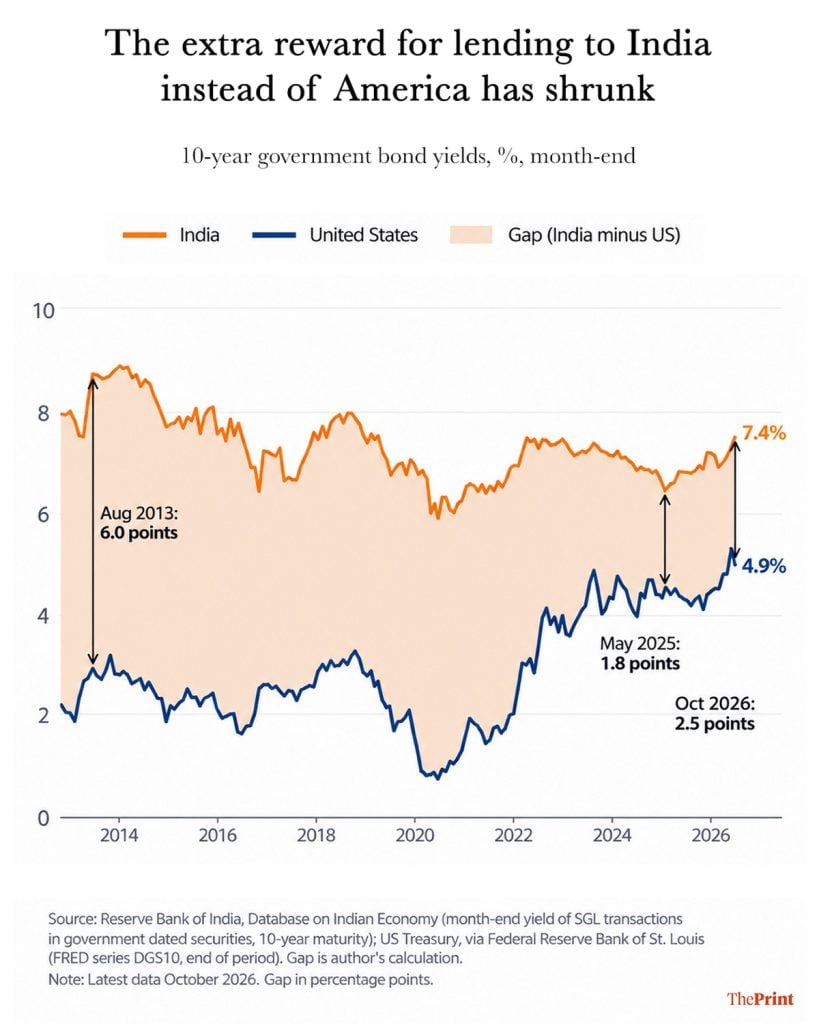
In India, the transmission mechanism is captured by a single metric: the additional return a foreign investor earns by investing in Indian government bonds rather than American ones.
During the 2013 taper tantrum, India’s 10-year bond offered a yield approximately six percentage points higher than its US counterpart. However, throughout 2025 and 2026, this differential has averaged less than half of that figure. Consequently, as the incentive to assume risk in India diminishes to this extent, any increase in US yields makes Indian assets comparatively less appealing.
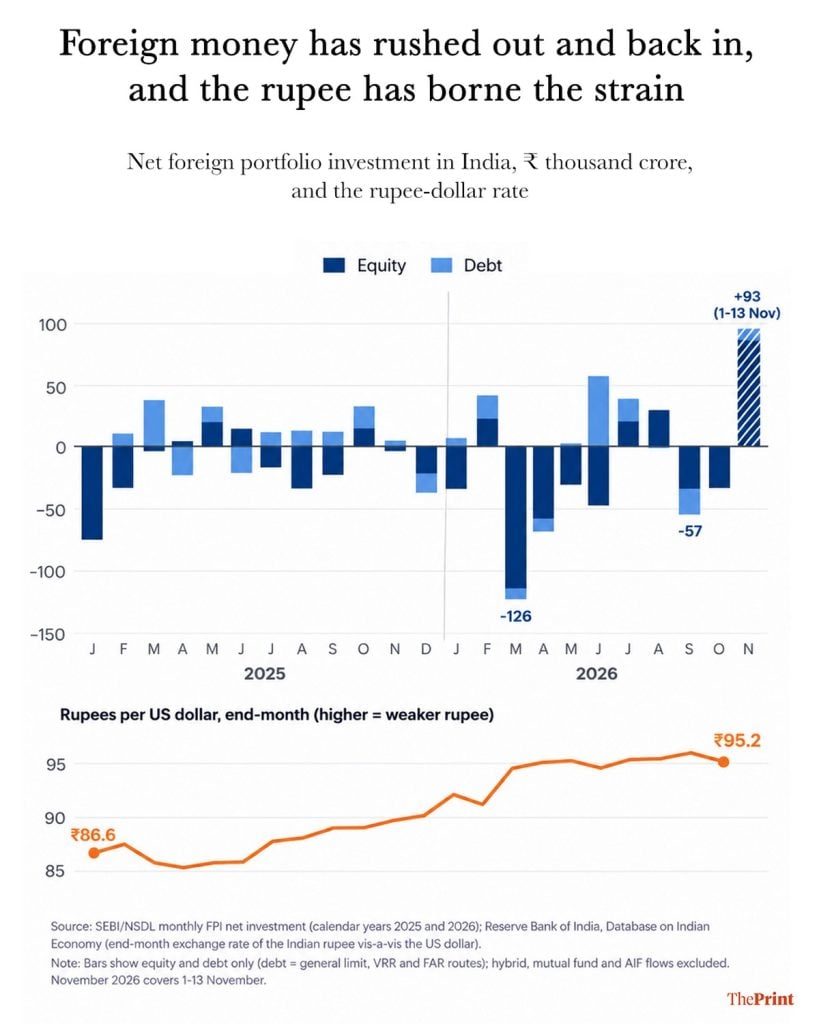
Between January and October, foreign portfolio investors withdrew approximately Rs 2.95 lakh crore from Indian equities, a figure significantly exceeding the total withdrawals for all of 2025. September exemplified this trend most clearly. The US 10-year yield ended the month at 5.29 per cent, and foreign investors withdrew approximately Rs 57,000 crore from Indian equity and debt markets combined. Consequently, the rupee depreciated to its weakest month-end level, approaching Rs 96 per dollar.
Market dynamics are not the sole contributors to rising costs. Since June, India’s 10-year yield has increased by approximately two-thirds of a percentage point, reaching 7.41 per cent by the end of October. While domestic factors have influenced this trend, it aligns with movements in Washington. Higher yields increase borrowing costs for the government, Indian companies, and households over time. A depreciating rupee also increases the cost of imported oil, electronics, and fertilisers, thereby worsening domestic inflation. As a result, a portion of America’s inflationary challenges subtly impacts India.
A notable shift occurred in the first 13 days of November—after two months of selling, foreign investors injected over Rs 92,000 crore into Indian markets. This reversal in such a short period clearly cannot be attributed to substantial changes in India’s economic fundamentals. Economist Hélène Rey’s work offers another explanation. At the Federal Reserve’s Jackson Hole conference in 2013, she argued that a “global financial cycle”, primarily influenced by US monetary policy, synchronises capital and asset price movements worldwide. For countries open to foreign capital, this creates a dilemma: monetary independence is achievable only through managing capital flows, regardless of the exchange rate regime. Consequently, India’s markets are now significantly influenced by Washington’s financial policies.
Today, India is better equipped to manage these challenges than it was in 2013, with foreign exchange reserves of approximately $720 billion and a reduced current account deficit. However, possessing a financial cushion does not equate to immunity. Nations integrated into the global financial system must prepare for its inherent risks. For India, this necessitates developing deeper domestic bond markets, building robust reserves, and increasing utilisation of the rupee in trade, thereby reducing reliance on the dollar.
The words of John Connally serve as both a boast and a caution. Fifty-five years later, they carry a new irony: when the issuer of the world’s reserve currency exhibits characteristics of an emerging market, it is the actual emerging markets that bear the consequences. While India cannot escape the ripple effects of fluctuations in the US economy, it can ensure that the impact is mitigated to a manageable level.
Bidisha Bhattacharya is ThePrint Consulting Editor (Economics) and an Associate Fellow, Chintan Research Foundation. She tweets @Bidishabh. Views are personal.
(Edited by Asavari Singh)