




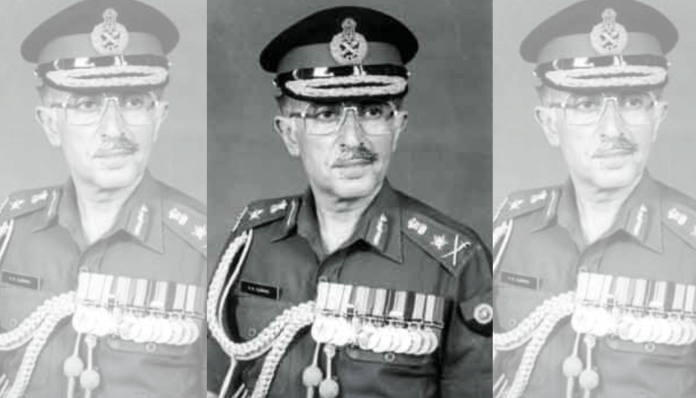

Former Indian army chief General VN Sharma passed away on 31 July 2026. He was from a military family with several family members serving different branches of the army. His father was Major General Dr. Amar Nath Sharma of Indian Medical Service and retired after serving as Director General of IMS.
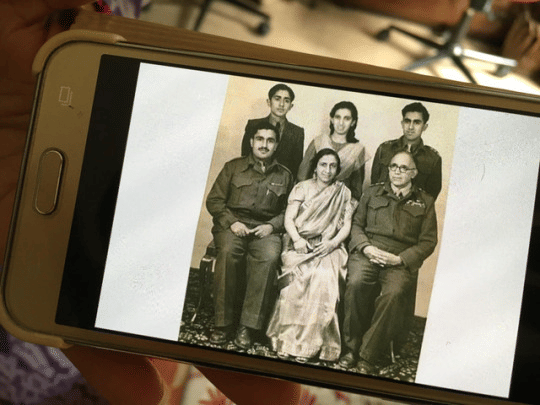
His eldest brother Major Som Nath Sharma (31 January 1923 – 03 November 1947) was from 4th Battalion of 19th Hyderabad Regiment (later 4 Kumaon Regiment of Indian army). He was the first recipient of the highest Indian gallantry award Param Vir Chakra (PVC) posthumously. His other brother, Lieutenant General Surinder Nath Sharma was from the Corps of Engineers and retired as the Engineer-in-Chief of the Army. His sister was Major Dr. Kamla Tewari, who served in the Army Medical Corps and married to Major General Krishna Kumar Tiwari of Signals and another sister was married to a gunner officer.
Sharma was alumni of Sherwood College and Prince of Wales Royal Indian Military College (RIMC) Dehra Dun. He joined Indian Military Academy (IMA), Dehradun in June 1948. For a young cadet from a military family, there are many pressures to not only live up to the expectations but also which branch of the army to join after passing out from the academy. In his first term, he thought about joining the Corps of Electrical and Mechanical Engineers (EME) as his brother was from the Corps of Engineers. In his second term, he became interested in the Regiment of Artillery while visiting his sister at the Artillery Center and School as his brother-in-law was an artillery officer. During these visits, he was impressed by two young gunner officers who were brothers; Sartaj Singh (later Lieutenant General) and Hartaj Singh (later Major General). Hartaj was posted at the IMA and encouraged Sharma to join artillery. He was doing very good at the academy and in his third term, his battalion commander, Lieutenant Colonel Siri Kanth Korla (later Major General), encouraged him to join the Gorkha Rifles. Korla, a Brahmin Dogra was the most decorated Indian officer. He was a sepoy in 10th Baluch Regiment battalion before getting his commission. He won a Distinguished Service Order (DSO) and a Military Cross (MC) during World War II, while serving as an officer of 7th Battalion of 10th Baloch Regiment (now 15 Baloch Regiment of Pakistan army). When his parent battalion was allotted to Pakistan, he joined 2nd Battalion of 1st Gorkha Rifles that he later commanded. Brigadier Man Mohan Khanna (later Lieutenant General) was the Deputy Commandant of the IMA. He was from the 4th Kumaon Regiment, and he encouraged Sharma to join his own battalion that was also Sharma’s famous brother’s battalion. The young cadet took a bold decision to defy everyone and decided to join Armored Corps which had no connection with his family. Once he made this decision, he was so firm that he listed the oldest cavalry regiment 16th Light Cavalry as his first, second and third choice and told his superiors that being third in order of merit, he had the right to choose his regiment.
After serving normal command, staff and instructional appointments, he was appointed the 14th Chief of Army Staff (COAS) on 1 May 1988 and serving until 30 June 1990. During his command, the most important task was to extricate Indian Peace Keeping Force (IPKF) from Sri Lanka where peacekeeping mission got entangled into a bloody campaign against Tamil separatists. This withdrawal was successfully completed in March 1990. The second challenge was Sikh separatist Khalistan movement in Indian Punjab. He kept the army only in supportive role focusing on plugging the border while Punjab police took the fight to the Sikh separatists. Kashmir militancy was only in its infancy and became a major national security crisis after Sharma’s tenure.
After retirement General Sharma was fully involved in philanthropic cause of establishing and running free tuberculosis clinics in Himachal Pradesh until his death. He was also actively involved in old boys association of Royal later Rashtriya Indian Military College (RIMC). This institution has produced senior brass of Indian and Pakistan armies. In 1997, Sharma as president of Rimcollian Old Boys Association (ROBA) was instrumental in bringing largest contingent of old boys from Pakistan for the platinum jubilee celebrations of the school. Two former Pakistan air force Chiefs, Air Marshal Asghar Khan and Nur Khan, a former army Chief Lieutenant General Gul Hassan, former lieutenant general and foreign minister Sahibzada Yaqub Khan, Major General Fazle Raziq and a highly decorated officer Captain Taj Muhammad Khanzada DSO and MC (5/11 Sikh Regiment; now 5 Sikh of Indian army) were warmly greeted by their alma mater.
Major General Muhammad Mumtaz Khan nick named ‘Mummy’ (5 Frontier Force Regiment) was also the guest. He had suffered a stroke and had difficulty walking and his son Major Tariq Mahmood (5 Frontier Force Regiment) was accompanying his father. Just when the ceremony was about to start, Mummy told his son that he had to go to the bathroom. By the time Mummy with the help of his son was getting back into the hall, General Sharma was at the podium and seeing Mummy announced that “Ladies and gentlemen, I want you to look at this gentleman. He has now difficulty walking but today I’m standing here as a general because of this man” and the whole hall full of serving and retired officers of Indian armed forces stood up to give a standing ovation to Mummy. Sharma then narrated the story that one day, he was getting late for the class and cut through the lawn. Mummy was his senior and stopped him and told him that never take a short cut in life. Sharma stated that he has lived up to this life lesson.
RIMC was the product of an effort by many British who cared about India and Indians. Commander-in-Chief of Indian army General Henry Rawlinson selected best education staff and sent first commandant to his own alma mater Eaton as well as Harrow and Winchester to spend time at these elite schools to study the house system. The life story of team members of the founders provides a glimpse of dedication and character of these folks. The first commandant of school was Colonel Henry Lawrence Haughton (1883 – 1955). His connection to India was as good as any Indian and his tribe contributed much more to India than many Indians.
His paternal grandfather Lieutenant General John Colpoys Haughton (1817-1877) spent a long military and civil career in India. He was commissioned in 31st Bengal Native Infantry (during many re-organizations it became 2nd Rajput, 1/7 Rajput Regiment and now 4 Guards of Indian army), fought in First Anglo-Afghan war (1839-42) where he lost his hand and taken prisoner. He was married in Calcutta and served as Chief Commissioner of Cooch-Behar. His maternal grandfather Edward Baker served with Indian Police Service (IPS) and was Deputy Inspector General (DIG) of Bengal police. He was a big game hunter and wrote a book about Indian game animals. His maternal uncle Charles B Baker also served a long career with IPS and became Inspector General (IG) of Assam Police. He was also a big game hunter, lost his left arm in a tiger attack and survived after being run over by a rhinoceros. He was also an ornithologist and wrote an eight-volume encyclopedic work on fauna of India. He gave his personal collection of 50’000 Indian birds eggs to Museum of Natural History.
His father Lieutenant Colonel John Haughton was born in Ranchi, served his whole career with 36th Sikhs, married in Banaras and died in 1898 commanding his battalion at Shin Kamar pass in Bara valley. He is buried at Christian cemetery of Peshawar. His elder brother who died in infancy and mother (she died when Haughton was three days old) are buried in Banaras. Haughton was educated at Winchester and joined his father’s 36th Sikhs later designated 4th Battalion of 11th Sikhs in 1921 re-organization (now 4 Sikh Regiment of Indian army) where his father was revered. In his first address to the boys, he told them that being selected for the college was a great honor but also cautioned them that “great honors are great burdens”.
The first adjutant and quarter master of RIMC was honorary captain Risaldar Sardar Khan. He was from 15th Lancers where Risaldar Major was Malik Mehr Khan; father of future Pakistan Air Chief Marshal Nur Khan. In 1921 reorganization, 14th Murray’s Jat was amalgamated with 15th Lancers ‘Curetan’s Multanis’ to form 20th Lancers. In 1935, when Doon School was established at Chandbagh estate in Dehra Dun, Sardar Khan served at that school and his son Ghulam Jilani was enrolled there. Jilani joined Indian army and fought in Second World War with 2nd Battalion of 13th Frontier Force Rifles (now 8 Frontier Force Regiment of Pakistan army). He rose to lieutenant general rank and served as Director General Inter Services Intelligence (ISI), Governor of Punjab and Secretary of Defence.
In 1985, he went to India for 50th anniversary celebrations of Doon School. He decided to establish a school in Pakistan on Doon model and in this effort an Indian Doon alumni Pushpindar Singh Chopra aided. Pushpindar’s father Major General Mohindar Singh Chopra was commissioned in 6th Battalion of 13th Frontier Force Rifles; now 1 Frontier Force Regiment of Pakistan army and always called himself a PIFFER; nick name of Frontier Force Regiment and Rifles. In 1998 Chandbagh School was established near Lahore to educate next generations of Pakistan.
Legendary educationist Hugh Catchpole (1907-1997) is a link between both countries, and he educated generations of Indians and Pakistanis. His sixty-nine years career was spent at RIMC, Cadet College Hasan Abdal, Pakistan Air Force College Sargodha, and Abbottabad Public School. In 2007, a memorable event was held on the centenary celebration of Catchpole’s birthday when Pakistani students of the great teacher visited RIMC and then Indian students visited Pakistan to pay tribute to a marvelous man joined by dozens of other students from all over the globe.
An institution is judged by how it molds a young boy to grow up with integrity while at the same time anchored to the code of honor that is not limited to one’s faith, ethnicity, skin color, or a randomly drawn line on the map. General Sharma was a thread in the beautiful tapestry woven over a century in the halls and classrooms of one of the finest institution and strived to live up to the RIMC motto Ich Dien (I serve).
Hamid Hussain. Brotherhood of Boyhood. Defence Journal, April 2015. This piece is about RIMCOLLIANS of India and Pakistan.
Views are personal.